ScienceSoft Global
 Healthcare
 Insurance
 Investment



Back-End Development Services
ScienceSoft’s engineers design, build, and evolve architecturally sound back ends that work both for the business and the developers who maintain them. We don’t just deliver code but challenge assumptions, refine requirements, and avoid overengineering. Our signature: clean, scalable, cost-aware solutions, delivered through disciplined agile practices and transparent execution.
Back-end development services give enterprises and software product companies access to expert software architects and engineers who cut through complexity and deliver reliable, high-performing systems that stand the test of time.
How We Can Strengthen Your Back-End Systems

Architecture and technical strategy
Our team designs fault-tolerant back-end architectures with data flows optimized for scaling, compliance, and cross-system reliability using vendor-neutral, modular components. We plan for graceful failure handling, service observability, and future integration needs from day one. The service is provided by principal and senior architects with 9–20 years of experience.

Custom back-end development and evolution
Whether you need a lean, scalable back end for an MVP or a high-throughput enterprise platform for complex business operations and data-heavy analytics, our architects and engineers can deliver the right solution for your goals. By combining robust security, automated testing, CI/CD pipelines, and clear API contracts, we ensure seamless integration, reliable performance, and faster development cycles for your teams and partners.

Legacy system modernization
We modernize legacy software through progressive refactoring, API layering, and data migration strategies that keep mission-critical systems operational during transformation. Our approach includes zero-downtime deployments to safeguard business continuity, even during large-scale infrastructure upgrades. We have successfully re-architected and reverse-engineered decades-old systems for high-risk, complex industries such as healthcare, insurance, investment, etc.

Integration engineering
We approach integration as a long-term reliability challenge rather than a quick connection task. To eliminate data inconsistencies, latency, and downtime, our architects design integration landscapes with patterns and technologies tailored to each workload. We employ message queues (e.g., RabbitMQ, Amazon SQS, Azure Service Bus) and event-streaming platforms (e.g., Apache Kafka, AWS Kinesis) for real-time data flow, API gateways and service meshes (e.g., Istio) for controlled service-to-service communication, and ETL/ELT pipelines (e.g., Apache NiFi, dbt) for reliable batch processing.

System scaling and resilience optimization
Our engineers fine-tune architecture, infrastructure, application code, and data flows to ensure stability during peak loads. We implement thoughtful autoscaling strategies that adapt to real-time demand while keeping cloud spending under control. Using predictive capacity planning linked directly to your business KPIs, we ensure your platforms grow in step with your customer base and transaction volumes. Where needed, we introduce resilience patterns (from fault-tolerant microservices and geo-redundant deployments to automated failover and disaster recovery drills) so your systems are prepared not just to scale, but to withstand disruptions without service degradation.

Performance and observability audits
Our team performs full-stack diagnostics to uncover bottlenecks across code, infrastructure, and data flows. We optimize queries, enable automated monitoring, tune cloud resources, and recommend migrations when needed. To strengthen long-term resilience, we expand automated test coverage, set up static code analysis, and introduce CI/CD quality gates. Where complex legacy components slow teams down, we gradually break the codebase into modules, update APIs, and standardize environments with the Infrastructure-as-Code (IaC) approach.

Code quality and developer experience enhancements
Our engineers refactor code to reduce complexity, clean up dependencies, and improve code documentation. DevOps specialists optimize tooling and pipelines to streamline workflows. Together, these efforts can cut maintenance costs by up to 40%.
Track Record You Can Rely On

ScienceSoft has been trusted by 1,500+ businesses worldwide, including IBM, Ford, eBay, Robert Half, PerkinElmer, Walmart, NASA, Leo Burnett.
Our team includes business analysts, project managers, architects, software engineers, testers, DevOps engineers, and data scientists. Only 3% of candidates pass our 5-step hiring process and make it to an offer at ScienceSoft. Over 50% of ScienceSoft's talents are senior and lead specialists.
Our quality management system meets ISO 9001 standards. Our security management system is ISO 27001-certified.









Industry-aware engineers and consultants
- Working with modern (.NET, Java, Python, Golang, Node.js, etc.) and legacy (PowerBuilder, Delphi, VB, COBOL, etc.) back-end technologies. See our full tech stack.
- Serving demanding industries, including healthcare, insurance, and investment, backed by over 21 years of experience in each.
- Mastery of high-impact technologies — big data, IoT, AI/ML, AR, VR, blockchain — to drive innovation at scale.
- Proficient in region- and domain-specific standards and regulations, including SOC 2, PCI DSS, GDPR, HIPAA, SOX, GLBA, NYDFS, NIST, and SAMA.
- Building enduring partnerships: 62% of our revenue comes from clients who have stayed with ScienceSoft for 2+ years, satisfied by our transparency, flexibility, and consistent delivery of measurable business value.
- Recognized for excellence: 4.8 rating on Clutch for responsiveness, communication, and driving client success.







Strategic Units to Drive Your Project to Success, Not Just Completion

Project Management Office (PMO)
48 certified project managers (PMP, PSM, PMI-ACP, ITIL, and more) take full ownership of successful delivery. They excel at navigating tight deadlines, evolving scope, multi-stakeholder alignment, and quality and budget risks. Our PMs’ goal is not just completing sprints but delivering the business results you came to us for.

Architecture and Solutions Center of Excellence
30+ seasoned architects (AWS, Azure, TOGAF, IASA certified) design business-first, resilient, scalable, and cost-efficient systems. At the core of the CoE are 9 principal architects with 15+ years of enterprise-scale experience. ScienceSoft has a 2x higher architect-to-developer ratio than the industry average, allowing us to provide expert oversight in every project that needs it.

Technology and Competency Center of Excellence
50+ senior technology and industry experts ensure that every engineer at ScienceSoft is industry-aware and project-ready from day one. They lead talent selection, mentorship, upskilling, and team assembly to find and train the right talent for every client challenge.
What Our Clients Say



They are knowledgeable, efficient, communicative, and are always able to provide a strong resource for any needs that arise. ScienceSoft is quite possibly the most beneficial outside resource we’ve ever had.



ScienceSoft offers resources of high caliber skilled in Microsoft Azure, .NET, mobile, and Quality Assurance. Over the past three years, Lixar was very pleased with the service provided by ScienceSoft development teams and executive management.

ScienceSoft has been a competent partner for medical software development. They are reliable, thorough, smart, available, extremely good communicators and very friendly.








Key Technologies We Work With
Front-end programming languages
Languages
- HTML5
- CSS
- JavaScript
JavaScript frameworks
- Angular JS
- React JS
- MeteorJS
- Vue.js
- Next.js
- Ember.js
Mobile
- iOS
- Android
- Xamarin
- Apache Cordova
- Progressive Web Apps
- React Native
- Flutter
- Ionic
- Swift
- Kotlin
Low-code development
- Microsoft Power Apps
- Microsoft Power Automate
- App Engine Studio (ServiceNow)
- Bubble.io
Databases / data storages
SQL
- Microsoft SQL Server
- Microsoft Fabric
- MySQL
- Azure SQL Database
- Oracle
- PostgreSQL
NoSQL
- Apache Cassandra
- Apache Hive
- Apache HBase
- Apache NiFi
- MongoDB
- Microsoft Fabric
Cloud databases, warehouses, and storage
AWS
- Amazon S3
- Amazon Redshift
- Amazon DynamoDB
- Amazon DocumentDB
- Amazon RDS
- Amazon ElastiCache
Azure
- Azure Data Lake
- Azure Blob Storage
- Azure Cosmos DB
- Azure SQL Database
- Azure Synapse Analytics
- Kinect DK
- Azure RTOS
Google Cloud Platform
- Google Cloud SQL
- Google Cloud Datastore
Other
- Microsoft Fabric
Big data
- Apache Hadoop
- Apache Spark
- Apache Cassandra
- Apache Kafka
- Apache Hive
- Apache ZooKeeper
- Apache HBase
- Azure Cosmos DB
- Amazon Redshift
- Amazon DynamoDB
- MongoDB
- Google Cloud Datastore
DevOps
Containerization
- Docker
- Kubernetes
- Red Hat OpenShift
- Apache Mesos
Automation
- Ansible
- Puppet
- Chef
- Saltstack
- HashiCorp Terraform
- HashiCorp Packer
CI/CD tools
- AWS Developer Tools
- Azure DevOps
- Google Developer Tools
- GitLab CI/CD
- Jenkins
- TeamCity
Monitoring
- Zabbix
- Nagios
- Elasticsearch
- Prometheus
- Grafana
- Datadog
Platforms
Legacy languages and platforms
- PowerBuilder
- COBOL
- Delphi
- VB.NET
Blockchain platforms
- Ethereum
- Hyperledger Fabric
- Graphene
- Bitcoin
- Solana
- EOSIO
- Tezos
- Stellar
- POA Network
- Parity Substrate
- Avalanche
- NEAR
- Terra (LUNA)
- Polkadot
- Fantom Opera
- Algorand
- Polygon
Machine learning platforms and services
- Azure Machine Learning
- Azure Cognitive Services
- Microsoft Bot Framework
- Amazon SageMaker AI
- Amazon Transcribe
- Amazon Lex
- Amazon Polly
- Google Cloud AI Platform
Machine learning frameworks and libraries
Frameworks
- Apache Mahout
- Apache MXNet
- Caffe
- TensorFlow
- Keras
- Torch
- OpenCV
Libraries
- Apache Spark MLlib
- Theano
- Scikit Learn
- Gensim
- SpaCy
Integration
- Oracle
- Talend
- Tibco
- Boomi
- MuleSoft
- Informatica
- Azure Integration Services
- AWS Integration Services
Key Service Options for Back-End Development
Not Just Development — Strategic, Scalable, Sustainable Delivery
|
|
Average vendor |
ScienceSoft Feel the difference with ScienceSoft |
|---|---|---|
|
Team seniority
|
Mostly mid-level or junior developers; senior oversight is minimal or sporadic. |
50% senior and lead specialists with 9–20 years of experience; principal architects are involved in planning. |
|
Approach to requirements specifications
|
Follow specifications without questioning them; risks are discovered late or in production. |
Challenge unclear requirements, uncover risks early, propose smarter architectures. |
|
Architecture philosophy
|
Overengineer to justify work hours; think tech-first instead of business-first. |
Pragmatic approach to architecture design: e.g., no microservices unless they add real value; focus on cost-aware scaling tied to business KPIs. |
|
Code quality and maintainability
|
Minimal documentation and quick fixes that run up technical debt; high future maintenance cost. |
Clear, well-structured, documented code built for easy maintenance. |
|
Scalability planning
|
Reactive scaling after performance issues arise. |
Predictive capacity planning; cost-aware autoscaling in the cloud. |
|
Integration expertise
|
Ad-hoc integrations prone to breaking with system updates. |
Seamless integration strategies with ESB, APIs, and data flows designed for longevity. |
|
Communication culture
|
Status updates only; risks are often hidden until they cause problems. |
Transparent and proactive communication; blockers and risks raised early; all decisions documented. |
|
Delivery speed vs. quality
|
Chaotic agility: constant scope changes, declining quality. |
|
|
Post-project handoff
|
Minimal handover; client is often reliant on vendor for fixes. |
Clear, comprehensive knowledge transfer to in-house teams. |


State of Back-End Cost Optimization (2025 Insights)
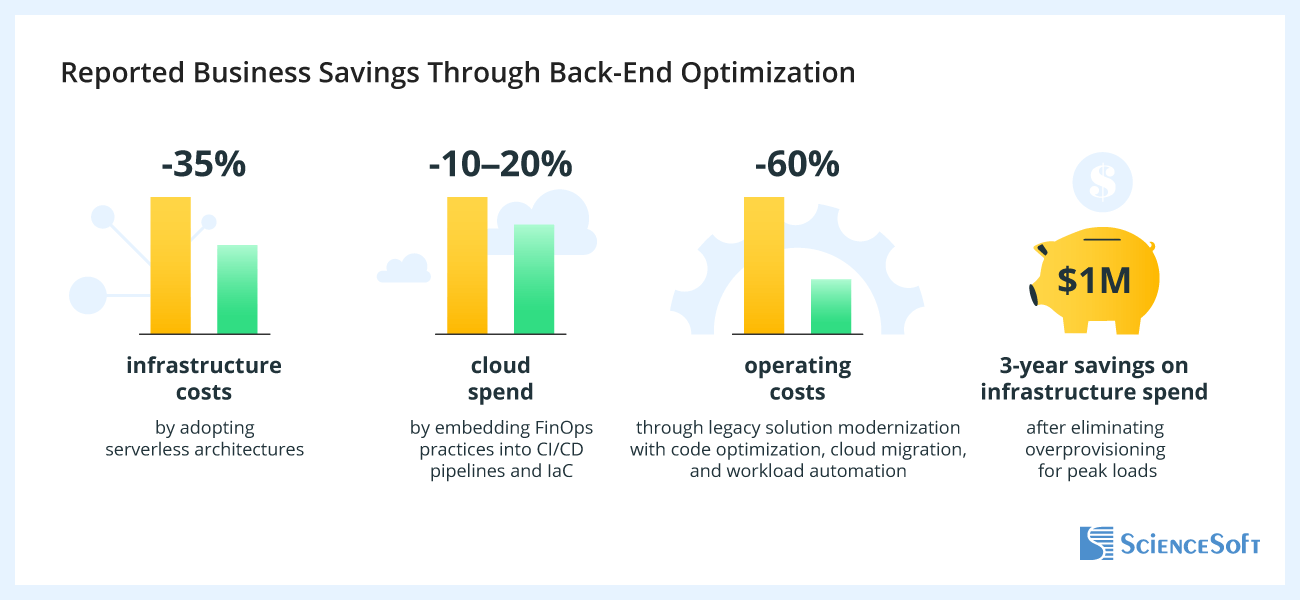
Sources: 2024–2025 studies by S&P Global, Forrester Consulting, McKinsey & Company, Red Hat.
FAQ
How do you ensure we don’t end up with tech debt or hard-to-maintain code?
We treat future software maintenance engineers as primary stakeholders. Architectural boundaries, separation of concerns, and coding standards are set upfront and enforced throughout development. All code is reviewed by senior engineers, designed for extension without rewrites, and covered with automated unit/integration tests. We also maintain clear, living documentation of architectural decisions and rationale, so no one will have to guess and reverse-engineer the logic six months or six years later.
Can you work with a partially built back end or modernize our legacy code without a full rewrite?
Yes. Full-stack modernization and project rescue are among our core strengths. We focus on precise, low-disruption refactoring. Every engagement starts with a detailed codebase audit to identify what’s stable, what’s risky, and what’s blocking future growth. We also keep business continuity front and center, isolating brittle areas, gradually modularizing, and selectively rewriting only where the risk or cost of keeping the existing code outweighs the benefits.
What do you do when the initial scope or priorities shift during the project?
When a shift happens, we re-estimate, highlight trade-offs, and work with you to make informed calls on scope, timeline, and sequencing.
However, it's important to note that changes to priorities within an ongoing sprint can have significant negative consequences. We recommend maintaining the current sprint’s priorities to avoid disruptions. Once the sprint is completed, we can integrate the new priorities into the subsequent planning phases.
How will you cooperate with our in-house developers or a cross-functional team?
We start by agreeing on working agreements, coding conventions, and interface contracts. To stay on the same page, we will integrate into your communication points: daily stand-ups or async updates, Slack or Teams channels, shared repos, and open architecture discussions. We keep code and decisions transparent, actively solicit feedback, and make sure no part of the team is left out of the loop.
Can you work within our existing CI/CD and DevOps toolchain or help us improve it?
Yes. We can integrate with GitHub Actions, GitLab CI, Jenkins, Azure DevOps, AWS CodePipeline, and other tools. If your pipelines are slow, brittle, or lack rollback safety, we can reconfigure them for faster builds, more reliable deployments, and safer rollbacks.
What will you do if your lead developer leaves the project or your company?
We maintain an exceptionally low annual turnover (under 10%, far below the tech industry average) thanks to strong retention programs and high employee satisfaction. Still, we plan for every scenario. Your project will have a secondary lead or senior developer already familiar with it, ready to step in immediately. We arrange a structured handover, covering the codebase, architecture, and requirements, all of which are always meticulously documented at ScienceSoft.
How do you help to reduce the risks when it comes to large-scale outsourcing?
We can conduct a non-binding feasibility study to compare the TCO of in-house and outsourced development for your project. Also, our developers can execute a test task before we sign a contract, so you can make sure their skills match your requirements.