Healthcare
 Insurance
 Investment



How We Hire and Retain Top IT Talent
At ScienceSoft, we don’t hire for impressive CVs. We hire thinkers, problem-solvers, and engineers who consistently deliver, own outcomes, communicate with clarity, and tackle complex challenges without hand-holding. Our talent thrives in high-stakes, fast-moving environments.
Proof That Our Formula Works

Annual employee retention rate
87%
Average employee tenure
5 years
Talent valued by industry leaders
Ex-ScienceSofters went on to become principal architects and lead developers at Oracle, AWS, Procter & Gamble, FedEx, and Wargaming.
Our Approach to Hiring: Finding the Best of the Best
Through five focused steps, we identify high-performing IT professionals who bring both technical strength and the mindset to succeed in demanding, collaborative environments.
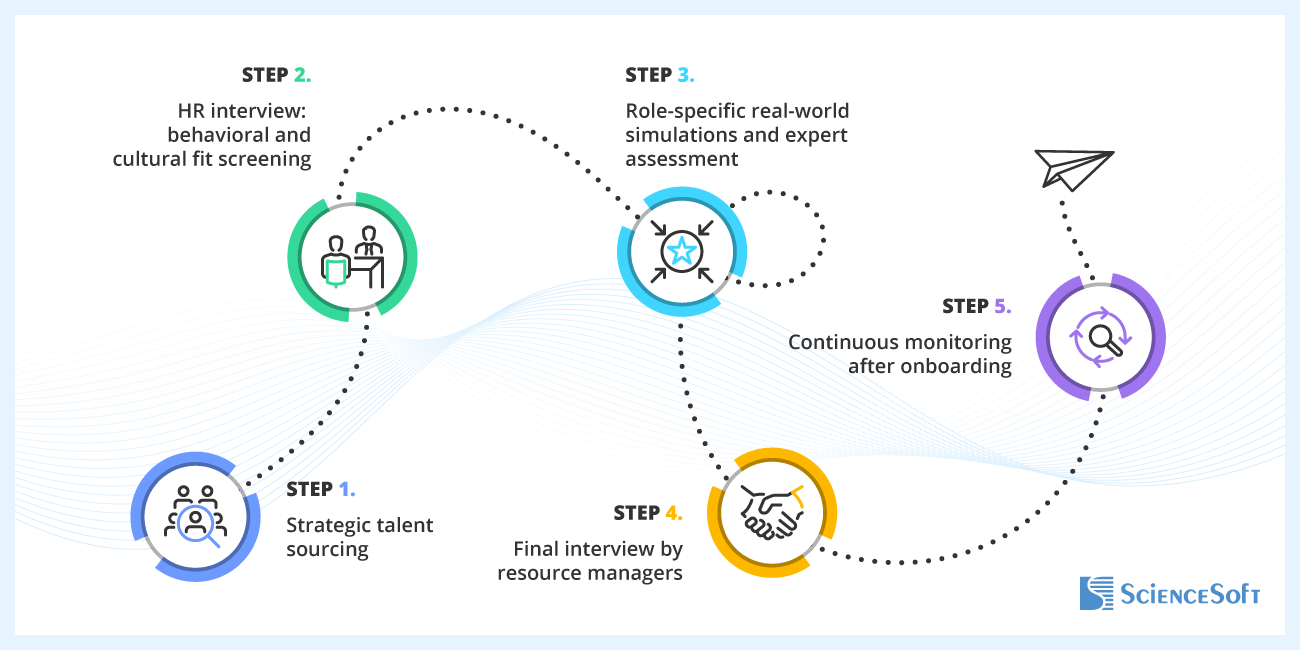
Through five focused steps, we identify high-performing IT professionals who bring both technical strength and the mindset to succeed in demanding, collaborative environments.
Step 1. Strategic talent sourcing
Our sourcing model goes beyond job boards. We’ve built a precision-focused system to quickly identify and engage high-caliber IT talent. Key channels include:
- Curated internal database: 10,000+ vetted professionals, continually refreshed to reflect market shifts.
- Referral engine: We reward employees for bringing in top talent from their networks. This a proven way to find people who already fit our culture and standards.
- Silver Talent Bench: We stay in touch with promising candidates who didn’t join us the first time, tracking their progress and re-engaging when the time is right.
- Shadow pipeline: We proactively monitor promising individuals through their code, community presence, and thought leadership, reaching out when we sense they’re ready.
- Own talent training ecosystem: ScienceSoft’s own tech labs and training centers for job candidates feed a pipeline of high-potential junior talent.

Every open position triggers a highly competitive hiring process where only the top 3% of applicants receive offers. This ensures that only professionals with outstanding technical skills and a proven delivery mindset join our teams.
Step 2. HR interview: behavioral and cultural fit screening
Our HR specialists conduct in-depth behavioral interviews to surface the traits that matter most when our experts work directly with your internal teams or end users. They assess communication style and fluency, ownership mindset, adaptability, and professionalism under pressure.
Key focus areas
- Result-oriented thinking. Do candidates ask “why” before jumping to “how”? Do they consider the impact of their work (rather than just checking boxes)? Will they actively build trust with teammates and clients, or passively wait for instructions? Can they question assumptions?
- Communication and collaboration skills. Can they explain technical decisions to non-technical stakeholders? Will they describe their tasks or issues clearly on ticket tracking platforms, handle ambiguity in messengers, and de-escalate calmly under pressure? We use async communication samples and storytelling-based questions to uncover how well they’ll function in your environment — not just in meetings, but in documentation and daily collaboration.
- Resilience and growth mindset. We explore how they respond to feedback, ambiguity, and high-stakes client situations. Can they stay constructive when things go sideways? What did they learn from past failures or difficult team dynamics?
Role-specific soft skills
We tailor our assessments to recognize traits that matter most in different roles:
- Engineers — autonomy tolerance, problem-solving pace, and how they resolve disagreements during code reviews.
- PMs — empathy-driven leadership, stress patterns, and ability to balance competing priorities.
- Consultants/business analysts — ability to bring clarity into chaos, turning vague stakeholder input into structured, estimable requirements, and resolving contradictions.
- DevOps/SecOps — risk awareness, incident response behavior, and prioritization under urgency.
- Designers — problem framing, user empathy, and creativity under constraints.
- Help desk and support staff — client care and escalation judgment.
Security mindset across the board
Even at this stage, we assess how seriously candidates take confidentiality, secure practices, and responsible client data handling. We look for a “secure by default” mindset, such as:
- Awareness of the importance of keeping sensitive information private.
- Care in how they share or discuss client or company data.
- Thinking ahead to prevent mistakes that could compromise security.
- A general understanding of compliance or regulatory responsibilities relevant to their role.
We also note candidates who have experience in high-reliability or regulated environments (e.g., healthcare, insurance, investment, finance, telecoms), where following rules and safeguarding information is critical.
|
|
This step focuses on soft skills and mindset, not hands-on technical execution. |
Step 3. Role-specific real-world simulations and expert assessment
Every candidate meets with senior specialists in their field who test how they think, communicate, and solve problems in realistic scenarios.
Key components:
Experience walk-throughs
Candidates describe how they approached past challenges with unclear requirements, the trade-offs they made, and what they would do differently today. We assess their thought process, pragmatism, priorities, and maturity of judgment.
Role-based simulations
Every candidate completes a tailored hands-on task that mirrors the complexity, ambiguity, and pressure of real client projects in their niche.
Examples of our role-specific assessments:
Theory and fundamentals check
For junior specialists, we also focus on theory and fundamentals, making sure they build a rock-solid foundation before advancing to complex problem-solving.
We use no automated scoring. Peers and team leads review every task themselves, assessing not just the results but also the candidate’s thinking, communication, and alignment with delivery goals.
Step 4. Final interview by resource managers
This stage isn’t just a formal wrap-up. It’s a final evaluation of a candidate’s strategic and long-term potential. This interview covers:
- Ideal project types, team setups, and delivery models for a candidate. For instance, we look at whether they thrive in Agile squads, prefer startup-paced environments, or excel in large enterprise frameworks. This helps us match them with the right projects from day one.
- Clarity on management style, performance review processes, and career growth paths.
- Cultural and motivational alignment. We explore what helps each candidate stay motivated and engaged in the long run, reducing turnover risk and boosting delivery consistency.
Step 5. Continuous monitoring after onboarding
Every new hire goes through a three-month integration period, during which we closely track their performance and team fit. Only after proving themselves on internal projects do they move on to real client engagements.
Key metrics we track:
- Work quality indicators, such as code quality, test coverage, and delivery velocity for developers.
- Communication effectiveness during team rituals like stand-ups and retrospectives.
- Feedback from PMs, team leads, and stakeholders.
How We Keep Our People Inspired: Retention and Motivation Strategies
Career growth and continuous learning

Personal growth with purpose
We believe in growth that’s both personal and purposeful. That’s why we listen to our professionals to define their long-term goals and build clear, achievable personal development paths (PDPs) to reach them. Our approach balances:
- Maintaining a high level of proficiency in current day-to-day responsibilities.
- Advancing professionally by building new skills, exploring new domains, and preparing for future roles.

Regular performance reviews with actionable feedback
Structured performance reviews happen once or twice a year, combining:
- 360° feedback from peers, managers, and clients.
- Evaluation of both technical and soft skills, like communication, proactivity, solution-focused mindset, leadership, and team collaboration.
- Measuring progress toward the goals set in the personal development plan.
Each review results in concrete next steps — from targeted trainings to promotions and role adjustments.

Embedded mentorship
Senior- and lead-level professionals actively mentor emerging talents through:
- Sharing best practices and methodologies.
- Providing real-time feedback on ongoing projects, helping mentees develop both hard and soft skills.
- Helping with risk mitigation and decision-making in real project scenarios.
- Letting mentees participate in strategic discussions, design sessions, and client meetings, especially for emerging leaders.

External and internal learning opportunities
We keep our teams’ skills aligned with market demands through:
- Internal knowledge-sharing sessions, tech talks, and innovation days.
- Participation in external workshops, industry forums, and global tech conferences.
- Cross-functional collaboration across domains. For example, a backend developer might join a mobile team for a sprint to broaden their scope, but always outside of core client delivery.

Funded certifications
We actively encourage and fund professional certifications by leading tech vendors and respected industry organizations. These include:
- Project and product management: PMP, PSM, PSPO, ICP-APM, SAFe PO/PM.
- Business analysis: PMI-PBA, CBAP, IREB-CPRE.
- Solution architecture: TOGAF, AWS Solutions Architect, Microsoft Azure Solutions Architect, BTA Blockchain Solution Architect.
- Software engineering: Microsoft Azure Developer Associate, AWS Certified Developer.
- Security: CISSP, CISM, CEH, ITIL.
- QA: ISTQB, CAT, CSQA.
Challenging and meaningful projects

Letting employees pick their challenges
We encourage and expect our managers to stay closely attuned to each team member’s interests, strengths, and aspirations. Whenever possible, we match people with projects that genuinely excite them.
This approach:
- Prevents stagnation by keeping day-to-day work intellectually engaging.
- Encourages intrinsic motivation, not just external rewards.
- Builds a culture where people feel heard and valued.

Smart rotation across domains and roles
We actively rotate team members across different types of projects and roles to help them gain new perspectives, adapt faster, and uncover hidden strengths. This creates a resilient, well-rounded workforce that thrives on variety and continuous learning. For example, our project managers often rotate between client-facing projects and internal innovation lab initiatives. Lead Project Managers also rotate roles with regular PMs to bring fresh perspectives to project management and mentoring dynamics across teams.

Fostering innovation
We empower employees to propose and lead their own mini-projects — whether it’s a new tool, internal process improvement, or a proof-of-concept idea. Many of our internal systems and productivity boosters were created by developers who simply wanted to “fix that annoying thing” or test a bold idea.
For example, one of ScienceSoft’s teams created a smart deployment dashboard that reduced release coordination time by 40%. It started as a side project, and now it’s used across the company.
Work culture that encourages ownership

Developers are decision-makers, not just coders
Our engineers are active contributors to both technical direction and solution strategy. They:
- Propose architecture improvements and performance optimizations.
- Suggest smarter approaches to business logic and workflows.
- Collaborate directly with product owners and business stakeholders to shape functionality that truly serves end users.

Trust over micromanagement
Our management philosophy prioritizes outcomes, not task-checking:
- We set clear goals and expectations from the start.
- We step in with support when needed, but avoid unnecessary control.
- We rarely micromanage, doing so only in critical cases to unblock progress or resolve urgent performance issues.

Radical honesty in peer reviews
We have a transparent, growth-focused peer review process where all work is openly critiqued. It’s not about nitpicking — it’s about making each other better:
- “Feedback = Opportunity” is a core company value that guides every review.
- We actively train team members in constructive criticism techniques.
- Feedback is given with context, respect, and clear suggestions.
Competitive compensation and meaningful benefits

Transparent career and salary framework
We provide well-defined expectations for every role and level, as well as fair, criteria-based evaluations. No office politics, hidden barriers, or bias.

Annual market-aligned salary reviews
We conduct annual compensation reviews for all employees, benchmarked against industry data and regional salary trends.
Employee well-being and work-life balance

A culture of psychological safety
We foster an open, inclusive atmosphere where every team member feels safe to:
- Speak up about concerns — whether technical, personal, or interpersonal.
- Share bold ideas without fear of judgment.
- Ask for help when needed.

Promoting a healthy and active lifestyle
We support mind-body balance through:
- Sports and fitness challenges (e.g., virtual month-long running competitions, step count goals).
- Company-funded awards to employees who voluntarily take part in local running races and marathons.
- Active internal sports communities, including jogging, football, yoga, and more.

Early burnout prevention
Burnout doesn’t just hurt productivity; it hurts people. We take a preventative approach by:
- Monitoring workload distribution closely. Team leads regularly review and rebalance tasks to prevent silent overload.
- Cultivating a culture that respects personal boundaries and off-hours.
- Training managers to recognize signs of overwork — even when productivity seems to spike — and intervene early.

Time to recharge
Sustained performance requires real rest. We ensure everyone gets meaningful time off, with no guilt or overload upon return:
- Every employee receives 20 days of PTO annually.
- Managers help plan time off with minimal overlaps to keep teams running smoothly before, during, and after well-deserved breaks.

Healthcare and recovery support
We care for our team’s health by providing:
- Comprehensive health insurance covering physical and mental well-being.
- Paid sick leave: full compensation for the first three weeks of illness or injury; partial pay until full recovery.
- Empathetic, flexible sick leave management with minimized bureaucratic hurdles.

Family-friendly policies and parental support
We encourage our employees to prioritize their families while keeping their careers on track:
- Extended parental leave opportunities with guaranteed job security.
- Structured return-to-work programs, including tailored role adjustments to best match strength and training to refresh skills.
- Family-inclusive company events and flexible scheduling to help employees balance work and home life.

Our commitment to psychological safety is active, not just a statement on paper. In retrospectives and 1:1s, managers and team leads check in on stress levels, emotional well-being, and workload sustainability. In addition, our HR team also holds yearly 1:1 conversations with 80% of employees we randomly select to surface silent pain points and fine-tune our work environment.
What Our Clients Say



ScienceSoft professional and knowledgeable staff has the willingness to endeavor best efforts to ensure project success.


ScienceSoft offers resources of high caliber skilled in Microsoft Azure, .NET, mobile, and Quality Assurance. Over the past three years, Lixar was very pleased with the service provided by ScienceSoft development teams and executive management. For accelerated project timelines which require skilled resources, ScienceSoft is a company that your team should consider.


ScienceSoft powered Tieto with a competent team to develop products for banking services. I’m absolutely satisfied with the quality of their services, their development skills and responsibility as well as the way they manage communication with us and our clients. I fully recommend ScienceSoft as a reliable IT staff augmentation company!