 ScienceSoft Global



Сlinical Сopilots
Use Cases, Architecture, ROI
Developing AI solutions since 1989, ScienceSoft helps healthcare organizations and healthtech vendors design, integrate, customize, and maintain human-in-the-loop clinical copilots.

Head of AI, Principal Architect, ScienceSoft

Senior Healthcare IT & AI Consultant, ScienceSoft
A clinical copilot is a human-supervised AI layer for clinical and clinical-administrative workflows. It can summarize records, draft notes, flag risks, or prepare review items. Diagnosis, prescribing, record updates, payer submissions, and patient-facing decisions require explicit human review and approval. Clinical copilot adoption is increasing in workflows where AI can assist care teams without taking over clinical decisions.
Clinical Copilots: Where We Currently Stand
Adoption is currently strongest in ambient documentation, chart review, clinical decision support, medication safety, precision dosing, and medication history management.
Depending on the use case, they can help healthcare organizations:
- reduce after-hours documentation and manual EHR entry;
- find critical patient context faster in long or fragmented records;
- keep treatment plans aligned with current patient status;
- simplify handoffs, discharge planning, and transitions of care;
- prioritize high-volume worklists, alerts, messages, and follow-up tasks;
- reduce prior authorization rework with quick clinical evidence extraction;
- support clinicians, nurses, pharmacists, care managers, and social workers in role-specific workflows.
Ambient documentation copilots that help reduce after-hours EHR work and speed up note completion are among the most mature examples. The Permanente Medical Group reported that its ambient AI scribe deployment saved physicians an estimated 15,791 documentation hours over one year, equal to 1,794 eight-hour workdays.
Chart review copilots are gaining attention where clinicians need to prepare for complex visits faster. In a study covered by MedCity News, 120 primary care physicians who used an AI copilot reported a 40% drop in average chart review time for complex visits, a 24% drop in chart review burden, and a 12% increase in appointments where physicians felt fully prepared.
Medication history and pharmacy workflow copilots can show efficiency gains even without supporting clinical recommendations. Baptist Health Jacksonville reported that AI-enabled medication history workflows saved 7 million clicks.
Main Use Cases of Clinical Copilots
Point-of-care support

Patient summary and chart review copilot
A patient summary copilot can create an EHR-embedded summary of recent encounters, active conditions, medication changes, and test results. It can also answer chart-related questions and highlight unresolved care items, such as pending results, missed follow-ups, or medication review needs, helping clinicians prepare for visits, rounds, handoffs, or case reviews.

Clinical documentation copilot
A clinical documentation copilot uses speech recognition to convert patient conversations or clinician dictation into text. Natural language processing models can detect complaints, findings, diagnoses, medications, and care-plan details; generative AI can then format them into draft notes, visit summaries, referrals, instructions, or structured EHR fields.

Clinical decision support
A clinical decision support copilot can work as a safety layer over the patient record. The copilot can compare patient history, symptoms, test results, and medications with clinical rules or guidelines. It can flag abnormal trends, contraindications, missing data, or guideline mismatches; clinicians can review these prompts before making diagnostic or treatment decisions.

Patient intake and triage assistant
A triage assistant can collect symptoms, medications, history, and escalation signs through forms, chat, or voice interaction. It can ask protocol-based follow-up questions when answers are vague and prepare a summary for nurse or clinician review. Care teams can use the structured summary to support routing, urgency assessment, and preparation for the visit.
Medication and treatment safety

Medication review and safety assistant
A medication review and safety assistant can support pharmacists and prescribing clinicians before therapy decisions are finalized. It checks medication lists, allergies, diagnoses, and lab results against drug knowledge bases and clinical rules; the output can flag duplicate therapies, interactions, dose risks, or incomplete histories.

Treatment management assistant
During ongoing care, a treatment management assistant can help clinicians and pharmacists compare the current plan with patient status, treatment goals, medication data, and relevant guidelines. This can reveal missing clinical context, possible therapy risks, or care-plan gaps before the next decision is made.
Clinical-administrative support

Prior authorization and clinical evidence copilot
A prior authorization and clinical evidence copilot can reduce manual chart review for clinicians and authorization teams. It pulls diagnoses, prior treatments, test results, and clinical rationale from the her. The draft materials can be used for requests, appeals, or payer-specific documentation.

Clinical trial matching copilot
A clinical trial matching copilot can help research nurses, oncology teams, and specialty clinics screen patients against complex eligibility criteria. By comparing diagnoses, biomarkers, lab values, and treatment history with trial requirements, it can surface potential matches for clinical or research review.
Clinical Copilots: Sample Architecture
ScienceSoft typically builds clinical copilot architecture around a clear separation of responsibilities: clinical context is prepared before AI processing, knowledge is retrieved with source traceability, AI output remains a draft, and write-back happens after qualified review.
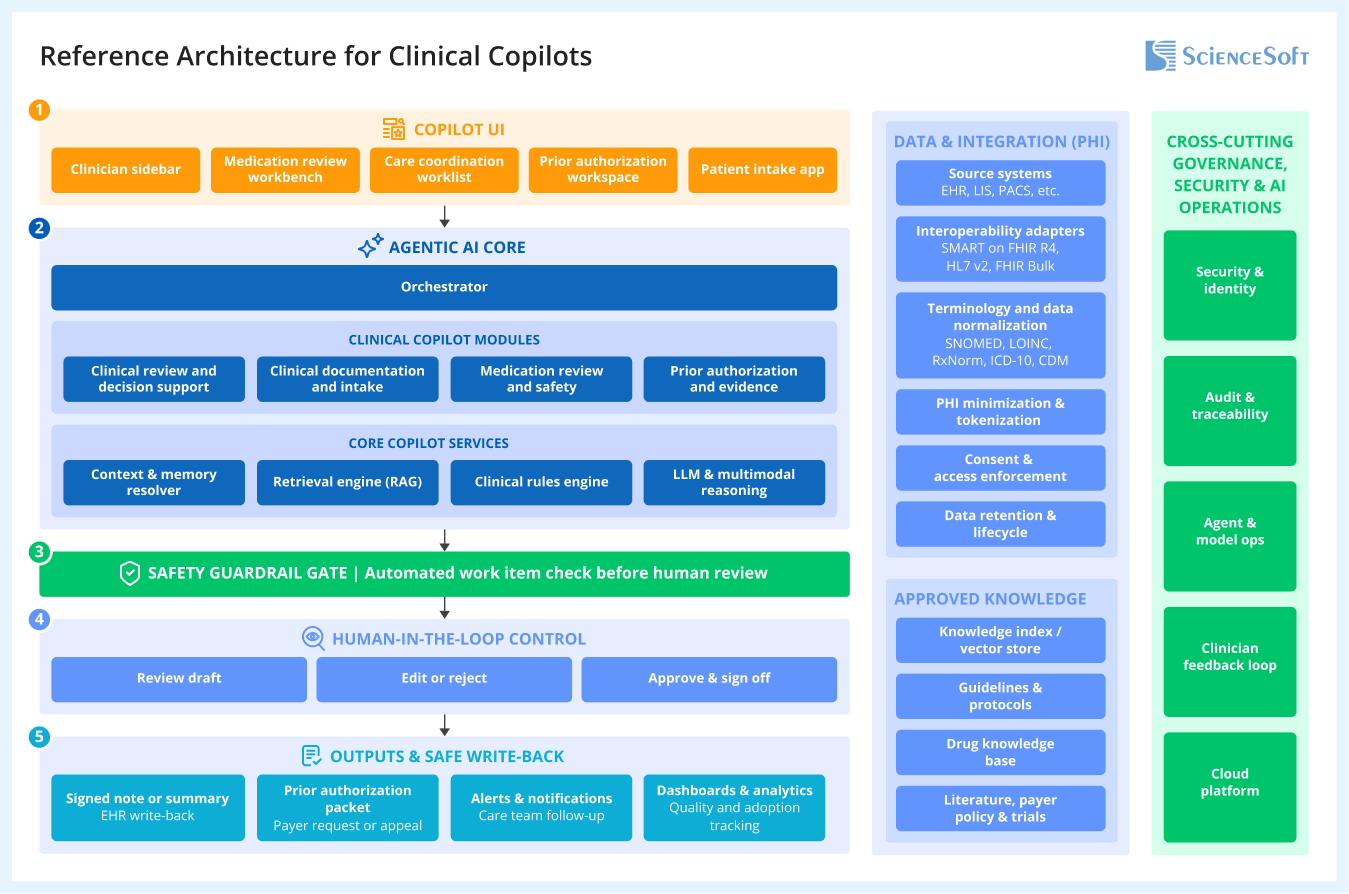
The workflow starts in a copilot user interface, such as an EHR-embedded clinician sidebar, med review workbench, worklist, or in-app assistant. These surfaces pass the active patient, encounter, result, or task to the agentic AI core through SMART App Launch, CDS Hooks, or ambient capture patterns.
When a user invokes the copilot, the data and integration layer prepares patient-specific context before the AI core generates a draft. It retrieves data from the EHR and other clinical systems, normalizes records and terminology, applies PHI minimization, enforces consent and access rules, and follows data retention policies. This reduces the risk of AI errors caused by outdated records, inconsistent codes, or incomplete medication data.
The agentic AI core coordinates the whole copilot workflow. The orchestrator routes each request to the right copilot module, breaks complex tasks into smaller steps, and invokes core copilot services when needed. This modular design allows healthcare organizations to start with one workflow and extend the copilot to other use cases over time.
The core copilot services handle different technical responsibilities inside the copilot logic. The context and memory resolver checks context and freshness. The RAG engine connects to the approved knowledge layer (clinical knowledge base) and brings source-linked evidence. The clinical rules engine applies deterministic checks. LLM and multimodal reasoning summarizes records, drafts notes and evidence packets, and extracts data from clinical conversations and documents. This separation makes each service easier to test, monitor, govern, and update without rebuilding the full copilot workflow.
Before a draft reaches human review, the automated draft check verifies that the output is grounded in the available context and approved sources. It also applies PHI controls, detects unsafe or irrelevant content, and blocks outputs that would overstep the copilot’s role, such as autonomous diagnosis or prescribing.
Human-in-the-loop review is the mandatory control point. The responsible user checks the draft (summary, note, alert, order set, or prior authorization packet), edits it if needed, and approves it before it moves downstream.
Only approved artifacts move to outputs and downstream actions. Signed notes, summaries, coded fields, or task updates can be safely written back to the EHR. Other approved outputs can support payer submissions, care team alerts, and analytics dashboards. This creates a clear audit trail from AI-generated draft to human approval and downstream action.
The cross-cutting governance, security, and AI operations layer protects PHI, controls access, and records AI actions for audit. It also supports model monitoring, version control, and HIPAA-eligible deployment.
Most people think clinical copilot integration means “connect the AI to the EHR so it can read patient data”, but that’s only half of the problem.
For a copilot to be genuinely useful, it also needs to know what the user is doing right now. Is the user viewing a patient chart, writing a note, preparing a referral, checking a lab result? Clinical copilots shouldn’t make users leave the EHR, copy-paste data, or explain the task from scratch.
Imagine a clinician is reviewing a test result. A basic AI assistant connected to the EHR will be able to summarize the patient’s labs, medications, and recent notes. That is useful, but the clinician still has to tell it what they are looking at.
A workflow-aware copilot can do more. Since it knows the active patient, the open encounter, and the result currently being reviewed, it can show related context automatically: recent trends, relevant medication changes, pending follow-up tests, and any unresolved care items. It can also link back to the source records, so the clinician can verify the information.
In a responsible implementation, we design a workflow-aware integration architecture. For example:
- SMART on FHIR may launch the copilot with patient and encounter context.
- FHIR APIs may retrieve medications, allergies, labs, diagnoses, and notes.
- CDS Hooks may trigger medication or order-related prompts.
- An embedded side panel may keep the copilot visible in the clinician’s workflow.
- A write-back API may save reviewed drafts, summaries, or structured outputs.
- RPA (robotic process automation) may be used only for narrow workflows where no safer integration route exists.
Our engineering goal is to make the copilot context-aware without making it unsafe, brittle, or intrusive.
Implementation Pitfalls and How We Tackle Them

Unusable draft notes
A clinical documentation copilot may produce a note that is grammatically clean but still unusable for clinical work. This happens when the system captures irrelevant conversation, misses negative findings, puts details in the wrong note section, uses vague assessment wording, or fails to match the organization’s documentation style. In such cases, clinicians spend too much time editing the draft, and the copilot loses its value.
Solution

PHI sprawl
A clinical copilot may create more PHI-bearing artifacts than expected: audio files, transcripts, retrieved chart snippets, logs, support tickets, etc. Even if the final note is stored safely in the EHR, intermediate data may sit in cloud storage or other systems.
Solution

Consent friction
Ambient AI and voice-based documentation may require patient notice, opt-out handling, and sometimes explicit recording consent, depending on jurisdiction and organizational policy. If every clinician has to improvise the explanation, the tool adds friction and legal risk. If the patient refuses, the workflow must still continue without the copilot.
Solution

Alert fatigue
Clinical decision support copilots can overwhelm users if every guideline mismatch, interaction, abnormal lab, or possible risk becomes an alert. Traditional CDSS already suffers from low-value alerts, especially in medication workflows. Adding generative AI on top can make the problem worse if the model creates verbose explanations or uncertain prompts that interrupt care.
Solution

Regulatory boundaries
A medical reference assistant that searches guidelines is different from a patient-specific tool that suggests what to do for an individual patient. The second category may fall under clinical decision support regulation depending on its intended use, claims, explainability, and whether clinicians can independently review the basis for the output. The risk increases when the copilot affects diagnosis, treatment, triage, or medication decisions.
Solution

Data quality gaps
Many copilot failures are not model failures. They come from inconsistent medication histories, duplicate problem-list entries, scanned documents, free-text orders, mismatched terminology, or incomplete referral data. The model may summarize what it sees correctly, but the underlying data may be wrong, stale, or not normalized.
Solution
Why Build Clinical Copilots With ScienceSoft
- AI development experience dating back to 1989, with healthcare IT delivery experience since 2005.
- 150+ healthcare IT projects for care providers, healthtech vendors, life sciences companies, and medical device organizations.
- 750+ IT specialists, including healthcare consultants, AI architects, data engineers, software developers, QA, DevOps, security, and regulatory experts.
- 50% of our specialists are senior or lead-level, supporting mature engineering decisions for complex healthcare AI initiatives.
- Architecture & Solutions Center of Excellence and in-house PMO to help keep clinical copilot projects risk-aware and cost-controlled.
- We design clinical copilot workflows with privacy, AI transparency, and patient-specific CDS constraints in mind, including HIPAA, HITECH, GDPR, ONC HTI-1, and FDA CDS guidance.
- For integration-heavy workflows, our teams account for healthcare data exchange and terminology standards, including HL7, FHIR, Da Vinci PAS, X12 EDI, RxNorm, SNOMED CT, LOINC, ICD-10, CPT, and HCPCS.
Our Clients Say


ScienceSoft delivered a fully customized AI medical chatbot PoC in just two weeks. The attention to detail in the chatbot design, and especially the pitch deck, was amazing — with this kit on hand, we are ready to go into investor discussions confidently. I’m genuinely grateful to ScienceSoft for their hard work and would absolutely recommend them to anyone looking for top-notch results in health tech.


bioAffinity Technologies hired ScienceSoft to develop automated data analysis software for detection of lung cancer using flow cytometry. In addition to the solid technical expertise shown by ScienceSoft, its developers demonstrated a profound understanding of laboratory software specifics and integrations. I am particularly impressed by the cooperative nature of ScienceSoft’s team. They are reliable, thorough, smart, available, extremely good communicators and very friendly.

King Saud University approached ScienceSoft to explore the possibility of developing a mobile solution for the early identification of a specific medical condition. The resulting Proof of Concept exceeded expectations, and we sincerely appreciated the way it was delivered. We found ScienceSoft to be dependable and forward-thinking, and we would confidently recommend them for high-responsibility projects.
Certifications and awards
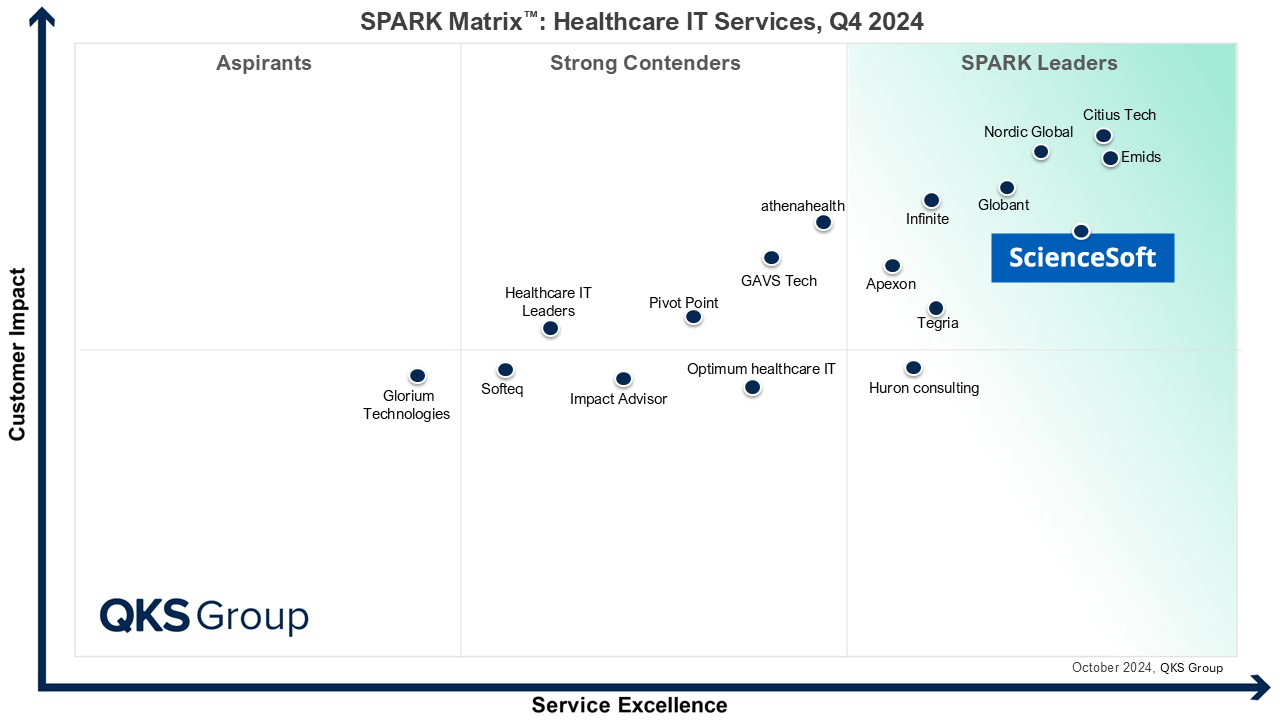
Featured among Healthcare IT Services Leaders in the 2022 and 2024 SPARK Matrix

Recognized for Healthcare Technology Leadership by Frost & Sullivan in 2023 and 2025

Named among America’s Fastest-Growing Companies by Financial Times, 5 years in a row
Four-time finalist across HTN Awards programs
Named among Becker’s Telehealth Companies to Know in 2026

Named Leading Healthcare Software Provider 2026 at Global Health & Pharma’s Healthcare & Pharmaceutical Awards

HIMSS Gold member advancing digital healthcare

ISO 13485-certified quality management system

ISO 27001-certified security management system
