ScienceSoft Global



How Much Will Your Insurance IT Project Cost?
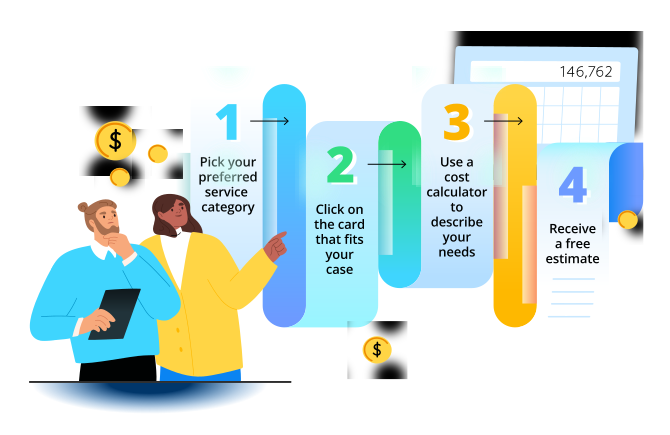
We’ve built over 200 cost calculators to help you estimate project expenses. Simply type a few words into the search bar to see the most relevant calculators — or browse the categories below to find the one that fits your project.
Cost Calculators by Solution Type
Click on the card to reach the cost calculator for your required solution type.
Core insurance solutions












Value-adding technology solutions














Explore Our Sample Cost Ranges
Insurance software engineering costs
- $150,000–$250,000 A native mobile app (e.g., for insurance customers, field agents) built on the existing back end.
- $150,000–$400,000 A multi-party web app (e.g., an insurance portal, a web insurance marketplace).
- $250,000–$600,000 A specialized operations solution for a particular type of insurance, featuring traditional automation with static and ML-powered analytics (e.g., risk scoring software, claims management software).
- $600,000–$1,500,000+ A fully-featured insurance blockchain system that comprises a multi-party transactional network, automation smart contracts, and role-specific apps.
- $600,000–$1,800,000+ A large-scale custom system that handles end-to-end operations across a particular insurance area (e.g., underwriting, claims processing and settlement). The system offers automation, analytics, and assistive features powered by AI, including GenAI. Major cost drivers include the number of supported insurance types and products, the complexity of integrations, as well as compliance requirements across service regions.
Data analytics and AI service costs
- $30,000–$250,000 Engineering a niche data analytics component (e.g., predictive analytics models, fraud detection algorithms, an optimization engine). The final cost will depend on the chosen type of algorithms.
- $100,000–$250,000 Implementing a statistical analytics platform for a particular insurance area (e.g., sales, underwriting, compliance).
- $250,000–$450,000 Building an area-specific predictive analytics solution powered by tailored statistical and non-neural-network machine learning models.
- $300,000–$600,000 Developing a business intelligence (BI) solution that calculates KPIs across multiple insurance business areas (operations, finance, CX, etc.) and features intelligent diagnostic and predictive analytics.
- $600,000–$1,000,000+ Creating a large-scale, real-time insurance analytics system powered by AI/ML, including deep learning and generative AI.
Security and compliance costs
- $10,000 One-time penetration testing of a client-facing app (e.g., an insurance portal, a mobile claims app).
- $8,000–$16,000 Code review of an internally used insurance solution (e.g., underwriting, claims processing).
- $10,000–$20,000 Compliance pre-audit (against GLBA, NYDFS, GDPR, HIPAA, or other regulatory frameworks).
- $20,000 One-time network security testing for a mid-sized insurance organization.
- $40,000+ A phishing campaign combined with white box insurance IT infrastructure pentesting.
- $45,000 QRadar implementation and user training for an insurance organization with 1K–10K employees.
QA and testing costs
- $5,000 One-time performance testing for an insurance mobile app.
- $24,000–$72,000+ Audit of insurance software QA processes and consulting on improvements.
- $20,000/month Continuous managed testing services for an insurer that has 3–5 iteratively evolving solutions.
Managed IT support prices
- $14–$40 per ticket L1–L2 IT support.
- $3,000–$16,000+/month Insurance software maintenance and L3 support.
How We Optimize Costs
Across its consulting, engineering, modernization, and support services, ScienceSoft continuously identifies ways to simplify delivery, reduce operational overhead, and maximize the return on technology investments. Below are some of the proven practices we apply to optimize project costs and long-term total cost of ownership without compromising solution quality, security, or regulatory compliance.
Applying AI where it delivers measurable value
When approved by the client, ScienceSoft selectively applies AI throughout the software delivery lifecycle, including requirements analysis, legacy code analysis, solution design, coding, testing, defect analysis, and documentation. In our experience, mature AI-assisted development can double productivity on routine coding tasks, reduce code review time by up to 40%, and lower engineering effort for the same scope by 30–70%, depending on project complexity and the share of repetitive work. Every AI-generated output is reviewed by experienced specialists, and all AI usage complies with project-specific security, confidentiality, and governance requirements. Clients may also require a strict no-AI policy for their engagements.
Automating software delivery and operations
Manual releases, environment configuration, regression testing, and infrastructure management remain significant sources of avoidable project costs. Whenever practical, ScienceSoft automates software delivery through CI/CD pipelines, Infrastructure as Code (IaC), automated testing, security validation, environment provisioning, configuration management, and operational monitoring. For insurance solutions with extensive business rules and integrations, automated regression testing helps validate policy administration, claims processing, billing, and underwriting workflows after every change, reducing release effort while improving solution stability. Depending on the project, automated testing and deployment reduce release preparation effort by 50–80%.
Eliminating unnecessary complexity
Many insurance IT initiatives become more expensive than necessary because of overengineered architectures, excessive customization of core insurance platforms, redundant integrations, or oversized cloud environments. ScienceSoft looks for the simplest architecture capable of meeting business, regulatory, scalability, and performance requirements. We continuously evaluate opportunities to consolidate integrations, simplify solution architecture, optimize cloud resources, improve database performance, and eliminate underutilized services. Through infrastructure rightsizing and workload optimization, our cloud architects regularly reduce infrastructure costs by 20–70% without compromising resilience or availability.
Reusing proven implementation assets
Many capabilities required by insurers — policy administration workflows, claims processing, billing, customer portals, document management, reporting, security controls, and system integrations — follow well-established implementation patterns. Rather than rebuilding standard functionality from scratch, ScienceSoft reuses proven reference architectures, integration templates, migration playbooks, testing assets, security baselines, automation components, and implementation frameworks refined across numerous insurance projects. This minimizes custom development, shortens delivery schedules, lowers project risk, and allows our teams to concentrate on business-specific differentiators. For common technical requirements, reuse can reduce implementation effort by up to 40%.
Prioritizing high-value requirements
Projects frequently become unnecessarily expensive because they include duplicate capabilities, excessive customization, or features that provide little measurable business value. During discovery and throughout delivery, ScienceSoft evaluates requirements against business objectives, implementation complexity, operational impact, regulatory obligations, expected adoption, and ROI. We regularly identify functionality already available in existing platforms, low-value edge cases, or requests that significantly increase long-term maintenance costs without delivering proportional benefits. Comprehensive discovery can eliminate 15–25% of the initially requested scope without affecting business outcomes and reduce overall development costs by up to 50%.
Keeping scope under control
Unmanaged change requests can quickly erode budgets and extend delivery timelines. Throughout the project, ScienceSoft continuously tracks scope evolution, budget consumption, delivery progress, dependencies, resource utilization, and project risks. Every proposed enhancement is assessed for its business value, implementation effort, impact on delivery timelines, regulatory implications, and long-term maintenance costs before it is added to the roadmap. This enables stakeholders to make informed investment decisions while maintaining predictable budgets and schedules.
Why Insurance Organizations Choose ScienceSoft
- Since 2005 in full-cycle IT services for the insurance industry.
- Insurance IT and compliance consultants (NAIC, HIPAA, GDPR, SOC 1/2, etc.) with 5–20 years of experience.
- 45+ certified project managers (PMP, PSM I, PSPO I, ICP-APM) who succeeded in large-scale projects for Fortune 500 firms.
- Principal architects with hands-on experience in designing complex insurance automation systems and driving secure implementation of emerging technologies.
- 350+ software engineers, 50% of whom are seniors or leads.
- Established practices to ensure the high quality of insurance solutions and their delivery on the agreed timelines and budget despite constraints and risks.









Our Clients Share Their Experience With ScienceSoft


ScienceSoft demonstrated a deep understanding of our requirements, and their insurtech developers needed minimal supervision.
What stood out was ScienceSoft's proactive suggestions for cost-saving architecture design and tech stack solutions. Their input ensured we stayed within budget without compromising on software quality. The value we derived from partnering with ScienceSoft is definitely worth the investment.


Partnering with ScienceSoft has been an excellent experience. Their team transformed our underwriting platform into a well-oiled machine. They identified and fixed several longstanding issues that had been causing us persistent difficulties. Their communication was exemplary; unlike our previous experiences with outsourcing, we never had to chase them for updates, and they were always prompt in responding to our queries.

Damien Sewell
Head of IT Projects

ScienceSoft’s quick buy-in and readiness to take the initiative made the project faster and less stressful for everyone involved, from Capital IM’s insurance specialists to leadership. At the end of a short yet highly productive two months, we got a secure and wholly owned property insurance solution that is fully adapted to Capital IM’s corporate practices and brand book. We couldn’t have asked for a better IT partner.