ScienceSoft Global
 ScienceSoft Finance



How Much Will Your Investment IT Project Cost?
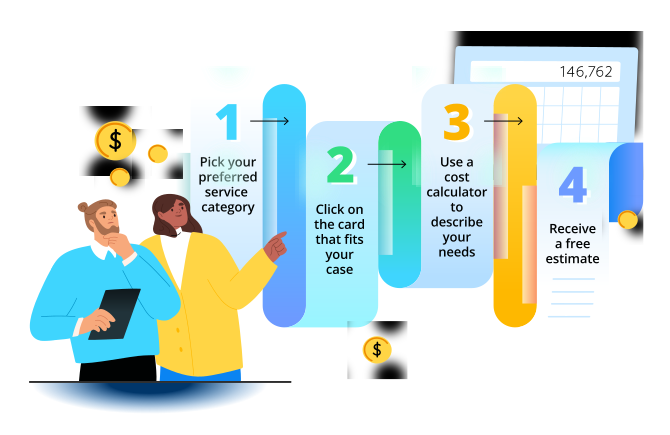
We’ve built over 200 cost calculators to help you estimate project expenses. Simply type a few words into the search bar to see the most relevant calculators — or browse the categories below to find the one that fits your project.
Cost Calculators by Solution Type
Click on the card to reach the cost calculator for your required solution type.
Core operations management solutions













AI and data analytics solutions




Client-facing solutions




Automation and blockchain solutions









Explore Our Sample Cost Ranges
Investment software engineering costs
- $150,000–$250,000 A native mobile app (e.g., investment, trading, robo-advisory) built on the existing back end.
- $150,000–$400,000 A client-facing web app (e.g., an investor portal, a web investment platform interface).
- $200,000–$500,000 Blockchain-based asset tokenization solution that includes a primary token offering platform and smart contracts for trade automation.
- $250,000–$600,000 A specialized investment operations solution featuring traditional automation with static and ML-powered analytics (e.g., research software, a deal management system, OMS).
- $600,000–$1,800,000+ A fully-featured investment blockchain system that comprises a multi-party transactional network, automation smart contracts, and role-specific apps.
- $600,000–$2,000,000+ A large-scale custom system that handles complex operations across a particular investment area (e.g., portfolio management, trade execution). The system supports multiple traditional and alternative vehicles, provides compliance with several jurisdictions, and offers automation, analytics, and assistive features powered by AI, including GenAI.
Data analytics and AI service costs
- $30,000–$250,000 Engineering a niche data analytics component (e.g., predictive analytics models, fraud detection algorithms, an optimization engine). The final cost will depend on the chosen type of algorithms.
- $100,000–$250,000 Implementing a statistical analytics platform for a particular investment area (e.g., portfolio management, compliance, investor servicing).
- $250,000–$450,000 Building an area-specific predictive analytics solution powered by tailored statistical and non-neural-network machine learning models.
- $300,000–$600,000 Developing a business intelligence (BI) solution that calculates KPIs across multiple investment business areas (operations, finance, etc.) and features intelligent diagnostic and predictive analytics.
- $600,000–$1,200,000+ Creating a large-scale, multi-domain investment analytics system powered by AI/ML, including deep learning and generative AI. The system features real-time analytics, multi-asset support, and multi-jurisdiction compliance.
Security and compliance costs
- $10,000 One-time penetration testing of a client-facing app (e.g., an investor portal, a robo-advisory tool).
- $8,000–$16,000 Code review of an internally used investment solution (e.g., portfolio software, a research tool).
- $10,000–$20,000 Compliance pre-audit (against SEC, NYDFS, GDPR, CMA, or other regulatory frameworks).
- $20,000 Network security testing for a mid-sized investment management organization.
- $40,000+ A phishing campaign combined with white box investment IT infrastructure pentesting.
- $45,000 QRadar implementation and user training for an investment firm with 1K–10K employees.
QA and testing costs
- $5,000 One-time performance testing for an investment mobile app.
- $24,000–$72,000+ Audit of investment software QA processes and consulting on improvements.
- $20,000/month Continuous managed testing services for an investment organization that has 3–5 iteratively evolving solutions.
Managed IT support prices
- $14–$40 per ticket L1–L2 IT support.
- $3,000–$16,000+/month Investment software maintenance and L3 support.
How We Optimize Costs
Across its consulting, engineering, modernization, and managed services, ScienceSoft continuously identifies ways to simplify solution architecture, eliminate unnecessary work, automate repetitive activities, and maximize the return on technology investments. Below are some of the proven practices we apply to optimize both project budgets and the total cost of ownership without compromising performance, security, regulatory compliance, or operational resilience.
Applying AI where it delivers measurable value
When approved by the client, ScienceSoft selectively applies AI throughout the software delivery lifecycle, including requirements analysis, solution design, coding, testing, defect analysis, and documentation. We also use AI to accelerate legacy code analysis, API documentation, regulatory requirements mapping, data migration validation, and knowledge discovery. In our experience, mature AI-assisted development can double productivity on routine coding tasks, reduce code review time by up to 40%, and lower engineering effort for the same scope by 30–70%, depending on project complexity and the amount of repetitive work involved. Every AI-generated artifact is reviewed by experienced specialists, and all AI usage follows project-specific security, confidentiality, governance, and regulatory requirements. Clients retain full control over whether AI is used within their engagements.
Automating delivery and operational processes
Whenever practical, ScienceSoft automates software delivery through CI/CD pipelines, Infrastructure as Code (IaC), automated testing, security validation, configuration management, environment provisioning, and operational monitoring. For investment platforms that process high transaction volumes or support continuous trading operations, automated regression testing and deployment validation help ensure platform stability while reducing release effort. Depending on the project, automated testing and deployment reduce release preparation effort by 50–80%.
Designing lean, scalable architectures
Investment platforms frequently evolve into highly complex technology ecosystems with numerous integrations, duplicated services, excessive customization, and overprovisioned infrastructure. Rather than introducing unnecessary architectural complexity, ScienceSoft designs solutions that satisfy business, regulatory, scalability, resilience, and latency requirements with the simplest practical technology stack. We continuously evaluate opportunities to streamline integrations, optimize data flows, eliminate redundant services, and rightsize cloud and on-premises resources. Through infrastructure optimization, workload placement, and storage tuning, our architects regularly reduce infrastructure costs by 20–70% while maintaining the performance required for trading, portfolio management, and analytics workloads.
Keeping scope under control
Even well-planned investment projects can accumulate significant costs through incremental change requests. Throughout delivery, ScienceSoft continuously monitors project scope, budget utilization, delivery progress, dependencies, and implementation risks. Every requested enhancement is assessed for its business value, engineering effort, timeline implications, regulatory impact, and long-term maintenance costs before being incorporated into the roadmap. This disciplined approach helps stakeholders make informed trade-offs while maintaining predictable budgets and delivery schedules.
Modernizing legacy investment platforms incrementally
Many investment organizations continue to rely on long-established trading, portfolio management, risk management, or settlement platforms that remain business-critical despite increasing maintenance costs. Replacing these systems in a single initiative often introduces significant operational and financial risks. ScienceSoft helps organizations modernize incrementally through API enablement, cloud adoption, component refactoring, data platform modernization, and targeted replacement of obsolete functionality. This approach reduces technical debt, extends the useful life of existing platforms, minimizes disruption to business operations, and spreads investment across manageable phases.
Designing for long-term maintainability
Ongoing enhancements, regulatory updates, market changes, integrations, and operational support typically account for a much larger share of total costs. ScienceSoft designs modular, standards-based solutions with well-defined interfaces, automated testing, comprehensive documentation, and maintainable architectures that simplify future upgrades, troubleshooting, and integration. Lower maintenance complexity translates directly into lower total cost of ownership and faster adaptation to changing business and regulatory requirements.
Why Investment Organizations Choose ScienceSoft
- Since 2007 in engineering custom solutions for the investment industry.
- Investment IT and compliance consultants (SEC, FINRA, GLBA, SOC 2, etc.) with 5–20 years of experience.
- 45+ certified project managers (PMP, PSM I, PSPO I, ICP-APM) who succeeded in large-scale projects for Fortune 500 firms.
- Principal architects with hands-on experience in designing complex investment management systems and driving secure implementation of value-adding technologies like AI/ML and blockchain.
- 350+ software engineers, 50% of whom are seniors or leads.
- Among ScienceSoft’s clients is one of the top 3 global asset managers with $5T+ in AUM.
Partnerships and recognitions




ScienceSoft's Approach, As Seen Through Our Clients' Eyes


Our collaboration was a true partnership. The team was open, attentive to our requirements, and accurate in addressing them. The delivered solution is exactly what we needed.


ScienceSoft came up with a go-to architecture, features, and tech stack and introduced a roadmap for app implementation. We appreciated their approach to consulting and mature project management culture.


ScienceSoft brought to the table truly customer-centered approach to app design. We especially appreciate their professional approach to security issues, which were among our main concerns due to strict regulations.