 ScienceSoft Global



Precision Medicine Module for EHR
Functionality, Integrations, Costs
In healthcare IT since 2005, ScienceSoft helps healthcare organizations implement precision medicine workflows on top of EHRs, integrating specialty diagnostics, clinical decision support, and adjacent systems into one compliant operating model.
Precision Medicine Solution in Brief
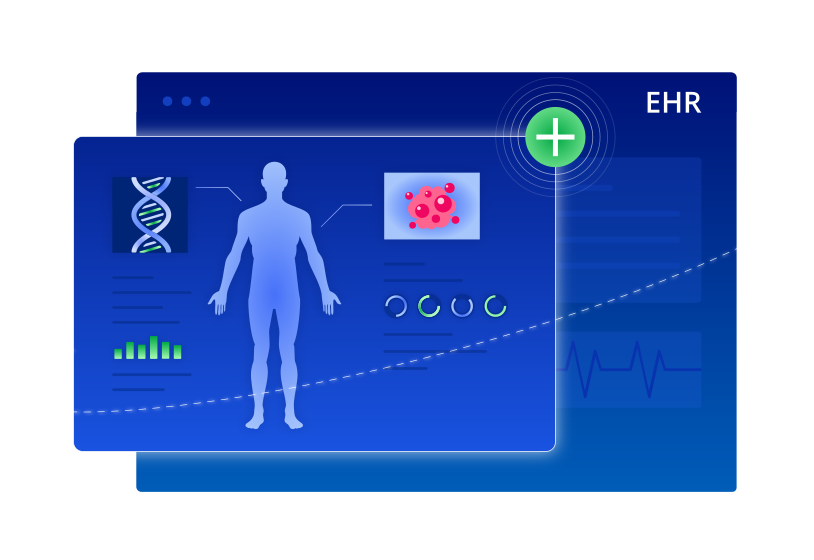
Precision medicine solutions help providers use genetic and molecular results in prescribing, oncology care, hereditary-risk review, and trial referral. While many organizations may have some vendor-supported precision medicine capabilities in their EHR suites, they often still face integration gaps with labs and testing providers, difficulty turning returned genomic reports into structured clinical data, and weak workflows for case review, governed follow-up, and controlled reuse of findings in routine care. That is why healthcare providers often invest in EHR integrations, workflow extensions, and custom EHR modules or layers that bring outside testing, structured results, and follow-up actions into one controlled environment.
Key Functionality of a Precision Medicine Module
Below are the precision medicine capabilities most often requested by healthcare providers that want to expand an existing EHR with genomics-driven workflows. ScienceSoft can implement any combination of these capabilities as a module within the client’s current EHR, using off-the-shelf precision medicine components where they fit and building custom tools where workflow, data, or integration needs call for it.

Molecular test ordering and results
Clinicians can order hereditary, PGx, and tumor tests directly in the EHR. The module turns the order into a lab-ready request, routes it to an external testing vendor, and tracks it through fulfillment. It can also collect the diagnosis, indication, consent, and other supporting data required for prior authorization and medical necessity review. When results return, the module stores the report in the chart and records key findings as structured data, so teams can review the case without leaving the EHR.

Longitudinal patient genetic profile
As the module pulls current results from external labs, it combines them with family history and patient chart data and adds the findings to the patient’s genetic profile in the EHR. It records core findings and recommended actions as structured entries, so clinicians can review prior germline and somatic results in future encounters instead of relying on scattered reports or repeat testing.

PGx-guided prescribing
When a prescriber selects a medication, the module checks the active order against the patient’s lab-reported genotype or predicted phenotype, which are already stored in the chart. If the drug is affected, the module shows the relevant gene-drug implication, highlights dosing or drug-selection considerations, and links to approved prescribing guidance in the ordering workflow.

Biomarker-based treatment planning
The module pulls tumor biomarker results from the molecular report into the patient chart, links them to the diagnosis and prior treatment history, and presents the relevant findings in the oncology review workflow. It can show biomarker summaries, treatment implications, and matched therapy options, so clinical teams can assess the case without switching between the EHR, lab portals, and standalone reports.

The module compares the patient’s diagnosis, biomarkers, and treatment history with trial eligibility criteria and local protocols, then presents likely matches in a review queue linked to the chart. It can assign referral tasks and track screening status, so teams can move from eligibility review to referral with less manual screening.

Case review, follow-up, and patient communication
The module brings complex findings, prior results, and follow-up context into a shared review workspace for molecular tumor boards, genetics teams, and other reviewers. Teams can document decisions, assign next steps, and keep a traceable change record. The module can also release approved result summaries to the patient portal and track reclassification or follow-up actions, so teams do not have to rely on email chains or manual logs.
How AI Can Support Precision Medicine Workflows

GenAI-assisted report summarization and review preparation
Care teams can use GenAI to turn long molecular reports and relevant chart context into role-specific summaries for oncologists, prescribers, and genetics staff. With RAG, the model can ground outputs in approved knowledge sources, prior findings, and the patient chart. Pre-engineered prompts keep the output focused on treatment context, prescribing considerations, risk signals, or follow-up needs. This type of clinical copilot can reduce manual summarization time and support more consistent communication, while clinicians still review the source report and make the final interpretation.

AI-supported trial pre-screening and therapy evidence triage
An AI assistant can help oncology and research teams screen patients against trial criteria using data from the chart, molecular reports, and trial sources. NLP can extract biomarkers, prior therapies, and exclusion signals from unstructured text, while traceable rules can keep the final screening logic transparent. This helps teams review candidate matches faster, reduce manual chart mining, and bring more relevant trial or therapy options into human review.

AI-supported hereditary-risk case finding and counseling preparation
AI can help identify patients who may need hereditary-risk review before genetics teams manually screen the chart. Using NLP and RAG, the solution can pull family-history signals from questionnaires and notes, compare them with testing criteria, and prepare counselor-ready summaries or patient-friendly explanations. A 2024 Journal of Biomedical Informatics study reported a 20.4% increase in identifying patients meeting hereditary-cancer testing criteria when structured family-history data was enhanced with NLP and partial-match logic.
Important Integrations
At most healthcare organizations, a precision medicine solution is implemented as a module or extension within the EHR, not as a standalone system. The success of this module depends on how well it exchanges data with labs, pathology, patient-facing tools, and trial management systems.
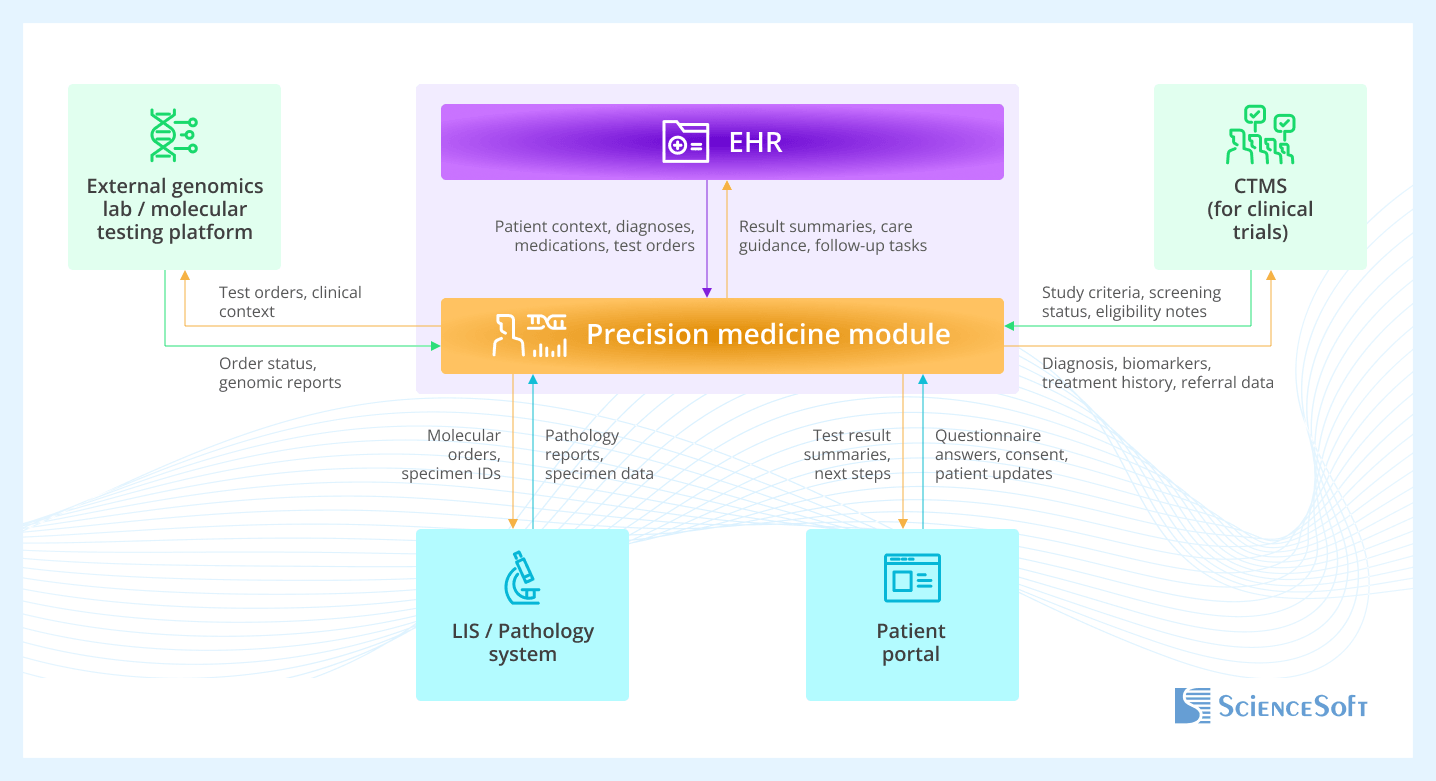
The actual integration map varies by provider and depends on the EHR vendor, the role of internal vs. external labs, existing pathology workflows, portal capabilities, and whether trial operations are in scope.
- EHR brings patient, encounter, diagnosis, medication, and family history context into the precision medicine workflow, so clinicians can order tests and review findings without leaving the main clinical system.
- External genomics labs or molecular testing platforms fulfill hereditary, PGx, and tumor testing and return the results needed for interpretation and downstream care decisions.
- Internal LIS and pathology systems provide specimen and pathology context that makes molecular findings clinically usable, especially in oncology and other diagnostic workflows.
- Patient portal supports family history intake, consent, and patient-facing result communication.
- CTMS or other clinical trial software can be integrated when trial screening and referral are in scope, so oncology and research teams can act on molecular findings without re-entering patient data.
Precision Medicine Module Development Recommendations
The recommendations below are based on real healthcare software delivery constraints and are meant to de-risk the project, keep scope realistic, and give the module the best chance of proving useful.

Limit the first release to one lab and one actionable workflow to avoid endless scope growth
A common risk in precision medicine module development is trying to support every genetics workflow, every lab, and every specialty at once. ScienceSoft’s consultants recommend fixing the first release around one external lab and one tightly scoped workflow, such as PGx for a short list of supported drug-gene pairs or biomarker review in one oncology service line. Create one supported order catalog, one inbound result template, one display model, and one validation pack for each result type. This will keep interfaces stable, shorten testing cycles, and help the module reach production faster.
Build a translation layer, so clinicians see clinical meaning instead of raw lab output
Raw genomic output can be too inconsistent to drive care workflows directly. Best practice would be to place a translation layer between inbound lab data and clinician-facing screens, so vendor-specific result strings are normalized into phenotype labels, biomarker interpretations, and recommended actions before anything reaches the chart. In practical terms, this means maintaining a canonical result model, a versioned interpretation table, and release rules for what enters the patient-facing or clinician-facing workflow. Without that layer, every new lab will force a redesign of the result display and CDS logic.
Put genomic findings in the chart views where clinicians already make decisions
Genomic data is easy to miss when it lives only in attached reports or a separate tab. ScienceSoft’s consultants recommend designing three task-specific views from the start: a patient summary card for quick awareness, a detailed result view for clinician review, and context-triggered prompts in prescribing or treatment planning workflows. Across these views, a good UI pattern is to surface the result status, the top clinical implication, and one clear next step, like “View details” or “Open prior result.” This makes the module useful at the moment a decision is made, not only when someone remembers to search for it.
How Much Does It Cost to Implement a Precision Medicine Module?
Precision medicine module implementation costs can range from $120,000 to $900,000+, largely driven by the existing EHR setup and the scope of integrations with laboratories, patient-facing tools, and research systems.

From $120,000 to $220,000+
For one workflow in one department
We build one EHR-integrated workflow for a defined use case, such as PGx prescribing or tumor biomarker review. Scope usually includes one lab integration, one result type or result family, structured result display in the chart, and one follow-up action such as prescribing guidance, review task, or referral trigger.

From $220,000 to $450,000+
For one specialty team with broader review workflows
We build a precision medicine module for one specialty team, such as oncology, genetics, or pharmacy. Apart from connecting to the EHR, this typically covers one or two lab integrations, several result types, clinician review views, patient intake or portal inputs, and task-based follow-up for care coordination.

From $450,000 to $900,000+
For a cancer or genetics program across multiple systems
We build a precision medicine module that connects several workflows and adjacent systems into one environment. The module may interact with multiple labs, normalize lab-specific result formats, support shared case review, maintain an audit trail, and integrate with pathology, patient portal, CTMS, or analytics tools.

From $900,000 to $1,800,000+
For a multi-department or multi-site rollout
We build a broader precision medicine environment for large provider organizations that need the same workflows to work across several departments or sites. The scope may cover multiple service lines, stronger governance, broader reporting, and specialized AI tools for data summarization or pre-screening.
Learn the Cost of Your Solution
ScienceSoft’s team is ready to provide a quote for your specific case. It’s free and non-binding.

Consider using low-code tools when you only need to add simple operational pieces around the module. Based on ScienceSoft’s project experience, building automation components with low-code platforms like Microsoft Power Apps can cost 30% to 60% less than custom development. Low-code works well for internal forms, routing, and admin tasks because these flows are usually simpler, change more often, and do not require deep real-time interaction with the EHR. For clinician-facing result review and tightly integrated decision support, custom development is usually the better choice because it gives more control over screen behavior, response speed, complex workflow logic, and how the module reacts to live EHR data.
Why Choose ScienceSoft as a Partner for Precision Medicine Module Development
- In custom software development since 1989.
- In healthcare IT since 2005.
- 150+ successful healthcare IT projects.
- Architecture and Solutions CoE with 20+ senior architects to shape robust integration architectures for EHR-native and EHR-agnostic precision medicine modules.
- Interoperability expertise spanning HL7 v2/v3, HL7 FHIR Genomics, mCODE, USCDI, C-CDA, SMART on FHIR, CDS Hooks, and NCPDP SCRIPT to efficiently connect EHR workflows with labs, prescribing systems, and patient-facing tools.
- Proficiency in SNOMED CT, LOINC, RxNorm, and ICD-10 to normalize clinical context, medication data, and test result-related information across connected systems.
- Support for genomics data modeling with HGVS, PharmVar-style allele notation, and structured genomic objects to translate lab-specific output into EHR-ready findings.
Our Clients Say

Todd Nilson
MD

We are thankful for the meticulous and value-driven approach of ScienceSoft's team. They created comprehensive project documentation, feature lists, and worked out thorough recommendations to help us improve the stability and performance of our solution. ScienceSoft proved to be a reliable vendor with a solid healthcare background.


Our project required coordination with multiple companies and individuals. ScienceSoft worked well with everyone. <…> They are reliable, thorough, smart, available, extremely good communicators and very friendly. We would recommend hiring ScienceSoft to anyone looking for a highly productive and solution-driven team.

It’s not often that you find a team that moves this fast without sacrificing quality. I’m genuinely grateful to ScienceSoft for their hard work and would absolutely recommend them to anyone looking for top-notch results in health tech.


During our cooperation, ScienceSoft proved to have vast expertise in Healthcare and Life Science industries <...>. They bring top quality talents and deep knowledge of IT technologies and approaches in accordance with ISO 13485 and IEC62304 standards. I would also like to point out that ScienceSoft's team demonstrated a great engineering culture, proactive approach in work, and the communication was easy and clear.
Certifications and awards
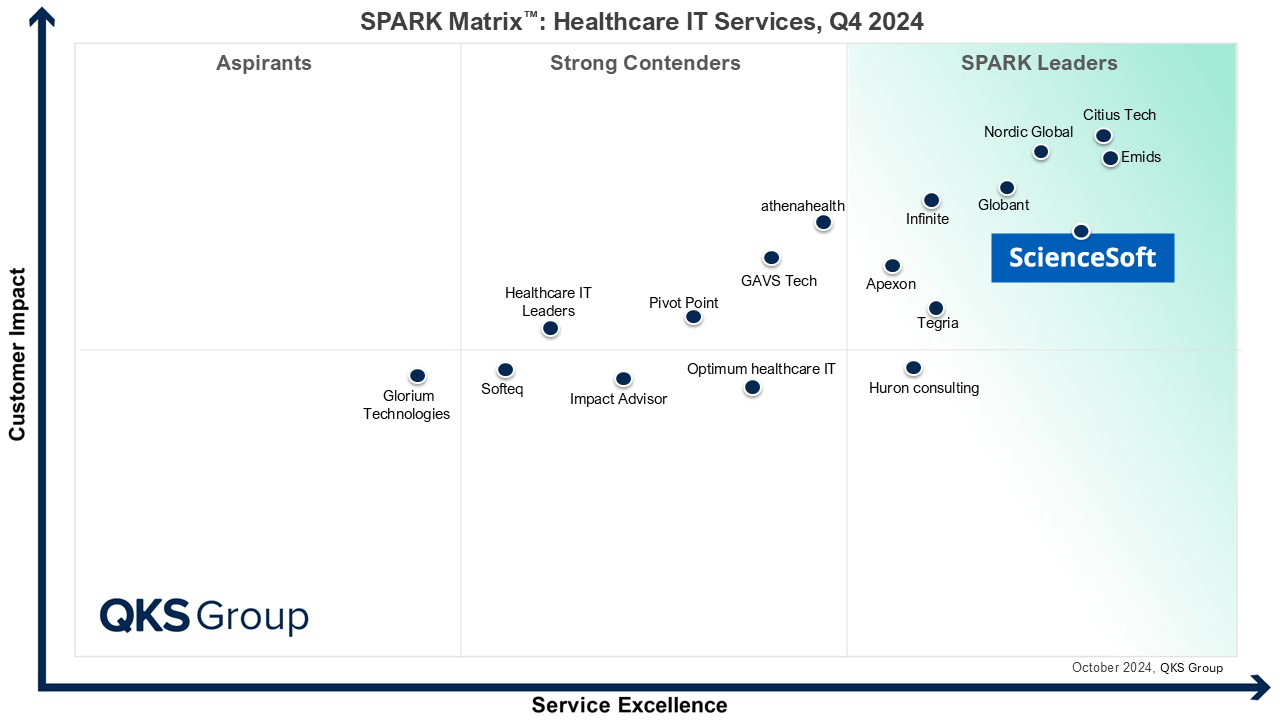
Featured among Healthcare IT Services Leaders in the 2022 and 2024 SPARK Matrix

Recognized for Healthcare Technology Leadership by Frost & Sullivan in 2023 and 2025

Named among America’s Fastest-Growing Companies by Financial Times, 5 years in a row

Four-time finalist across HTN Awards programs
Named among Becker’s Telehealth Companies to Know in 2026

Named Leading Healthcare Software Provider 2026 at GHP’s Healthcare & Pharmaceutical Awards
HIMSS Gold member advancing digital healthcare

ISO 13485-certified quality management system

ISO 27001-certified security management system
