 ScienceSoft Global



EHR for Obstetrics and Gynecology (OB/GYN)
Capabilities, Integrations, and Development Costs
In healthcare IT since 2005, ScienceSoft delivers full-scale EHR solutions and focused OB/GYN extensions that give providers stronger care continuity, cleaner data exchange, tighter disclosure control, and fewer losses tied to fragmented billing workflows.

EHR for Obstetrics and Gynecology in Brief
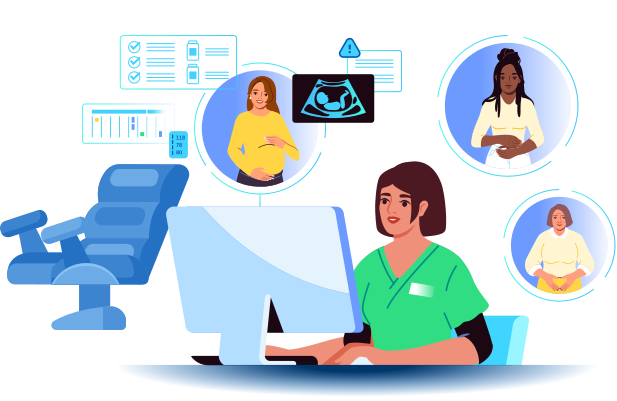
An obstetrics and gynecology EHR provides a shared clinical record for prenatal care, gynecology visits, labor documentation, postpartum follow-up, and newborn-related handoffs. OB/GYN EHR modules for ambulatory practices and women’s health clinics can also support prenatal episode tracking, visit documentation, preventive follow-up, and patient communication. Hospitals and perinatal service lines often need added support for labor and delivery operations, mother-baby record linkage, fetal monitoring, and postpartum transitions. Health systems and multi-site providers may also need a shared women’s health layer for consistent data exchange, reporting, and disclosure controls across locations.
A custom obstetrics and gynecology EHR system is most justified when ready-made EHR or OB/GYN platforms leave gaps in specialty operations. Typical pressure points are prenatal and inpatient continuity, partner-specific data exchange, reproductive-health disclosures, maternity billing, reporting, and bedside data flows. Ambulatory women’s health practices and perinatal care providers typically choose the following custom solution paths:
- Focused OB/GYN extensions when providers want to keep the current EHR and add prenatal episode management, specialty documentation, preventive follow-up, or procedure workflows in one governed layer.
- A patient engagement layer when providers need to unify portal tasks, intake, scheduling, education, and remote updates in one patient journey connected to the EHR.
- An interoperability and reporting layer when providers need to centralize partner exchange, hospital handoffs, payer workflows, quality reporting, and disclosure controls without redesigning the core EHR.
- A full-scale OB/GYN clinical platform when providers need one coordinated environment for ambulatory, inpatient, and postpartum workflows, reporting, and partner exchange while the enterprise EHR remains the certified core.
|
|
|
|
|
Useful integrations for an EHR for OB/GYN: scheduling systems, patient portals, LIS, RIS, PACS, pharmacy systems, RPM tools, perinatal monitoring systems, HIEs, payer systems, and quality reporting registries. Implementation time: 6–10 months for a focused extension or specialty module, and 12–20+ months for a multi-module solution. Development costs: from $120,000 for a narrow operational layer to over $2,200,000 for enterprise obstetrics and gynecology software with device integrations, advanced reporting, and optional AI modules. Use our free calculator to get a case-specific estimate. |
|
|
|
Main Capabilities of OB/GYN EHR Software
Below are the main OB/GYN EHR features most often requested by ambulatory women’s clinics, hospitals, and health systems with perinatal service lines. ScienceSoft can deliver any selection of these capabilities as narrow functional modules or full-scale OB/GYN solutions, depending on each provider’s needs and existing IT tool stack.
Ambulatory OB/GYN clinical workflows

Prenatal episode management
- A pregnancy episode workspace stores obstetric history, risks, and prenatal findings in a configurable flowsheet and timeline, optimized for in-visit decision-making and longitudinal review.
- A delivery due date verification tool captures dating sources and automatically recalculates gestational age at each visit using the clinician-approved estimated due date.
- A gestational care planner organizes recommended services, orders, and checklists by gestational week and helps clinicians confirm the right actions at each prenatal visit.
- A cumulative prenatal record generator compiles the up-to-date pregnancy summary, screening history, and key risks into a standardized prenatal packet in a partner-ready HL7 or FHIR format.
Value-adding features:
- A schedule completeness dashboard monitors patient adherence to configured prenatal pathways, flags missing items, and routes outreach tasks to assigned staff.
- A dating reconciliation tool flags conflicts between the last menstrual period and ultrasound-based dating, routes them to the responsible clinician, and blocks automatic care schedule updates until approval.

Gynecology care delivery
- Protocol-based gynecology templates encode required clinical fields for well-woman, contraception, menopause, and problem-focused visits, including screening history, pelvic exam findings, procedure notes, and follow-up planning.
- In-note lab, imaging, and medication orders let clinicians place tests and send prescriptions from the assessment, attach the clinical indication, and route each order to the right external partner without duplicate entry.
- A unified results and medication follow-up worklist routes incoming reports, refill requests, and pharmacy questions to the responsible clinician, flags urgent items, and records sign-off, patient notification, and next actions in the chart.
- Procedure documentation and consent capture guides staff through colposcopy and in-office ultrasound notes, collects patient signatures on clinic devices, and stores timestamped forms with the encounter.
Value-adding features:
- A preventive care and follow-up worklist converts due preventive services (e.g., cervical screening, mammography, cancer screenings, and follow-up visits) into longitudinal outreach plans with owners, due dates, escalations, and closure tracking.
- Subspecialty support tools (e.g., for urogynecology) provide subspecialty templates and referral coordination workflows, auto-compile referral packets from chart data, and track specialist recommendations back into the care plan.
Inpatient perinatal care operations

Labor and delivery unit operations
- A labor and delivery unit status board automatically pulls room, stage, and risk flags from documentation and supports shift handoffs via live unit-state visibility and role-based alerts.
- A bedside nursing flowsheet keeps assessments, interventions, and progress in one screen to support real-time charting.
- A delivery event summarizer captures key labor milestones and outcomes for clinical documentation and postpartum workflow transitions after sign-off.
- A workload trending panel consolidates open tasks, room status, staffing assignments, and patient acuity indicators from labor documentation, bedside nursing flowsheets, and admission data into a live unit view.
Value-adding features:
- A standardized shift handoff report captures patient status, risks, and pending actions and records the transfer of responsibility with a timestamp.
- A clinical documentation completeness validator blocks finalizing the delivery record until required clinical fields are complete and escalates gaps to the charge nurse.

Fetal monitoring
(via bedside device integration)
- A barcode-based device pairing tool links each fetal monitor to the correct patient record and unlinks it when the patient transfers or discharges.
- A bedside waveform viewer shows live and recent fetal tracing waveforms inside the EHR with time-synced markers for rapid escalation review.
- An annotation and alert console lets staff add standardized notes to the tracing, set patient-specific device alert thresholds, and acknowledge alarms.
Value-adding features:
- A remote monitoring workspace streams tracings to central stations and role-approved remote sessions, enabling off-unit review.
- A tracing export tool creates a signed PDF package for selected time ranges and attaches it to the clinical note for audits and consults.

Newborn care and feeding safety
- A mother-baby record linkage tool creates the newborn chart and links it to the mother record, with traceable, rule-limited carryover of approved delivery details.
- A newborn admission and escalation transfer workflow places the infant on census, assigns a bed and care team, and supports NICU transfer when clinical escalation is required.
- A milk intake and inventory workspace supports labeling and chain-of-custody inventory, such as printing bottle labels, combining and splitting bottles, tracking pump time, storage state, and expiration.
Value-adding features:
- A bedside milk verification tool scans the infant wristband and bottle barcode, blocks mismatches and expired milk, and logs blocked events for safety review.
- A milk discharge and audit reporting suite tracks the chain of custody, reconciles remaining bottles at discharge, and produces exception reports for compliance and investigations.

Maternal care quality reporting and analytics
- A maternal quality dashboard displays severe obstetric complication rates, delivery method mix, and other maternity quality indicators by unit and provider, with links to supporting encounter records.
- A delivery summary export sends signed delivery fields, such as blood loss, labor milestones, Apgar scores, and delivery method, to analytics dashboards.
- A quality data mapping workspace links required maternal quality data elements to EHR fields, flags missing values, and assigns correction tasks to owners.
- An OB clinical data audit log records edits to OB physical exam and parity fields to support investigations.
Value-adding features:
- A CMS eCQM submission validator checks QRDA files before upload, explains errors, and prepares clean batches.
- A reporting reconciliation workspace compares CMS submission results with internal dashboards, highlights mismatches, and stores evidence snapshots for audits and improvement plans.
Clinician productivity and revenue integrity

- A risk summary workspace consolidates pregnancy, gynecology, and preventive care risks into a prioritized list and keeps approved diagnoses visible across visits.
- Guideline-linked prompts display patient-specific clinical protocol recommendations on the assessment screen, enabling clinicians to act with consistent guidance at the point of care.
- A role-based suggestion tool recommends actions, such as nurse outreach, physician escalation, follow-up testing, or referral, based on documented risks and tracks completion back to the trigger.
- Configurable EHR CDS risk alerts with separate notification tiers for low-severity and high-severity events, showing clear reasons and next steps.
Value-adding features:
- A CDS rule management console lets teams build rule logic, edit prompt text, test on sample charts, and publish approved versions with audit history.
- A CDS performance dashboard counts rule trigger events, measures dismissal rates by role and site, flags noisy prompts for review, and allows threshold changes without code changes in production.

Documentation accelerators
- An OB/GYN mobile charting workspace lets clinicians draft and sign prenatal, gynecology, preventive, and follow-up notes at the point of care, with one-tap access to approved templates and macros.
- A role-based master visit template library lets clinicians select approved note sections for prenatal care, preventive visits, contraception management, and gynecology follow-up.
- A shared macro catalog inserts standardized text for pregnancy or contraception counseling, procedure follow-up, and preventive care, and lets clinicians save approved variants.
- An automatic summary carryover propagates signed-note vitals and key labs into OB/GYN tracking views and shows the exact source line for each value.
Value-adding features:
- A template governance and versioning console lets admins build OB/GYN templates, set default auto-filled sections, require approvals, and manage versions.

Interoperability and document exchange
- A clinical handoff tool transmits the latest prenatal summary, gynecology referral packet, or procedure note to the selected partner and records send status with timestamps.
- A document exchange gateway delivers women’s health records for each partner, checks required fields, and shows pass or fail status before the staff sends the packet.
- A cross-venue continuity-of-care view embeds key pregnancy or gynecology history, risks, and recent test results into admission, referral, and procedure workflows for faster intake decisions.
- An in-chart imaging workspace opens external imaging, ultrasound, lab, and referral tools with single sign-on, preserves patient context, displays images and measurements, and saves findings and reports back to notes without re-entry.
Value-adding features:
- An exchange reliability console monitors message queues, retries failed deliveries, triggers approved fallback channels when partners cannot receive electronically, and alerts assigned staff.
- An interoperability reconciliation workspace flags mismatches in demographics and key clinical fields across systems, prompts staff for approval, and records the source of each value.

OB/GYN billing support
- A women’s health coding assistant uses preconfigured rules (and, optionally, AI suggestions) to propose visit, procedure, screening, and modifier codes with rationale, routing uncertain cases to coders.
- A global maternity claim builder groups antepartum, delivery, and postpartum services into a single delivery claim and flags transfers of care and payer changes.
- A charge capture workspace prompts staff to record procedure supplies, imaging, medications, anesthesia services, and other billable items, and alerts teams when high-value charges are missing.
- A claim readiness validator applies versioned payer rules for women’s health claims, blocks incomplete encounters, and exports charges with supporting documentation links to the billing system.
Value-adding features:
- A charge reconciliation dashboard performs pre-submit reconciliation by matching documentation (on medications, supplies, anesthesia time, etc.) to posted charges and assigning correction tasks.
- A multi-site billing governance tool tracks charge ownership across clinics, physicians, and care episodes and prepares compliant proration when patients move between providers.
Patient experience and remote care

Pregnancy portals, self-monitoring, and remote monitoring
- A secure patient portal and mobile app can support patient self-scheduling, appointment reminders, secure messages, and virtual visits.
- A digital check-in and intake workflow collects demographics and forms before arrival, supports eligibility checks and pre-visit questionnaires for in-person or virtual care, confirms insurance details, takes online payments, and sends post-visit surveys after checkout.
- A pregnancy education timeline delivers week-by-week guidance, explains upcoming tests and visits, and sends reminders that patients acknowledge inside the portal.
- A pregnancy self-monitoring toolkit includes a kick counter, contraction timer, symptom journal, and note sharing in messages, so patients can manually track changes between visits inside the mobile app.
Value-adding features:
- A clinic-managed remote monitoring workspace captures blood pressure and glucose readings from connected home devices, records them in the EHR, and routes abnormal results to a nurse triage queue.
High-Impact AI Modules for OB/GYN EHR Workflows
ScienceSoft helps women’s health providers build HIPAA-aligned AI modules for OB/GYN EHR environments to free up clinician time, expand appointment capacity, and support consistent documentation quality across clinics, service lines, and locations.
Each use case described below can start as a narrowly scoped component, with clear data boundaries, auditability, and mandatory human review, and then scale when results and governance meet leadership expectations.

AI scribe for OB/GYN documentation
Such tools can produce EHR-ready draft notes from clinician-patient conversations during prenatal visits, postpartum follow-ups, gynecology consultations, and procedures. They can also structure text into configured note sections, flag missing history details, support coding, and prepare a review-ready summary.
Reported benefits: ~20% less time in notes per appointment and ~13 percentage-point drop in staff burnout rate with AI scribing.

AI for patient access and self-service
Such tools can answer routine prenatal and gynecology questions in the patient portal, support self-scheduling for suitable visit types, provide visit-ready and post-visit discharge instructions, and collect structured request details. They can hand low-certainty or high-risk conversations to staff, draft follow-up replies, and route messages to the right work queues.
Expected benefits: shorter response times for routine requests, more consistent portal communication, and lower staff workload.

Such tools can extract diagnoses, procedures, medications, and prior treatment history from the record, compare them with payer rules, suggest codes and modifiers, and flag missing support before submission. They can also draft prior authorization requests, denial appeal letters, and coder review tasks from the supporting record.
Reported benefits: ~25–50% reduction in coding-related denials with AI coding.

AI-assisted pregnancy risk flagging and pathway orchestration
An NLP module can extract documented risk factors from both structured and unstructured EHR data, identify patients who may need closer review, and support clinician-led risk stratification for prenatal outreach, monitoring, and care-pathway assignment.
Reported benefits: up to 2x higher capture of at-risk patients with NLP-based EHR screening.
Important Integrations for OB/GYN EHR
In OB/GYN electronic health record projects, integrations often decide whether clinical teams will see outside records in time, whether payers will respond before scheduling, and whether quality submissions will reflect reality.
The integration architecture design starts with what must stay consistent across systems: patient identity, encounter context, and mother-newborn linkage, so orders, results, and safety checks land in the right chart. Then, ScienceSoft’s solution architects choose partner-ready data exchange formats: FHIR or HL7 for clinical exchange, X12 or FHIR for payer transactions, NCPDP for ePrescribing, and QRDA formats for CMS eCQM submissions. Typically, they also establish end-to-end data flow tracking with message queues, retries, and an exception worklist that assigns owners, timestamps, and next actions. This way, message delays can be caught before they affect care or billing.
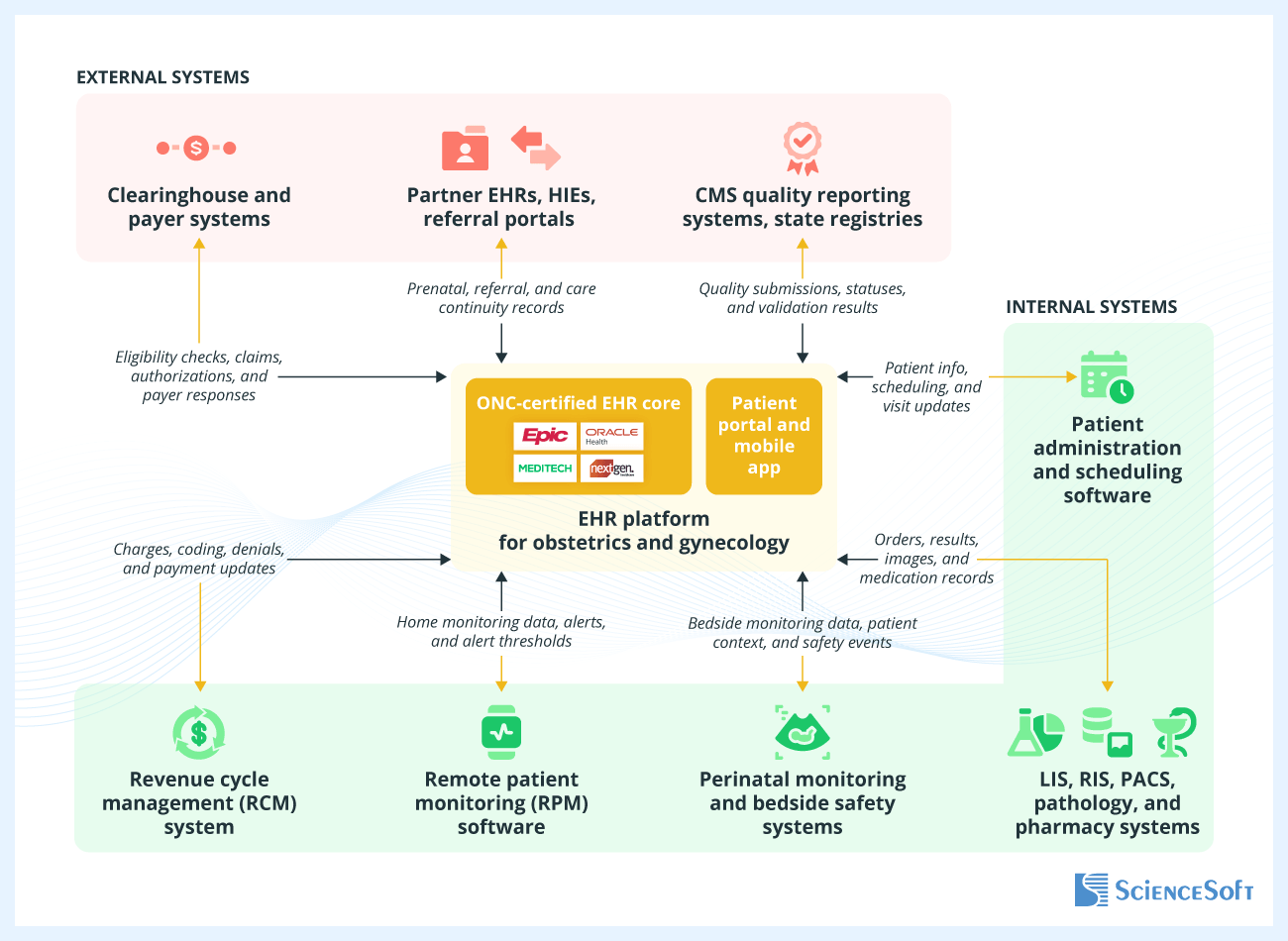
- Patient administration and scheduling software — to keep identity and appointments consistent for prenatal care and gynecology visits; to prevent duplicate charts and mismatches during transfers and specimen collection.
- LIS, RIS, PACS, pathology, and pharmacy systems — to trigger prenatal and gynecology workflows from visit notes; to surface imaging, pathology, and medication updates in views and follow-up worklists.
- Revenue cycle management (RCM) software — to align gynecology procedures and prenatal encounters with coding rules; to apply maternity package logic across episodes and reconcile charges before billing cutoffs.
- Remote patient monitoring (RPM) software — to collect patient-submitted vitals in triage queues for nurse review; to adjust monitoring protocols by risk group without manual data re-entry.
- Perinatal monitoring and bedside safety systems — to link fetal monitoring and feeding safety devices to the patient chart; to enable escalation review and verification during labor and postpartum care.
- Partner EHRs, HIEs, referral portals — to review outside obstetric and gynecology history during admissions and consults; to deliver structured handoffs that shorten intake and support specialist follow-through.
- CMS quality reporting systems, state registries — to submit evidence for maternity outcomes and gynecology screening measures; to validate quality KPIs with feedback so teams correct data gaps before submission.
- A clearinghouse and payer systems — to confirm benefits for pregnancy care and gynecology procedures before scheduling; to route payer rejections into coder worklists so teams can correct supporting documentation earlier.
Other frequently requested integrations include:
- Identity and access management services — to unify clinician sign-in across clinical apps and portals and enforce least-privilege access and audit logs for HIPAA reviews.
- Document intake and consent tools — to ingest outside records into pregnancy episodes without manual indexing; to capture e-signatures for procedures and releases in clinic workflows.
- Payment gateway and patient billing tools — to collect copays and balances during digital check-in; to post payment status into finance workflows without manual reconciliation.
- Enterprise analytics and data warehouse tools — to consolidate maternal quality and gynecology performance metrics across sites; to support tuning for CDS and follow-up worklists based on outcomes.
Development Tips for OB/GYN EHR Projects
Below, ScienceSoft’s experts highlight three engineering decisions that reduce hidden delivery risks and keep the software predictable for clinical, operational, and IT teams.

Pregnancy episode and mother-baby dyad as a first-class data model
Pregnancy documentation often gets split across visits, while the newborn record lives in a separate chart. IT teams typically try to fix it by adding one-off mapping rules and workarounds, and then revisiting them when upstream fields change. The hidden cost is interface rework and clinical time lost to resolving mismatches between maternal and newborn data.
ScienceSoft recommends building a data model in which the pregnancy episode and the mother-baby dyad are core records, with shared identifiers and time-ordered events. This foundation supports maternity analytics, interoperability, and a clear source of truth across prenatal, labor, delivery, and postpartum care.
Reproductive-health privacy by design
OB/GYN providers often face high-risk record requests that involve reproductive-health data. As disclosure rules and request types change, they often exceed what EHR release workflows can document and prove in an audit. Then, staff try to collect attestations and approvals in emails or shared files and manually override disclosure rules, but this creates audit gaps, rework, delays, and legal exposure.
ScienceSoft’s architects recommend building an EHR-embedded disclosure service with a rules engine that keeps privacy policies as versioned, effective-dated decision sets. When disclosure rules change, teams can update the active decision set without rewriting application code or reworking the release workflow. In a centralized change workflow, OB/GYN compliance staff can draft updates, the legal team can approve them, and the provider’s IT team can publish a new policy version and link it to each disclosure record. This approach shortens sensitive-request turnaround, produces defensible audit trails, and reduces regression defects when policies change.
RAG-grounded content governance for OB/GYN policy search and patient education
OB/GYN teams often keep triage guidance, postpartum warning-sign instructions, and patient education content in separate documents, portal pages, and internal knowledge repositories. Staff then search several sources, reuse old message templates, or rely on generic AI assistants when preparing patient portal replies or internal answers. That can result in inconsistent or outdated guidance and also creates safety and privacy risks.
ScienceSoft recommends organizing this content as a governed knowledge base that supports policy-aware retrieval through regular enterprise search and also powers retrieval-augmented generation (RAG) through a controlled LLM assistant. In the assistant flow, retrieval keeps answers tied to approved, versioned OB/GYN protocols and patient education materials, tagged by audience, effective date, and care stage. Staff can use this setup for policy lookup and drafting education content. Our engineers ensure that the architecture separates staff and patient materials, keeps protected health information out by default, and sends symptom-based or low-confidence patient messages to clinical staff.
How Much It Costs to Develop an OB/GYN EHR Solution
Development costs for an obstetrics and gynecology EHR extension or clinical platform vary from $120,000 to over $2,200,000. The main cost drivers are the range of care processes covered, the number of connected systems, the need to process live data from bedside devices, and the addition of advanced reporting or AI-assisted functions.
The ranges below exclude third-party vendor fees, infrastructure and hosting costs, transaction fees for connected services, and long-term support.

$120,000–$180,000
A low-code OB/GYN workflow extension covering one narrow operational layer around the current EHR. For example, it can include digital intake, consent routing, staff worklists, and one or two basic data exchanges.

$250,000–$550,000
An OB/GYN module for an existing EHR covering one specialty workflow set. For example, it can include prenatal episode management, visit templates, results follow-up, and a small group of supporting interfaces.

$600,000–$1,200,000
A multi-module OB/GYN extension combining two or three connected workflows around the current EHR. Typical scope joins specialty workflows, patient portal functions, reporting, and several system interfaces under shared business rules.

$1,200,000–$2,200,000+
A custom women’s health platform designed to extend existing clinical systems across outpatient and inpatient workflows. Depending on the case, it may support ambulatory care, labor and delivery, mother-baby linkage, device connectivity, reporting, multi-site interoperability, and AI features.
Low-code platforms such as Power Apps can reduce development time and cost because they let you assemble workflow apps from prebuilt components instead of coding every layer from scratch. In my experience, this works best for OB/GYN providers who want to keep their current EHR and add a few specialty workflows fast, for example, intake checks, consent routing, prenatal follow-up queues, or quality-data correction worklists.
It stops being a good fit when those apps start carrying complex integrations, strict access rules, audit-sensitive logic, or core care workflows that need to stay consistent across systems and over time. That is why a hybrid setup is often the safer option: low-code for internal admin and coordination workflows, custom code for functions such as mother-baby linkage, bedside data flows, patient-facing journeys, and more demanding AI features.
Why Choose ScienceSoft for Your OB/GYN EHR Project
- Since 2005 in healthcare software engineering with 150+ successful projects, including EHR modernization, extension, and integration.
- 750+ IT specialists, including in-house MD consultants and solution engineers with healthcare backgrounds.
- 9 principal architects with 15–25+ years of experience to keep OB/GYN EHR architectures scalable, auditable, and maintainable.
- Hands-on experience with meeting HIPAA, HITECH, ONC, and the 21st Century Cures Act requirements.
- EHR integration expertise across HL7 v2/v3, FHIR, USCDI, CCDA, and XDS/XDS-I, with clinical terminology mapping for SNOMED CT, LOINC, RxNorm, ICD-10-CM/PCS, CPT/HCPCS, and more.
Certifications and awards
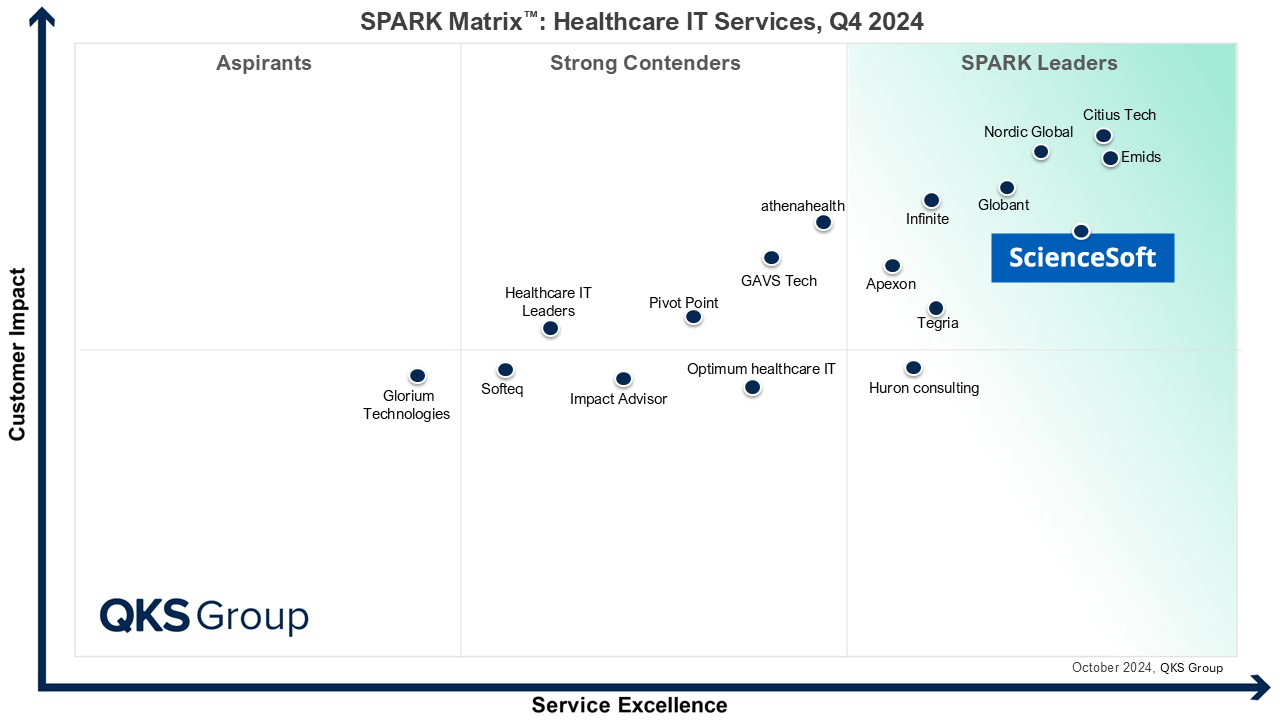
Featured among Healthcare IT Services Leaders in the 2022 and 2024 SPARK Matrix

Recognized for Healthcare Technology Leadership by Frost & Sullivan in 2023 and 2025

Named among America’s Fastest-Growing Companies by Financial Times, 5 years in a row

Four-time finalist across HTN Awards programs
Named among Becker’s Telehealth Companies to Know in 2026

Named Leading Healthcare Software Provider 2026 at GHP’s Healthcare & Pharmaceutical Awards

HIMSS Gold member advancing digital healthcare

ISO 13485-certified quality management system

ISO 27001-certified security management system
What Our Healthcare Clients Say

Our project required a large amount of industry-specific methodology and algorithms to be implemented into our new software connected to EHR/LIS systems, which the team handled well. ScienceSoft has been a competent partner for medical software development. They are reliable, thorough, smart, available, extremely good communicators, and very friendly.



Working with ScienceSoft was a pleasure from A to Z. We are grateful for their can-do attitude, responsiveness, and straightforward communication. RIVANNA already witnessed tangible benefits of our cooperation. We have more projects to come and are looking forward to working with ScienceSoft again.

Todd Nilson
MD

We worked with ScienceSoft on the refactoring and modernization of our telehealth web portal and a cross-platform patient application. We were impressed by their code analysis proficiency and in-depth knowledge of telemedicine specifics. ScienceSoft proved to be a reliable vendor with a solid healthcare background.


Our clients in healthcare rely on Qventive for the support and administration of essential software solutions such as EHR and practice management systems. When we were faced with a large influx of support requests, having ScienceSoft step in for a 24/7 help desk was a lifesaver. We appreciate their proactive communication and commitment to quality. Highly recommend them!
