Healthcare
 Insurance
 Investment




Enterprise-Grade Lending AI Agents for Atlas Credit
Summary
ScienceSoft delivered a suite of tailored AI agents for Atlas Credit, a Texas-based consumer loan provider operating since 1968. Designed with a focus on governance, data security, and compliance, these AI agents enable safe and controlled automation of lending workflows.
About Atlas Credit
Atlas Credit is a consumer lending company that provides personal, credit starter, and signature loans to individuals, including those from underserved communities. Since its inception in 1968, Atlas Credit has served more than 2.5 million customers and grown into one of the most reputable consumer lenders in Texas, with over 50 offices across the state and service centers in Oklahoma, Virginia, and Missouri.
Atlas Credit already had a robust proprietary loan management system to automate core loan processing and servicing tasks. With recent advancements in large language models (LLMs) and agentic artificial intelligence (AI), the company saw an opportunity to further improve operational efficiency and profitability.
Atlas Credit sought professional help to validate the feasibility of agentic AI for its business, plan agentic solutions, and deploy them safely within the company’s workflows. Having worked with ScienceSoft’s lending software engineering team for over five years, Atlas Credit turned to its trusted partner, which already knew its core systems and had a decades-long track record in lending AI engineering.
Consulting on Agentic AI Use Cases and Deployment Paths
ScienceSoft’s consultants conducted a series of focused workshops with Atlas Credit’s stakeholders to understand the company’s operational needs, expectations for agentic solutions, and AI implementation constraints. Based on the collected insights, the consultants scoped high-impact agentic use cases tailored to Atlas Credit’s lending workflows. For each use case, the team delivered a clear agentic solution concept, a detailed software requirements specification, and a tailored set of agent performance, quality, and user acceptance metrics to guide development and evaluation.
Having studied ScienceSoft’s discovery documents, Atlas Credit prioritized launching three task-specific agentic AI solutions:
- A loan application verification agent. The agent was meant to capture loan applications that passed initial credit bureau checks and automatically contact applicants via a consented voice call. During the call, the agent was to verify the applicant's identity using a Social Security number and date of birth, and confirm the borrowing intent. By handling early-stage verification, the agent would help ensure that only authentic and qualified applications proceed to human specialists for final processing.
- A debt collection agent. The agent was to make calls to debtors, guide them through loan repayment options, and propose alternative payment terms on the fly while adhering to FDCPA regulations. Atlas Credit wanted the agent to collect approvals for repayment via the customers’ saved payment methods, retrieve new card and bank account details, and capture promises to pay and loan renewal confirmations. On the backend, the solution would trigger real-time payment processing via payment gateways, enforce ACH direct debit transactions, registered payment promises, and handled eligibility screening and loan renewals. ScienceSoft estimated that these capabilities could increase debt recovery rates by 15–20% and decrease collection costs.
- An incoming call handling agent. The agent was intended to triage inbound customer calls, understand the intent of each request, and route it to the appropriate loan servicing specialist. By automating call dispositioning and initial interaction handling, the solution would reduce wait times, improve servicing capacity, and help address customer inquiries more efficiently.
During calls, the AI agents were to switch instantly between English and Spanish to ensure consistent communication with Atlas Credit’s multilingual customers.
Initially, Atlas Credit planned to use ready-made agentic AI tools and customize them for the company’s needs. ScienceSoft’s consultants researched available market options and shortlisted the most suitable vendor offerings. However, upon deeper investigation, it became apparent that most commercial agentic AI products weren’t ready for enterprise-grade rollout and required extensive rework to handle Atlas Credit’s real lending processes. ScienceSoft’s feasibility study showed that it would be cheaper to build task-specific custom agents using cloud AI services and commercial LLMs than to customize packaged tools. That path had comparable agent release timelines while offering more control over agentic workflows and solution scaling.
Atlas Credit reconsidered its original approach and opted for a custom solution. ScienceSoft’s project manager suggested developing tailored agents incrementally and managing each as a separate project. That approach minimized the risk of scope creep and delays, simplified resource coordination, and enabled the reuse of software components and delivery best practices in subsequent iterations with minimal QA overhead. It also let assign the same development team for the entire initiative, allowing Atlas Credit to scale agentic AI capabilities with familiar experts. ScienceSoft’s project manager crafted a detailed work breakdown structure for each project, suggested an optimal team composition, provided timeline and cost estimates, and mapped tailored risk mitigation steps.
Technical Design of an AI Agent for Loan Application Verification
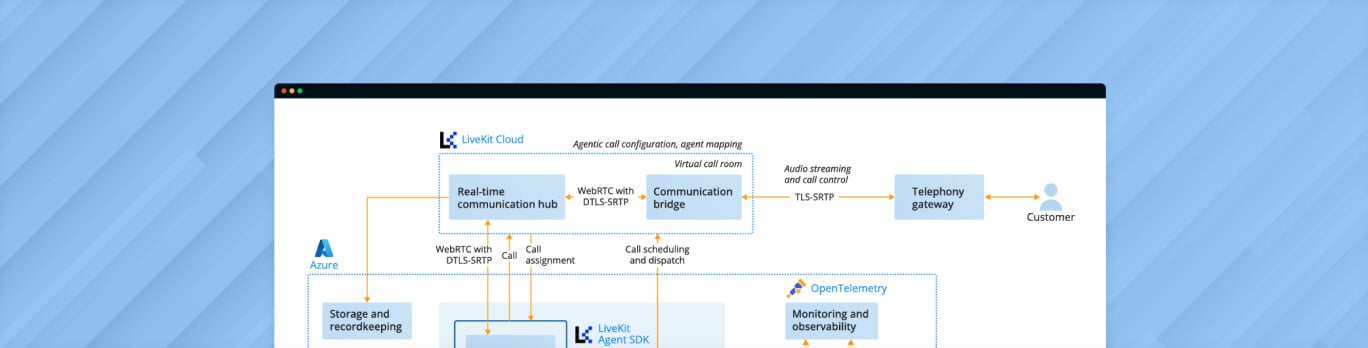
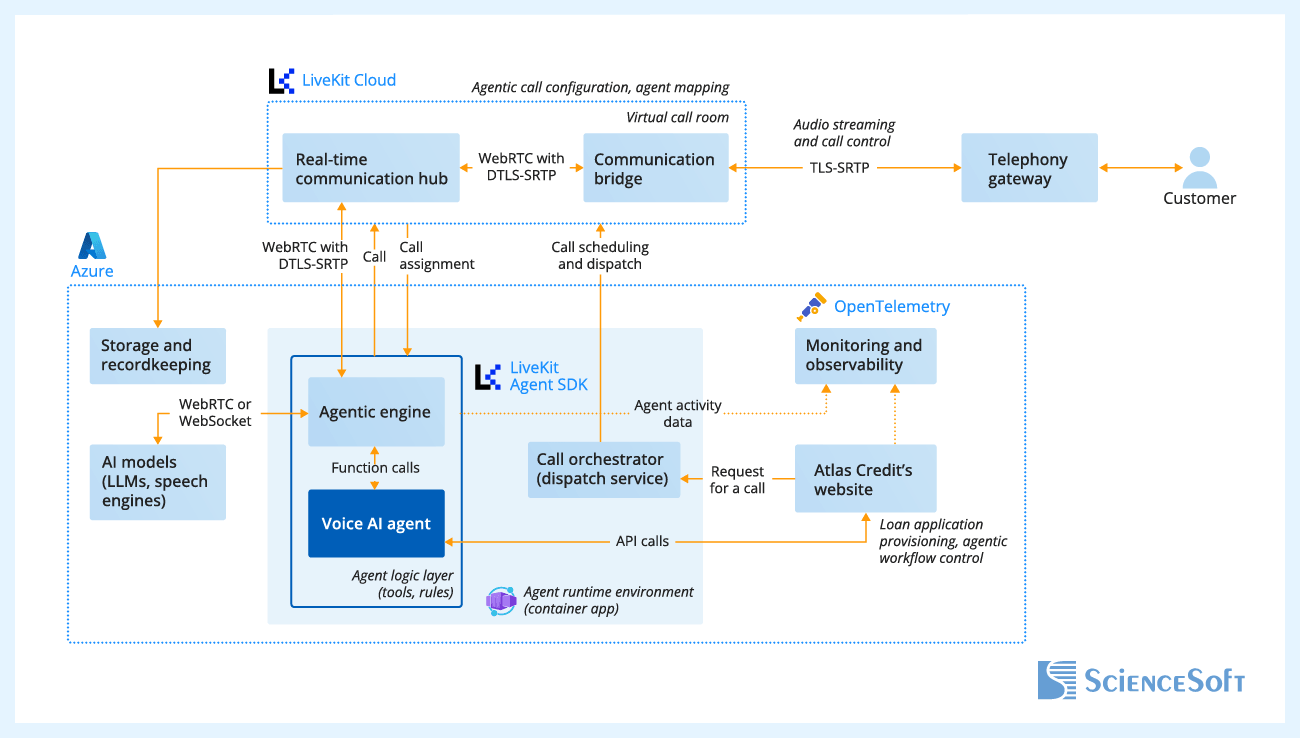
Having received Atlas Credit’s approval for the incremental development roadmap, ScienceSoft proceeded with the architecture design and tech stack selection for the first solution, a loan application verification AI agent. ScienceSoft’s architects designed the agent around modular, event-driven components and applied managed cloud services where possible to minimize the share of costly custom coding. They leveraged LiveKit Cloud as an agentic call configuration layer and used the LiveKit Agent SDK framework for agent logic development. As Atlas Credit’s systems ran on Microsoft Azure, ScienceSoft chose Azure to host the agent. The architects employed Azure Container Apps as an agentic workflow execution environment to simplify integration and reduce cloud service costs.
The proposed technical design addressed the following critical aspects:
Cost-effective scaling
The modular, cloud-native solution architecture enabled on-demand horizontal scaling of agentic workflows based on computing resource utilization and active session count. The architects applied a call dispatch service with queue-based load leveling and configurable session limits to prevent resource overprovisioning while securing sufficient scaling. They also evaluated multiple LLM hosting options (Azure OpenAI, OpenAI Realtime, and more) and selected configurations that balance token consumption, concurrency limits, and pricing tiers to optimize agentic infrastructure costs.
Low latency
To achieve the near-real-time latency required for voice calls, the architects relied on real-time audio streaming via LiveKit. This service would enable low-latency (sub-250 millisecond) concurrent audio transmission between the AI agent and customers and provide go-to streaming APIs for agent-LLM interactions, cutting integration efforts and ensuring conversational continuity even under heavy load.
Interoperability
ScienceSoft designed the agent to interact with Atlas Credit’s application platform and external services via standardized APIs. The use of a modular integration architecture and cloud-native integration services would make it easy to extend agentic functionality through third-party services and plug in new loan application sources, customer interaction channels, and AI models with minimal changes to the core solution.
Agent governance
The architects defined a controlled execution model where the agent operates through structured function calls and predefined business logic, ensuring that every action is deterministic, auditable, and aligned with Atlas Credit’s business rules. They set clear boundaries for agent autonomy, introducing control and configuration modules for agent instruction, action tracking, and approval. A comprehensive observability layer based on the OpenTelemetry toolset was added to support real-time monitoring and optimization of agent performance. The architecture also enabled AI explainability through full interaction tracing and auto-reconstruction of agentic decisions.
Security
The architects applied zero-trust principles and robust encryption mechanisms, such as WebRTC, DTLS, and SRTP, to ensure that lending data and audio streams are encrypted in transit and at rest. They added layered protection so sensitive customer data would be additionally encrypted before entering the communication layer and only decrypted within isolated agent runtime environments. This approach ensured that sensitive information is only accessible within controlled components and is not unintentionally exposed to external services and LLM vendors. By designing the agent to operate within a dedicated Azure Virtual Network space with private endpoints, ScienceSoft minimized the risk of public data exposure and unauthorized access to Atlas Credit’s sensitive data.
Compliance
ScienceSoft opted for region-specific Azure deployments to maintain data residency and agentic processing boundaries mandated by GLBA and DSP. The architects planned tailored pipelines for agentic interaction logging and recording to support the auditability of intelligent application verification workflows. They designed the pipelines to control the compliance of agentic customer outreach (consent, call timing, intent identification, and more) with Atlas Credits’ internal policies and TCPA regulations. The dedicated observability tools would track agent compliance with GLBA requirements for handling consumers’ personal and financial data. The use of secure identity management and robust encryption aligned with the GLBA data protection standards.
Development of an AI Agent for Loan Application Verification
Once Atlas Credit approved the proposed technical design, ScienceSoft’s engineers proceeded with the development of the agentic solution components. They connected the custom modules and third-party services and integrated the agentic system with Atlas Credit’s website, the primary source of loan applications. The team also expanded the website’s admin panel with customizable agent control dashboards, where loan processing specialists could track application verification statuses and manually resolve outstanding cases.
The developers worked closely with ScienceSoft’s quality assurance (QA) engineers to ensure the reliable and production-ready agentic loan verification process. The team conducted comprehensive functional testing to confirm that the agent correctly interprets user input, calls back-end services, and executes interaction logic. Integration testing focused on validating interactions among the agent, telephony services, LLMs, and Atlas Credit’s website. End-to-end testing simulated full loan verification calls to assess conversation flow, response accuracy, latency, and customer experience.
The QA team gave particular attention to edge and non-standard scenarios. The team validated the agent’s behavior under ambiguous and inconsistent customer responses, interrupted calls, unexpected inputs, and failures in external dependencies (API timeouts, model response delays, and more). Such tests ensured the agent handled uncertain and negative conditions gracefully without breaking the conversation flow or exposing sensitive data.
ScienceSoft used the same realistic approach in performance testing to confirm that the agent can smoothly handle real application load. The QA engineers conducted load tests on varying data volumes to assess agent scalability, latency, and concurrent call handling capacity at scale. Dedicated voice interaction testing helped validate agentic speech quality, responsiveness, and conversational coherence during live calls.
Finally, ScienceSoft submitted the agentic solution for user acceptance testing (UAT) on Atlas Credit’s side to validate its performance in a real business environment. During the UAT sessions, the agent accurately handled loan verification, maintained stable conversational flows, and smoothly moved data across the connected systems.
Early feedback from business users during AI agent pilot run at one of Atlas Credit’s branches confirmed that the agent reduced manual workload and improved consistency in application verification.
As of April 2026, ScienceSoft had completed a full production deployment of the loan application verification AI agent for all Atlas Credit’s branches. The team proceeded with the technical design of an AI agent for debt collection, applying the same architectural principles to ensure reliable and controllable agentic automation.
Vanessa Howland, Vice President of Operations at Atlas Credit:
Throughout the past five years, ScienceSoft has always brought structure, technical insight, and a strong understanding of lending operations to our IT initiatives. Seeing that they approached AI engineering the same way gave us confidence from the start. We knew our agents would be secure, well-governed, and aligned with the way we work without overspending. The first live agent fit naturally into our application review process and brought results right away. It was a strong first step for Atlas Credit, and we’re already looking at where agentic AI can help next.
Key Outcomes for Atlas Credit
- Launch of an agentic AI solution tailored to the company’s loan processing requirements and regulatory compliance rules.
- Reduced workload for call center and lending teams by offloading repetitive verification and communication tasks to an AI agent.
- Enhanced lending risk control and minimized redundant efforts through automated applicant validation at early stages.
- The opportunity to increase debt recovery rates by up to 20%, enhance collection capacity, and reduce operational costs with agent-driven debtor outreach.
- Quick pilot rollout and early business value due to modular agent architecture, pragmatic tech stack, and fast iterative delivery.
- Secure and compliant customer interactions thanks to built-in identity verification, data encryption, and governed decision flows for the AI agent.
- Full transparency and auditability of agent actions enabled by end-to-end observability components.
- Scalable foundation for further AI adoption, allowing Atlas Credit to expand agents across diverse use cases with minimized risk.
Technologies and Tools
LiveKit (Cloud, Agent SDK, WebRTC), Azure OpenAI, OpenAI Realtime API, Azure Container Apps, KEDA, Azure Service Bus, Azure Key Vault, Azure Virtual Network, Azure Private Endpoints, PostgreSQL, Redis, OpenTelemetry, Azure Application Insights.