ScienceSoft Global
 Healthcare
 Insurance
 Investment



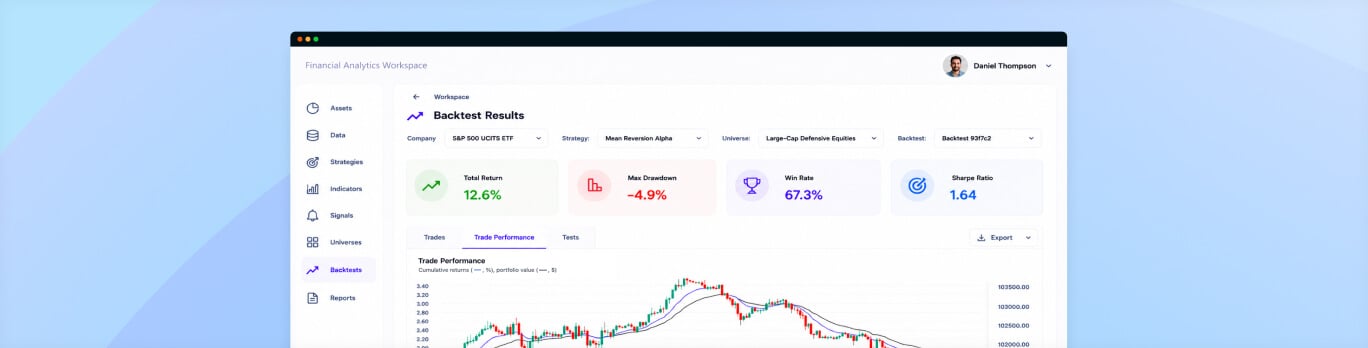
Custom Investment Modeling Platform Powered by AI
About Our Client
The Client is an investment management firm serving high-net-worth (HNW) individuals. The company continuously improves its investment planning and execution technology stack to enhance service value and maximize returns for demanding HNW investors.
Fragmented Tools Limited Efficient Investment Modeling
The Client’s investment analysts and researchers used to rely on multiple fragmented tools to review capital market data, define reusable trade signals, design investment strategies, and validate their performance. The lack of a unified workflow slowed investment planning and complicated collaboration. It also created inconsistencies in how different asset types and investment models were handled, raising concerns about modeling accuracy and limiting the firm’s ability to expand into multi-asset portfolio services.
The Client decided to build a centralized investment modeling platform that would provide its teams with a single workspace for market research, data visualization, and investment strategy development. The platform needed to include convenient interfaces for market data exploration, a toolkit for trading model design, and strategy backtesting capabilities for proprietary datasets.
The Client’s in-house IT team lacked the resources needed to build a comprehensive investment modeling solution from scratch. Owing to ScienceSoft’s experience in custom investment software engineering, the Client turned to ScienceSoft for help with platform design and development.
Planning and Design of a Custom Investment Modeling Platform
Feature scoping and AI strategy
ScienceSoft’s investment IT consultant conducted a series of interviews with the Client’s stakeholders, researched the operational bottlenecks and technology usage patterns of the platform’s target users (investment analysts, traders), and aligned the workflow automation, user experience, and platform interface design with the actual business and user expectations. The consultant also identified and documented the applicable regulatory compliance requirements for the solution.
The Client was also considering using artificial intelligence (AI) to improve investment research, analytics, and backtesting within the platform. ScienceSoft’s consultant analyzed potential AI use cases and workflows where AI could accelerate strategy research and validation while maintaining transparency of investment decisions. Based on this assessment, ScienceSoft proposed an AI assistant that would help teams build, test, refine, and document investment strategies through natural-language conversations. This approach would help analysts work faster while keeping all investment decisions subject to human approval. To address the Client’s concerns about the accuracy and explainability of AI-generated insights, ScienceSoft demonstrated how the assistant could expose the source data and reasoning behind its recommendations and optimization suggestions.
After the Client approved the proposed functionality, the consultant converted all gathered requirements into a detailed software requirements specification.
Technical design
To plan the platform’s architecture and technology stack, ScienceSoft engaged a principal architect with 20 years of experience in engineering custom software and specialized AI solutions for the financial services industry.
The architect suggested applying a modular architecture that combined SOA and monolith design patterns. The monolithic core would simplify platform governance and security management while supporting low-latency data processing and smooth scaling of analytical workloads. Applying SOA principles to integrations and reusable business services would allow the Client to standardize interactions between the platform’s modules, AI-powered capabilities, and external services, reducing infrastructure complexity and integration engineering costs. With reusable services and integrations separated from the monolithic core, the Client would also be able to introduce new functions, asset classes, and third-party analytical services faster and without major redesign.
To boost platform performance without inflating operating costs, the architect planned dynamic workload distribution and real-time processing capabilities. Lightweight analytical operations would be executed near-instantly, while complex calculations and AI-assisted tasks would run through dedicated processing mechanisms optimized for computationally intensive scenarios. The architecture also included data caching and asynchronous processing components to maintain stable performance under concurrent user activity and heavy modeling automation workloads.
The architect treated security and compliance as key platform design priorities. The proposed architecture incorporated SEC-compliant secure authentication mechanisms, controlled execution environments for user-defined analytical logic, and tailored pipelines for validating the integrity of incoming data, investment calculations, and research outputs.
Another priority was to make the platform interoperable with different asset classes and external systems. ScienceSoft designed a unified approach to handling asset-specific data and analytics, so the platform could later expand beyond equities without major rework. The architect also planned standardized API integrations with corporate and third-party services for investment data storage, caching, session management, and conversational assistance. For each integration area, the architect compared available service options and recommended those that offered the best balance of performance and cost for the Client’s needs.
AI architecture and safety design
ScienceSoft designed the investment research and modeling AI assistant as a controlled copilot that provides fully traceable logic behind its outputs with links to the source data used for reasoning. This approach preserved analyst oversight of AI-assisted workflows and supported explainability.
ScienceSoft’s architect compared several approaches to implementing AI-assisted workflows and suggested integrating locally deployable large language models (LLMs) from the Microsoft Azure OpenAI ecosystem. This approach offered the best balance of operational flexibility, auditability, scalability, and engineering costs. It also minimized data confidentiality and compliance risks because sensitive investment data, proprietary formulas, and analytical outputs could be processed within the Client’s controlled cloud environment rather than transferred to external AI providers.
To ground AI output in the Client’s proprietary data, the architect designed retrieval-augmented generation (RAG) pipelines and engineered a pack of optimized prompts for common analytical scenarios such as asset data exploration, signal summarization, and strategy refinement. The proposed architecture also included deterministic validation pipelines for AI outputs to identify potential data gaps, mathematical errors, and irrelevant strategy suggestions before AI-produced insights reached analysts.
UX and UI design
ScienceSoft’s UX/UI designer mapped end-to-end user journeys for investment analysts and researchers and created UX wireframes illustrating the platform’s structure, navigation logic, and core modeling workflows. In particular, the designer created blueprints for the interactive research workspace, asset selection and filtering flows, market indicator and trade signal creation screens, strategy backtesting panels, and dashboard views.
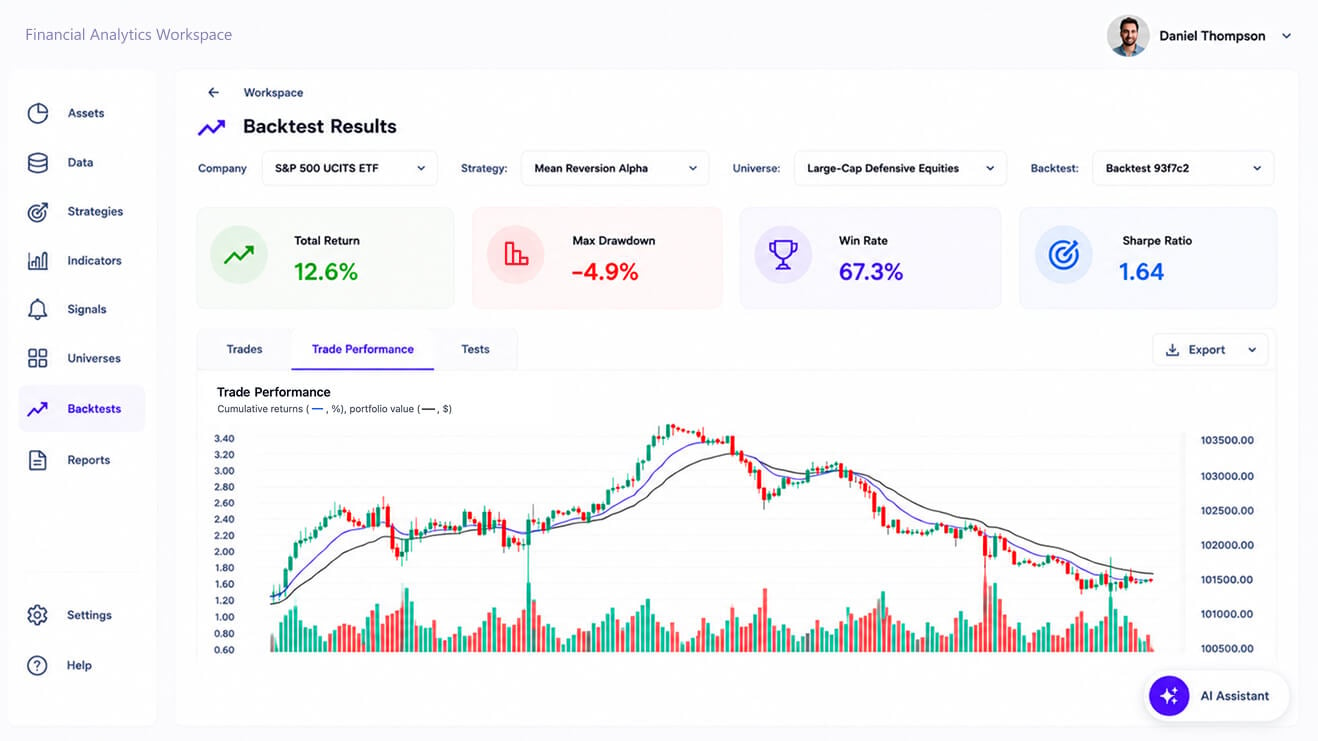
To simplify investment modeling, the designer prioritized straightforward user journeys and clean, data-centric interfaces that would allow users to easily shift from raw market data exploration to strategy validation and performance analysis. The proposed design emphasized intuitive chart interactions, responsive data visualization, convenient tool access, and customizable workspaces.
ScienceSoft also involved a data engineer to confirm that the platform’s research dashboards and analytical models accurately reflected data mappings and calculations.
Development project planning
After the Client approved the proposed functional, technical, and UX/UI designs, ScienceSoft’s project manager began planning the development project. The PM studied the feature scope, mapped the development tasks, determined the resources needed to complete the project, and estimated project cost and timeframes.
The Client also received a risk mitigation strategy addressing operational, technology, user adoption, and regulatory risks.
Engineering of Investment Modeling Core and AI Features
ScienceSoft assembled a team of a project manager, a business analyst, a front-end engineer, back-end engineers (including AI engineers), and QA specialists to develop the investment modeling platform’s MVP. The business analyst scoped the MVP around the platform’s core analytical capabilities and AI features that were expected to significantly improve employee productivity.
During the MVP engineering stage, ScienceSoft developed the following core components of the investment modeling platform:
- Market research tools that allowed research desks to upload proprietary and third-party investment datasets and compile structured data tables.
- Market segmentation tools that enabled analysts to dissect market data by ticker, geography, exchange, sector, valuation, performance, and ownership structure, and save the results as reusable custom market segments.
- Market indicator and trade signal creation functionality that enabled users to convert custom analytical findings into reusable indicators and combine them into actionable buy, sell, or hold signals using configurable business logic.
- A calculation engine relying on the Client’s proprietary formulas and analytical models for statistical analysis, correlation analysis, performance attribution analysis, trend indication, and asset ranking.
- A backtesting engine to evaluate custom investment strategies against historical data, simulate transaction costs and slippage, run scenario and what-if simulations, and assess trade strategy performance through selected risk and return indicators.
- Reporting capabilities supporting multi-chart modeling output visualization, side-by-side strategy comparison, and compilation of structured backtesting reports.
- An AI assistant to help the Client’s teams research asset-specific markets, summarize research findings, draft and optimize investment strategies, and interpret modeling results. To support transparency, the assistant displayed source citations and step-by-step reasoning.
ScienceSoft’s QA engineers conducted functional, performance, and usability testing to validate the reliability and stability of the delivered components. The testing process confirmed the technical feasibility of the proposed architecture, the accuracy and explainability of AI-assisted analytical workflows, and the platform’s ability to support high-performing, scalable investment research and modeling operations.
Satisfied with the MVP, the Client asked ScienceSoft to prepare the ready platform components for deployment in the production environment. The team packaged the deliverables into portable Docker containers to simplify deployment and reduce maintenance overhead for the Client’s IT team.
A Foundation for Accurate and Scalable Investment Modeling Workflows
The Client received a production-ready, SEC-compliant investment modeling platform with assistive AI capabilities. With a centralized solution, the Client got the opportunity to eliminate fragmented investment research, strategy development, and backtesting workflows, driving faster collaborative investment planning and higher productivity for analytical teams.
ScienceSoft’s advice on the architecture and technology stack for the solution helped the Client avoid costly technical design decisions at the early project stages and reduce future maintenance expenses. The proposed technical design supported scalable, low-latency investment modeling workflows, safe AI use in managed portfolio operations, and flexible expansion to new asset classes, features, and integrations.
Technologies and Tools
Python, React.js, TypeScript, FastAPI, Vite, Recharts, PostgreSQL, Redis, Microsoft Azure OpenAI, LiveKit, Docker, OpenAPI/Swagger.