Healthcare
 Insurance
 Investment





AI-Driven 3D Inspection Software for Cerulean Delivered in 6 Months
Summary
ScienceSoft delivered an AI-powered solution that performs high-precision 3D inspection of batteries for a global leader in manufacturing quality control. In just 6 seconds, the system transforms X-ray scans into volumetric models and detects even the slightest structural deviations in batteries.
About Cerulean
Cerulean is a UK-based leader in test and measurement solutions for manufacturing with over 80 years of experience and a global network of sales and service branches. Cerulean has one of the longest-standing legacies in precision testing for the tobacco industry. Over the years, Cerulean has successfully expanded beyond traditional tobacco testing into emerging domains such as e-cigarettes, vaping, heat-not-burn products, food temperature measurement, and packaging testing.
As global regulations on tobacco, vaping, and heated products tighten, precision testing has become mission-critical, Cerulean’s equipment is trusted worldwide for rigorous compliance verification and meets the highest standards of measurement and calibration. Its operations follow lean manufacturing and continuous improvement principles and comply with ISO 9001 and ISO 17025 standards. The company also actively contributes to scientific and industry bodies (CORESTA, ACS, TSRC).
To strengthen its position at the forefront of innovation, Cerulean sought to enhance its inspection hardware with an intelligent software layer that would automate the quality control of batteries. The envisioned solution had to process raw X-ray scans captured by Cerulean’s robotic inspection complex, reconstruct high-fidelity 3D models of each battery, and identify cathode-anode misalignment, overhang issues, and other internal defects.
To bring this vision to life, Cerulean looked for a technology partner with deep expertise in 3D imaging, computer vision, and industrial quality control. ScienceSoft was chosen to deliver a robust, efficient, and scalable image analysis software for the product.
Engineering a High-Precision, Real-Time Battery Inspection System
ScienceSoft’s team of four software engineers and one project manager planned and executed a 6-month project to build a fully automated image analysis system and integrate it into Cerulean’s production equipment.
Speeding up CT image analysis through an additional 2D pipeline
The project began with collecting sample data and reviewing all available documentation to gain a complete understanding of Cerulean’s production equipment and inspection objectives. With this foundation, ScienceSoft’s engineers conducted in-depth R&D on CT scan data, testing reconstruction approaches and defining optimal processing parameters to maximize accuracy, stability, and speed.
Overcoming the innate challenges of battery X-ray image quality
During early R&D, ScienceSoft’s team noticed uneven reconstruction quality when processing CT data, which is a typical issue in radiographic imaging of metallic or composite components like battery cells. Variations in material density, surface reflectivity, and cell positioning affected the intensity of the captured X-ray projections, which in turn led to local artifacts and inconsistent voxel brightness in the 3D models.
To stabilize reconstruction accuracy, ScienceSoft’s engineers fine-tuned key reconstruction parameters and introduced adaptive noise-reduction filters that dynamically adjusted to local image contrast and density. This helped reduce beam-hardening and scattering effects and produced consistently clear internal structures across varying cell types. As a result, the inspection process became far more reliable: quality engineers could detect even subtle internal defects with confidence, reducing false rejects and minimizing costly rework or manual re-inspection.
Developing 3D quality control software end-to-end
Once the analytical core was validated, ScienceSoft’s team engineered a complete production-ready solution comprising the following key modules:
- The real-time data ingestion and preprocessing module connects directly to Beckhoff-controlled scanning equipment (e.g., line-scan cameras, CT scanners), orchestrates data capture, validates scan completeness and metadata integrity, and triggers subsequent analysis steps.
- The 2D linear analysis module uses CNN-based computer vision algorithms to extract control points from 2D X-ray scans, performs quick dimensional checks, and verifies cross-section geometries, symmetry, and positioning against tolerance limits.
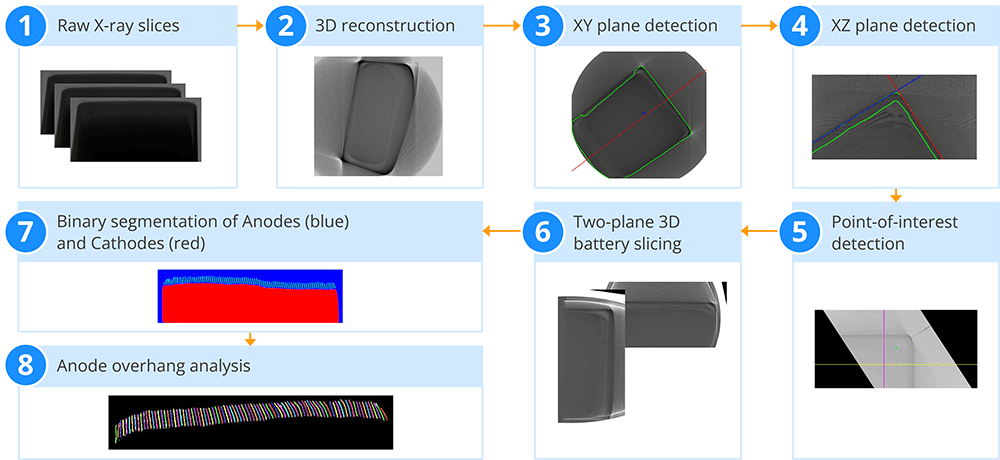
- The 3D reconstruction and battery-position localization engine combines multiple X-ray slices into a full volumetric model of the battery. Next, it determines the battery’s true position and orientation by detecting its XY and XZ reference planes and locates the exact region of interest. Once the battery is virtually straightened, the system extracts two correctly oriented 2D cut-plane frames — always at the same standardized angles. These slices consistently reveal the anode–cathode layers, no matter how the battery was originally placed inside the scanner.
- The anode–cathode segmentation, tracking, and overhang calculation module colors the anodes and cathodes using a neural network trained to distinguish their textures, density patterns, and shapes. This produces clean binary masks for each structure. With these masks, the system calculates the track/control points for every anode, anode overhang (how far an anode extends past the cathode), distances between anodes, and spacing between anode layers (density metrics). A Vision Transformer (ViT)-based model compares all extracted structures to reference patterns and tolerance rules to detect misalignment, excessive overhang, spacing irregularities, and other hidden internal defects.
- The data export and reporting component structures and sends processed results to the visualization interfaces and clients’ MES or production control database for recordkeeping and downstream analytics.
- System monitoring and diagnostic panels that track processing logs, hardware utilization, and module performance (e.g., scan throughput, error rates, latency) to ensure stable, high-speed operation.
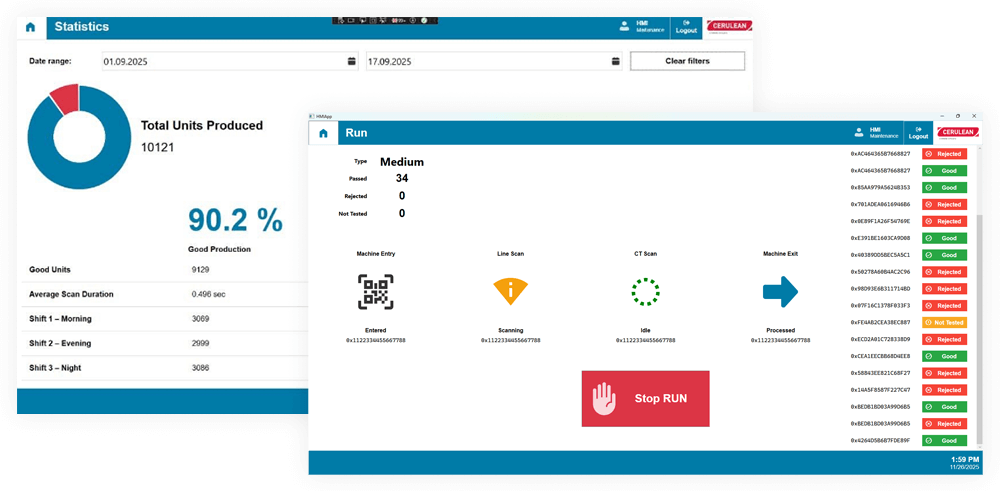
- User-friendly interfaces for quality managers display key inspection metrics (e.g., pass/fail rates, average scan duration, and defect distribution).
On-site validation and final tuning
ScienceSoft’s engineers worked closely with Cerulean’s technical team during on-site validation. Joint debugging and calibration sessions ensured the software operated flawlessly with the scanning equipment and production data, maintaining accuracy under real load conditions.
Key Outcomes for Cerulean
- Expanded and enhanced product portfolio: Cerulean broadened its offerings with an automated, highly accurate solution for battery quality control. Thanks to hybrid 2D-3D analysis and optimized workflows, the complete analysis pipeline now runs in just 6 seconds.
- Rapid value realization: ScienceSoft brought the new solution from concept to production in just 6 months.
- Enhanced market position: By integrating AI and 3D technology into its equipment, Cerulean further cemented its reputation as a pioneer in precision testing and quality control systems.
- Future-ready scalability: A modular architecture and flexible tech stack allow Cerulean to easily extend the solution to new product lines and inspection scenarios.