 Healthcare
 Insurance
 Investment


Family Office Gets a Roadmap for End-to-End Trading Automation With a Custom Platform
About Our Client
The Client is a family office serving an ultra-high-net-worth (UHNW) client in the Gulf Cooperation Council (GCC). Its in-house team includes wealth managers, finance consultants, and traders managing the family’s multi-asset trading operations.
Region-Specific Manual Trading Called for Custom Automation
The Client’s trading team had market screening, signal generation, and trade analytics automated with a third-party platform, while trade ordering and execution remained manual. Traders spent much time planning liquidity, creating and routing orders, and reconciling positions. These manual processes limited trader capacity and delayed order placement.
The Client wanted to automate its trading processes end to end without introducing fragmented trader tools. The company envisioned a single platform covering the entire trading workflow, from market research to ordering to reporting. While some commercial trading platforms could provide such functionality, the Client chose to build a custom platform. A custom solution would support the Client’s proprietary trading logic, integrate with its established local brokers and liquidity providers, and allow the Client to add new assets and partners as needed. It would also give the Client full control over its trading data and infrastructure, eliminating concerns related to the latency, security, and compliance of third-party tools.
Before starting development, the Client decided to engage professional consultants to shape the platform’s functionality and technical design and plan implementation. The Client selected ScienceSoft for its expertise in custom investment software engineering and experience automating family office operations in the GCC.
Functional Concept for a Custom Trading Platform
ScienceSoft’s investment IT consultants analyzed the Client’s existing trading workflows and automation needs across target trading strategies, asset classes, and jurisdictions. The consultants assessed the criticality of individual trading operations and the impact of existing bottlenecks. They also mapped dependencies on custodians, brokers, liquidity providers, market data services, and payment utilities, as well as the required integrations. This helped identify operational and technical constraints related to latency, market data licensing, vendor onboarding, and external APIs early in the concept design.
Based on the findings, ScienceSoft proposed the following features for the trading platform:
Market research
The solution would automatically collect market data for equities, commodities, and digital assets from selected providers. It would normalize the data, present it in charts, and calculate technical indicators. It would also generate composite trading signals with quality scores, mirroring the analytical capabilities the Client’s trading team already used.
Liquidity management
The platform would aggregate real-time liquidity data and executable bid/ask prices from connected brokers and liquidity providers. It would pull the data into consolidated views to help traders plan liquidity across instruments and providers.
Order management
The platform would be designed to support the Client’s specific order types, trading strategies, and time-in-force settings. Traders would create orders and instructions using prebuilt templates. A real-time order blotter would allow traders to track the order lifecycle.
Order execution and settlement
The platform would select brokers or other execution venues based on executable prices, spreads, fees, settlement costs, and configurable criteria for specific instruments and asset classes. It would support the Client’s proprietary and broker-provided smart order routing algorithms and maintain execution records for best-execution analysis. Integrations with broker and custodian platforms would enable automated order placement, position reconciliation, and settlement workflows.
Trade risk management
Before placing an order, the platform would check it against the Client’s margin and exposure limits, instrument restrictions, buying power rules, and price deviation thresholds. It would also support continuous compliance screening, configurable approval workflows for large orders, and operational kill switches.
Trade analytics and reporting
The platform would provide interactive drill-up and drill-down dashboards, automated calculations, and modeling tools for portfolio, account, execution, and risk analytics. It would also automate internal, client, and regulatory reporting in the Client’s required formats.
ScienceSoft documented the proposed functional capabilities and prioritized them for launch based on business value, operational criticality, and implementation complexity.
Architecture for Secure, High-Performing Trade Automation
ScienceSoft’s architect suggested applying a layered, modular architecture for the Client’s trading platform. The architect divided the solution into four layers:
- The user-facing layer would let traders interact with operational data and manually configure trading workflows. It would also provide APIs and streaming pipelines that would deliver real-time market, signal, and trade data to user dashboards.
- The data and analytics layer would contain components for automated data processing, signal capturing, calculations, and analytics. It would also provide dedicated storage for transactional, market time-series, and workflow data.
- The trade execution layer would handle broker connectivity and order-related operations. Its components would automate order creation and placement, risk checks, position tracking, reconciliation, and settlement.
- The cross-cutting services layer would provide security and operational control capabilities that could be shared across the platform.
Such a layered design would separate complex, accuracy-sensitive trade execution functionality from the rest of the system. Changes to dashboards, analytics, or trader-led workflows would therefore have limited impact on order processing logic, reducing the risk of regressions and trading disruptions as the platform evolved.
A modular structure within each layer would let the development team build, test, release, and update individual trading features independently and in parallel, enabling faster delivery and avoiding unnecessary changes to unrelated components. It would also let the team use technologies best suited to specific functions and right-size computing resources to each component’s workload. In ScienceSoft’s experience, this approach has typically improved software performance and reduced infrastructure costs.
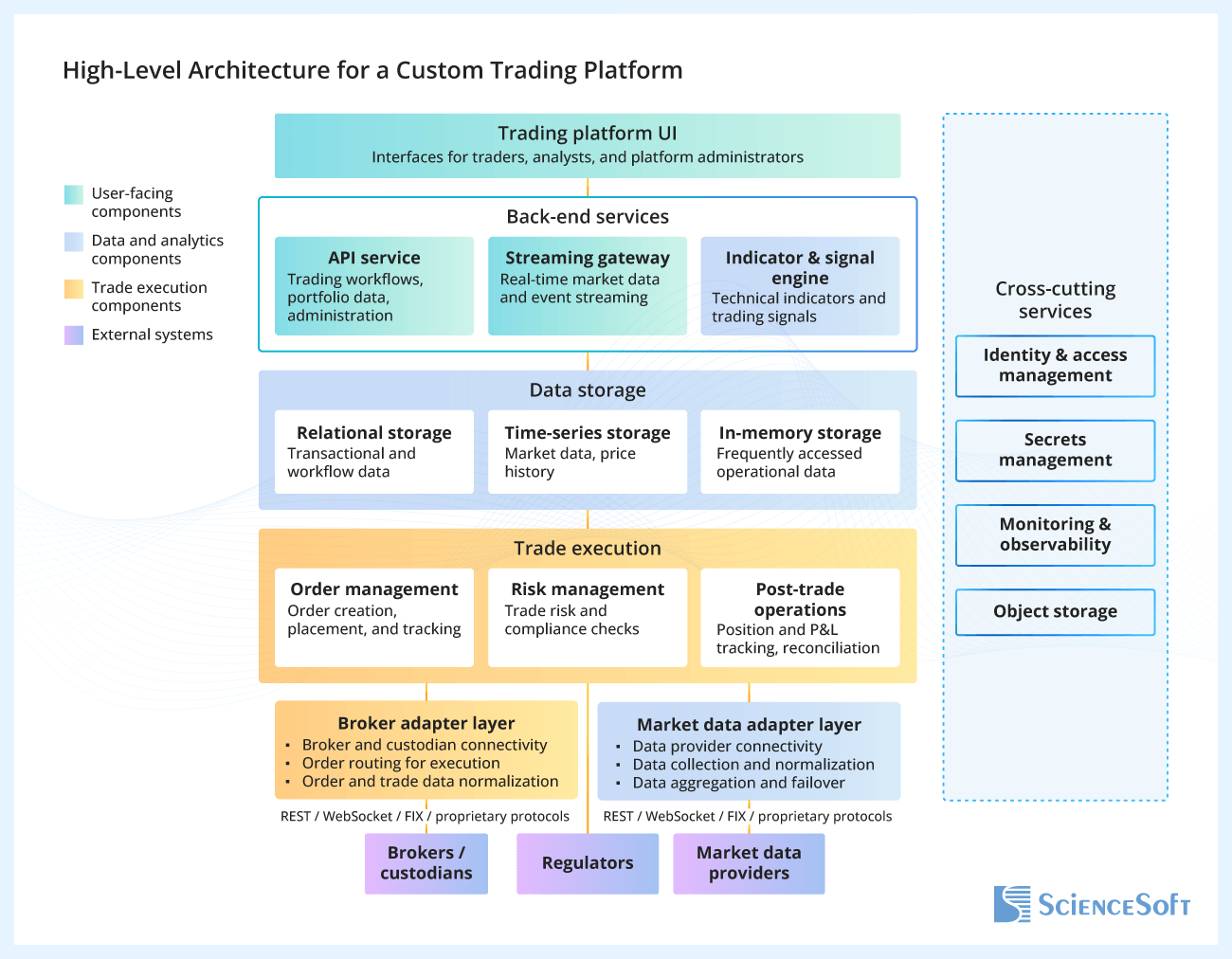
ScienceSoft’s architect also mapped the integrations with broker facilities, market data platforms, and other external systems. Each type of external system would connect to the trading platform through a dedicated adapter layer. The layer would contain the required integration components (APIs, connectors, etc.) and convert provider data coming in diverse formats into the Client’s unified internal format. Separating integrations from the platform’s core logic would make it easier to add new integrations or replace existing ones later.
The architect also specified the necessary security and observability mechanisms. The architecture included user authentication and role-based access controls, as well as secrets management tools to protect broker credentials, API keys, and other sensitive connection data. It also included system performance monitoring tools and backup and recovery mechanisms for critical trading data.
ScienceSoft recommended deploying the trading platform in the cloud. The cloud setup would allow scaling computing and storage resources with actual workloads, enabling the Client to handle peaks in trading activity without maintaining excess capacity. Hosting the primary environment in a cloud region close to the Client’s traders and connected trade infrastructure would reduce network latency, supporting faster market data delivery and order transmission. It would also help the Client maintain compliance with data residency requirements imposed by its local regulator.
Tech Stack Options and AI Usage to Accelerate Engineering
When composing the technology stack for the trading platform, ScienceSoft’s architect prioritized ready-made components and tools for standard functionality where appropriate. The architect estimated that component reuse could eliminate 2–3 months of custom coding, reducing the platform’s time to launch. The development team could then focus custom engineering on Client-specific trading logic.
The architect selected mature third-party components for trade charting, technical analysis, FIX connectivity, and data storage, prioritizing open-source options to reduce software operating costs. The architect also recommended proven tools for authentication, credential management, and platform observability. For external integrations, the team would use provider APIs and develop only the adapters needed to connect them to the trading platform.
ScienceSoft also outlined development automation and AI tools that could reduce manual engineering effort and speed up platform delivery. The consultants identified the following tasks to safely handle with AI:
- Code generation. Developers could use AI to generate initial code for integration adapters, data mapping pipelines, and other components that follow established structures and patterns. Developers would remain responsible for the quality and reliability of the final code and would review and refine AI-generated code to ensure its correctness, security, and compliance with the platform’s technical requirements.
- Code review and analysis. AI tools could analyze code changes for potential defects, security gaps, and deviations from established coding practices. This would help engineers identify issues before the code reached QA.
- Test generation. AI could generate unit and integration test scenarios based on available code and QA requirements, helping increase test coverage without a proportional increase in manual test-writing effort.
- Documentation. AI could generate and update API descriptions, code documentation, and user instructions based on system changes, reducing the manual effort required to keep documentation up to date.
Based on ScienceSoft’s experience, AI use could cut effort for individual engineering tasks by up to 70% and accelerate code reviews by 40%, lowering overall development costs.
Risk-Aware Roadmap for Trading Platform Implementation
ScienceSoft’s project manager studied the trading platform capabilities prioritized by the consultants and proposed delivering the solution in phases. This approach would let the Client distribute investment across project stages, start using the platform before its full completion, and adjust later scope based on the results of earlier releases.
- Discovery (Phase 0). The team would detail the requirements, identify any additional operational and regulatory constraints, and prepare a comprehensive software requirements specification (SRS) to guide development.
- Phase 1. The team would establish the core platform infrastructure and deliver market research and analytics capabilities. These modules would provide immediate value to traders without the risks associated with live order execution. The Client could gradually transition from its current trade platform to the new solution, reducing the time and costs of running parallel systems.
- Phase 2. The Client would receive automated trade order management and execution capabilities, including broker and liquidity provider connectivity and trade risk controls. By this stage, the team would have established and tested the underlying infrastructure and data processing capabilities, reducing the risk of technical issues affecting live trading operations.
- Subsequent phases would extend the platform with additional operational, reporting, compliance, and integration capabilities according to the Client’s priorities.
The project manager also proposed team compositions for each implementation stage and prepared preliminary estimates of the project timelines and costs.
ScienceSoft recommended organizing development into two-week iterations under the Scrum methodology. With frequent work reviews, the Client would be able to quickly provide feedback on the delivered functionality and reprioritize upcoming work in line with its business priorities. This would give the Client greater control over the platform scope and engineering progress.
Foundation for Fast and Reliable Custom Trading Automation
ScienceSoft developed a functional concept, architecture, and implementation roadmap for a custom trading platform, giving the Client a clear technical and investment plan for end-to-end trading automation. The proposed phased implementation approach would help the Client manage development risks and control investment, with opportunities to validate functionality and adjust priorities between releases. The recommended reuse of ready-made components could shorten development by 2–3 months, while AI-assisted engineering could further reduce effort for selected tasks by 40–70%.
Once deployed, the platform would help the Client:
- Increase trading capacity by automating activities that previously required substantial manual effort.
- Accelerate trade execution by reducing manual steps between identifying a trading opportunity and placing an order.
- Reduce trading risks through consistent execution processes and automated controls over trading operations.
- Improve trading outcomes by enabling traders to act on market opportunities faster and access more favorable execution conditions.
Technologies and Tools
AWS, Java, React.js, TypeScript, Spring Boot, TradingView, Ta4j, QuickFIX/J, PostgreSQL, QuestDB, Redis, OpenTelemetry.

