ScienceSoft Global
 Healthcare
 Insurance
 Investment



Software Development Lifecycle Transformation With AI
With 37 years of software delivery experience, ScienceSoft helps organizations embed AI across the software development lifecycle to improve engineering productivity without compromising quality or security. We design AI-enabled processes, advise on tools and architecture, and train SDLC teams. Our approach is suited to regulated industries, such as healthcare, insurance, and investment, where reliability, privacy, and auditability are critical.
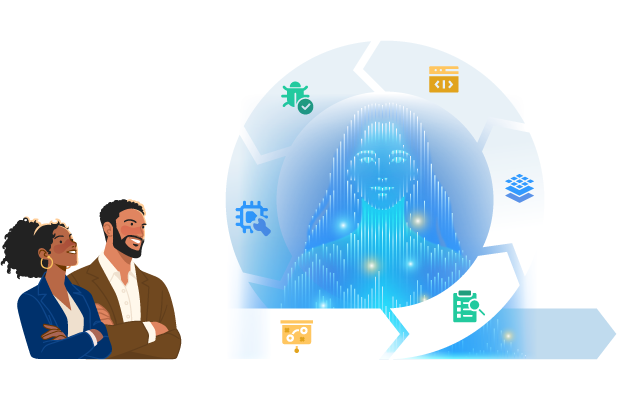

AI-intensive SDLC consulting helps organizations integrate AI into software delivery processes in a structured, measurable, and secure way.
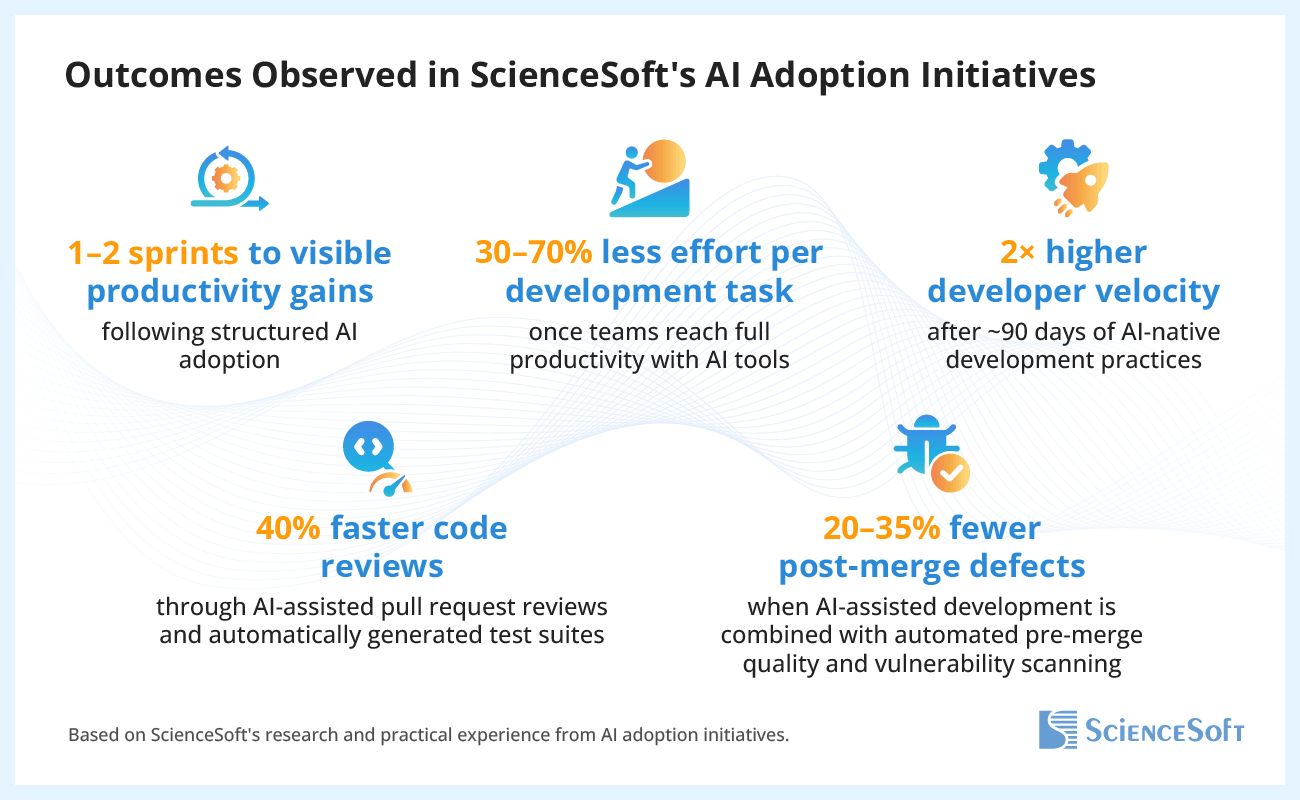
Where ScienceSoft Embeds AI Assistance Across the SDLC

Requirements clarification and story drafting
Code generation and refactoring

Test case generation and test data creation
Defect triage and root-cause analysis
CI/CD pipeline diagnostics
Release note generation

Incident summarization

Project documentation generation and management

Engineering knowledge retrieval (across codebases, documentation, tickets, repositories, etc.)
How ScienceSoft Can Help You Add AI to Your SDLC

AI readiness assessment
We review how your software delivery lifecycle operates. This includes evaluating how standardized and repeatable your delivery workflows are, how much work still depends on manual effort or individual expertise, and how well your toolchain is integrated and capable of producing structured, traceable data that AI systems can use effectively. We also analyze governance and control points within the SDLC to understand where decisions, approvals, and compliance checks are formally defined versus handled informally in practice. The assessment provides a clear view of your readiness for assistive AI, semi-automated workflows, or more advanced agent-driven delivery models, and highlights the gaps that need to be addressed before scaling AI across the SDLC.

AI opportunity mapping and prioritization
We identify and prioritize the highest-value opportunities for applying GenAI and automation across your software delivery lifecycle. This includes analyzing potential AI use cases across SDLC activities, evaluating expected business impact, implementation complexity, risks, and required levels of human oversight. We define where AI can augment teams, automate repetitive work, or enable new delivery models while establishing appropriate controls for quality, security, compliance, and accountability. The result is a practical AI adoption roadmap that helps organizations focus investments on the initiatives with the greatest productivity and business impact.

AI governance, compliance, and risk management
We define the enterprise-level control framework that ensures AI is used safely, securely, and in compliance with organizational and regulatory requirements. This includes approved AI tools, models, and access policies, protection of code, data, and intellectual property, as well as traceability and auditability of all AI-generated outputs. We also establish quality thresholds, fallback mechanisms, and compliance controls needed for regulated environments, ensuring AI adoption remains secure, auditable, and aligned with enterprise risk management standards.

AI-driven role and responsibility redesign
We redefine how SDLC roles operate when AI becomes part of everyday delivery processes. This includes identifying which activities can be accelerated or automated, which responsibilities shift, and what new skills teams need to work effectively with AI. For example, developers may use AI to generate code but remain responsible for reviewing, validating, and maintaining it, while QA engineers may use AI to create test scenarios but remain accountable for coverage, accuracy, and quality. The goal is to create a clear AI-enabled operating model where teams understand their evolving responsibilities.

AI tooling selection and integration
We help organizations select, integrate, and operationalize the right AI tools for their software delivery environment. This includes evaluating and recommending AI coding assistants, QA copilots, AI testing tools, and AI capabilities within DevOps platforms based on security, scalability, integration, and business requirements. We design how AI capabilities connect across the SDLC by integrating development environments, source code repositories, ticketing systems, documentation platforms, CI/CD pipelines, and observability tools, including custom integrations where needed. We also define reference architectures and adoption patterns for AI-enabled engineering workflows to ensure controlled implementation, avoid tool fragmentation, and enable consistent AI usage across delivery teams.

Enterprise AI gateway design and implementation
We help organizations establish secure control over how teams and applications interact with external AI models. This includes designing and implementing AI gateways that enforce AI usage policies, protect sensitive information through data filtering and masking, monitor AI activity, and provide visibility into AI adoption across the organization. Depending on the organization's risk profile, regulatory obligations, existing security stack, and AI adoption goals, the solution may be implemented using a combination of custom-developed components, existing security platforms, endpoint technologies, and cloud services (e.g., for telemetry analysis and visualization).

AI training and change enablement for software delivery teams
We help development teams build skills, workflows, and practices required for sustainable day-to-day AI use. Our practical workshops are tailored to specific roles, tools, and delivery scenarios. We measure adoption progress and help teams establish repeatable AI practices that deliver sustainable value.
What AI Adoption Goals Are You Working Toward?
Whether you are starting your AI transformation journey or looking to scale existing initiatives, we can help define the processes, tools, governance, and skills needed for successful AI adoption across the SDLC. Let’s discuss your objectives and co-shape a realistic plan tailored to your engineering environment. The consultation is free and non-binding.
Why Choose ScienceSoft
- Proven 7-week AI adoption program: a structured program refined through real-world delivery and validated through ScienceSoft’s internal initiatives and engagements with large product companies.
- Role-specific AI enablement: tailored learning paths for developers, QA engineers, DevOps engineers, architects, business analysts, product managers, and security specialists to ensure effective AI adoption across every SDLC function.
- Measurable AI adoption outcomes: weekly tracking of AI usage, productivity impact, and per-developer ROI to provide clear visibility into adoption progress and business value.
- 48 certified project managers backed by centralized insights from 4,300+ completed IT projects and with hands-on experience to coordinate AI-enabled delivery environments.
- Practical training programs designed to prepare engineering teams for AI certifications from leading providers such as Anthropic and OpenAI.
- 21 years in healthcare and insurance domains, meeting strict requirements for security, privacy, reliability, and auditability.
- 37 years in software development and enterprise-grade AI.
Partnerships and recognitions
Named among America’s Fastest-Growing Companies by Financial Times, 5 years in a row
Winner of two 2026 AI Leader Awards: Best AI Solution for Financial Services and Best AI Solution for Insurance
HTN Now Awards 2025/26 finalist in the Best AI Scribe Solution category

Shortlisted in the Best Use of AI for Healthcare category at The 2026 A.I. Awards

Claude Certified Services Partner
Microsoft Solutions Partner for Data & AI
AWS Partner since 2017

ISO 9001-certified quality management system
ISO 27001-certified security management system, extended with ISO 27701 privacy controls
What Our Clients Say



They’ve found answers to many undefined challenges and suggested dozens of impactful improvements for our IT environment. Everyone is always friendly, helpful, and ready to answer our questions. They also regularly ask for feedback to better cater to our needs, and that’s how I know this partnership will last.



They are knowledgeable, efficient, communicative, and are always able to provide a strong resource for any needs that arise. They are a very versatile company in terms of the range of services they provide. ScienceSoft is quite possibly the most beneficial outside resource we’ve ever had.


We know for sure that competent consultants can make a true difference for business decision-making, cut expenses and guarantee a product's marketability. That's what we expected from ScienceSoft, and they totally lived up to our expectations. Their consulting assistance was action-driven and brought a bunch of practical action points to us.
AI Technologies We Work With
The tools below are among those we most frequently recommend and implement in AI-intensive SDLC initiatives because they are mature, enterprise-ready, and well-suited for secure, governed AI adoption.
AI coding tools
- Claude Code
- GitHub Copilot Enterprise
- Codex
- Cursor
- JetBrains AI Assistant
LLM gateway and observability
- Kong AI Gateway
- LiteLLM
- Bifrost/Maxim AI
- Azure API Management
- Cloudflare AI Gateway
- Arize
- Galileo
- Helicone
Agent frameworks
- LangChain
- LangGraph
- OpenAI Agents SDK
- Microsoft Copilot Studio
Security
- Claude Code Security
- Snyk AI
- SonarQube AI code scanning
Recent Client Success Story
 AI Coding Enablement Helps a Global Technology Company Achieve Up to 50% Time Savings
 AI Coding Enablement Helps a Global Technology Company Achieve Up to 50% Time Savings
A global provider of leading digital tools engaged ScienceSoft to assess the business impact of AI-assisted software development in its complex engineering environment and establish a scalable approach to AI adoption across development teams. We designed and delivered a structured AI enablement program featuring real-world engineering scenarios, AI coding best practices, code validation techniques, and practical integration into existing development workflows.
Results across participating engineering teams:
-
61% adopted AI coding tools in their daily work.
- 52% reported 26–50%+ time savings across software development, research, and documentation tasks.
- 42% reported frequently obtaining AI-generated code that required only minimal edits.
- 87% supported expanding AI adoption across the organization.
- Feature development (68%) and debugging (55%) emerged as the primary AI use cases, demonstrating successful adoption in core software engineering activities.
FAQ
How do we adopt AI without pulling developers away from delivery?
ScienceSoft designs AI enablement around active engineering work, not separate from it. Our 7-week program fits into existing sprint cycles and focuses on immediate application: developers practice AI-assisted coding, refactoring, debugging, test creation, documentation, and code review using the tools they already use. The program combines 10 focused training modules with hands-on exercises based on real engineering scenarios, so teams build working habits rather than complete another theoretical training course.
How do we prevent AI from creating security, compliance, or data leakage risks?
ScienceSoft helps organizations establish controlled AI usage environments where security requirements are built into the way teams work. This can include private AI deployments or controlled access to enterprise LLMs through secure gateways, IDE integrations with approved AI tools, role-based access policies, and audit trails of AI usage. AI gateways can enforce which models employees can use, prevent sensitive information from being shared externally through data filtering and masking, and provide visibility into AI activity across teams.
How do we keep AI costs predictable as usage scales?
ScienceSoft helps organizations manage AI spending through architecture and usage optimization. This includes selecting the right models for different workloads, automatically routing lower-complexity tasks to more cost-efficient models, reducing unnecessary token consumption through prompt and context optimization, and providing cost visibility by team, project, or application. Regular usage analytics help engineering leaders understand where AI creates value and where optimization is needed.
How do we ensure AI adoption continues after the initial training?
ScienceSoft extends enablement beyond workshops with a structured adoption program. Over 90 days after training, we support teams through regular sessions with AI engineers, updated prompt and workflow playbooks, adoption analytics reviews with engineering leaders, and targeted coaching for teams or individuals with lower adoption levels.
Talk to Engineers Who Run AI-Intensive Software Delivery Environments
The first conversation is an opportunity to exchange ideas and concerns — no rigid agenda or commitment. We'll discuss your goals, key challenges, and trade-offs, and share practical results from implementing AI-powered software engineering practices across organizations. Together, we'll outline a realistic adoption plan tailored to your environment.