Healthcare
 Insurance
 Investment




Custom ETF Automation Software Supporting Compliant iNAV Disclosures
About Our Client
The Client is an asset management company focused on investment fund management, private equity investments, and discretionary portfolio management services.
ETF Market Entry Required Compliant iNAV Automation
The Client wanted to launch a locally traded exchange-traded fund (ETF) in the new market. To meet jurisdiction-specific regulatory rules, the company needed a reliable automation solution that would calculate the ETF's indicative net asset value (iNAV) and publish it to the Client’s investor-facing channels and local stock exchanges at a regulator-defined, near-real-time frequency. The Client also wanted to automate day-to-day ETF portfolio management and fund administration processes.
The Client sought professional consultancy to plan its ETF automation platform. ScienceSoft came across as a full-service technology partner with expertise in engineering custom investment software and digitally transforming ETF operations in the Client’s target region.
Practical Functional Design for an ETF Automation Platform
ScienceSoft’s investment IT consultants analyzed the Client’s planned ETF operations and automation needs. They studied the responsibilities of the intended platform users (portfolio managers, fund administrators, authorized participants, etc.) to shape role-specific ETF workflows, automation capabilities, and access permissions. The compliance consultant documented applicable regulatory rules and translated them into functional and technical requirements for the ETF solution.
Next, the consultants investigated workflow dependencies on the Client’s external partners (market data providers, broker-dealers, custodians, securities depositories), along with the required integrations. This helped identify operational and technology risks related to asset price data availability, iNAV publication, ETF trading, and underlying asset trading and address them early in the solution design.
ScienceSoft also assessed the capabilities of the Client's existing software systems. Doing this helped identify ETF processes that could be automated using already available tools. For example, the consultants suggested automating regulatory and investor reporting on ETF operations using the Client's existing reporting platform. Similarly, trading of ETFs' underlying assets could be handled through the Client's existing trading software. Effort-intensive custom engineering would then be limited to the tailored data integration pipelines.
Drawing on their findings, ScienceSoft's consultants proposed a practical functional scope for the ETF automation platform. They prioritized capabilities that would eliminate low-value manual routines, improve the efficiency of complex ETF operations, and simplify regulatory compliance without compromising human control over sensitive decisions and actions:
ETF basket management
The solution would automatically research the Client’s target indices and construct baseline ETF baskets based on predefined index replication strategies and asset diversification rules. It would track changes in index constituents and propose corresponding adjustments to basket composition.
iNAV calculation and publishing
The solution would retrieve up-to-date prices for the ETF's underlying assets from the Client’s market data provider. It would calculate iNAV and publish updated figures to the Client’s investor apps and local stock exchanges every 15 seconds during trading hours, as required by the regulator. It would also log source price data and iNAV disclosure details to support troubleshooting and provide evidence of compliant publication frequency.
ETF creation and redemption
The solution would automatically process ETF creation and redemption requests from authorized participants (APs). It would capture basket specifications and generate transaction instructions for fund administrator approval. Upon approval, the system would send instructions to custodians and depositories and issue transaction confirmations to APs.
ETF portfolio management
The solution would monitor intraday holdings and positions across the Client’s ETF portfolio and individual ETFs. It would identify deviations from investment objectives, target limits, and asset weights and dynamically generate rebalancing proposals. Portfolio managers would be able to configure automation rules for selected ETF portfolio allocation and rebalancing strategies.
Fund administration
The solution would automate routine administrative tasks such as tracking ETF capital flows and corporate actions, calculating servicing fees, and maintaining fund accounting records. It would also reconcile financial and transaction data and flag discrepancies and exceptions for fund administrator review.
Risk and compliance management
The solution would provide interactive dashboards with drill-down capabilities for the Client's teams to monitor ETF risks at the portfolio, holding, and transaction levels. It would calculate and track selected risk indicators and alert risk managers to growing exposures. The software would also monitor ETF operations and transactions for compliance with the Client's internal policies and regulatory rules.
ETF workflow orchestration
The solution would coordinate multi-step ETF workflows within individual functional areas (iNAV calculation, portfolio management, etc.) and across them based on predefined rules. It would route tasks and data between processes, trigger automation workflows, and assign tasks requiring manual handling to the responsible employees.
Architecture Built Around the Client’s Business Priorities
ScienceSoft's architect suggested applying a cloud-based modular, layered architecture for the Client’s ETF platform. The proposed design would address several technical and business priorities critical to the Client’s local ETF operations.
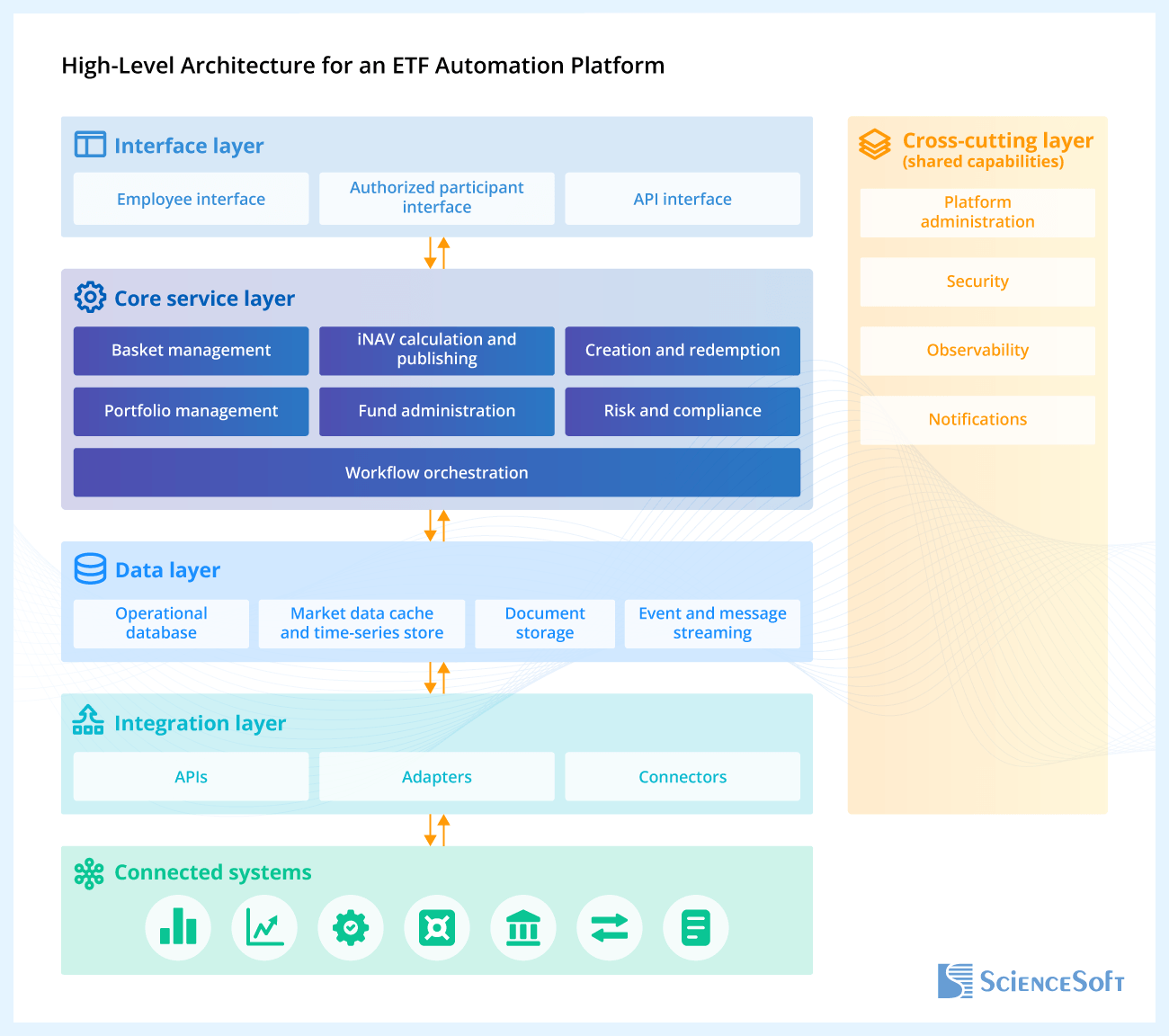
Operational resilience
The layered design would separate core workflow automation components from user interfaces, data storages, and integrations. This would reduce the risk of changes or failures in connected systems and user-facing applications disrupting time-sensitive ETF operations. It would also allow the Client to expand each layer without redesigning the entire solution. For example, the company could connect new brokers without modifying the core ETF automation logic, or introduce new features without changing existing integrations.
Fast time to market
With the modular, microservices-based architecture, the engineering team would be able to build and update individual solution components within each layer independently. This would allow engineers to introduce critical functionality first and then gradually expand the platform's capabilities. For the Client, this would mean entering the new ETF market faster by launching the regulator-required iNAV capabilities before completing the full platform.
High performance without overspending
The modular structure would let engineers choose the best-performing and most economical technologies for individual components instead of applying a unified tech stack. The engineers would also be able to cover selected functions through integrated ready-made services where applicable to reduce development costs.
Modularity would also allow the Client to calibrate computing resources according to each component's workload. For example, the company could allocate minimal processing power to less demanding routine approval workflows and significantly more capacity to computation-intensive iNAV calculations. This would help maintain consistently high platform performance and avoid paying for idle capacity.
Low-latency, highly available iNAV automation
To support compliant iNAV updates during trading hours, ScienceSoft’s architect prioritized low-latency data processing and high availability for the iNAV automation component. The architect proposed applying caching and data partitioning mechanisms to speed up processing. Adding multiple application instances and load balancing would help distribute processing workloads and maintain service availability during peak activity. Horizontal autoscaling would automatically adjust computing capacity to handle workload spikes and support long-term growth as the Client launched more ETFs.
Data accessibility
ScienceSoft suggested using different types of data storage to match the performance needs of individual platform components and optimize storage costs. The architect designed the platform to use fast-access storage for frequently updated market data and cheaper static databases for historical ETF transaction records. The expert also outlined workable backup and recovery mechanisms, including database recovery and failover arrangements.
Security of ETF data and operations
For security, the architect proposed encrypting sensitive investment data in transit and at rest to protect it from unauthorized disclosure. Multi-factor user authentication and role-based access controls would restrict access to ETF data and functions according to user responsibilities, helping prevent unauthorized changes to valuation settings, portfolio rules, and transaction approvals. The proposed architecture also included secure management of system credentials to reduce the risk of unauthorized system access, and protection against common application and network attacks to prevent data breaches and service disruptions.
Cost-effective infrastructure management
The cloud-native architecture would give the Client access to managed cloud infrastructure services and remove routine infrastructure administration and maintenance tasks. This would reduce the workload on the Client's IT team and free resources for maintaining and improving ETF-specific functionality.
Implementation Roadmap Prioritizing Time-Critical Deliverables
ScienceSoft's project manager reviewed the Client's functional priorities and proposed organizing ETF automation platform delivery into two streams:
- iNAV automation. The development team would implement iNAV calculation and publication capabilities, including the necessary data storage, integrations, and risk and compliance components. Prioritizing this functionality would help the Client meet regulatory requirements and launch its ETF without waiting for the full platform.
- Broader ETF operations automation. The team would gradually introduce ETF basket management, creation and redemption, portfolio management, fund administration, and workflow orchestration components. The gradual rollout would let the Client prioritize automation capabilities with the greatest operational impact, validate each set of capabilities with business users, and refine subsequent releases based on user feedback. It would also reduce the implementation and integration risks of introducing multiple complex workflows and system connections at once.
The project manager also proposed a suitable team composition for each delivery stream and prepared preliminary estimates of the project timelines and costs.
ScienceSoft recommended an iterative development approach based on the Scrum methodology, with iterations lasting two to four weeks. Frequent demonstrations and reviews of deliverables would allow the Client to assess working functionality, provide feedback, and adjust upcoming priorities without waiting for major releases. This flexibility would be particularly valuable for the broader ETF automation stream, where operational and integration requirements could evolve as the project progressed.
Foundation for Compliant and Scalable ETF Operations
ScienceSoft developed a functional design, architecture, and implementation roadmap for a custom ETF automation platform, giving the Client a clear technical and investment plan for launching compliant iNAV functionality. The proposed architecture would support low-latency, scalable, and secure ETF operations. The recommended component-specific technologies, calibrated computing resources, and managed infrastructure services would help the Client reduce platform engineering and operating costs.
Once deployed, the platform would help the Client:
- Speed up ETF launch by introducing compliance-critical iNAV calculation and publication capabilities ahead of the broader automation platform.
- Increase operational efficiency by automating ETF management processes and coordinating workflows across teams and systems.
- Minimize operational and compliance risks through regulation-aligned iNAV disclosures, automated controls, and fewer manual data transfers.
- Scale its ETF business more efficiently by accommodating growing transaction volumes without proportionally increasing headcount.