 ScienceSoft Global



How AI Is Reshaping Revenue Cycle Management: From Denial Prevention to Smarter Billing Operations

Related topics:
6 min read
Last updated:
Editor's note: Hadeel explores how AI is reshaping revenue cycle management in practical, high-impact areas, including front-end verification, coding, and denial prevention. She looks at the operational failures AI can address, the results early adopters are seeing, and the governance and data challenges healthcare organizations need to account for.
Introduction: The RCM Inflection Point
Revenue cycle management has always been expensive to run poorly. What has changed is that the cost of running it manually, in denials absorbed, staff hours lost, and revenue left uncollected, is now measurable enough that it can no longer be treated as acceptable overhead.
The American Hospital Association estimates hospitals spend more than $43 billion annually on administrative billing and insurance costs, losses driven not by complexity alone, but by predictable, recurring workflow failures. What follows is a stage-by-stage breakdown of where AI works, how workflows change, and what the evidence shows.
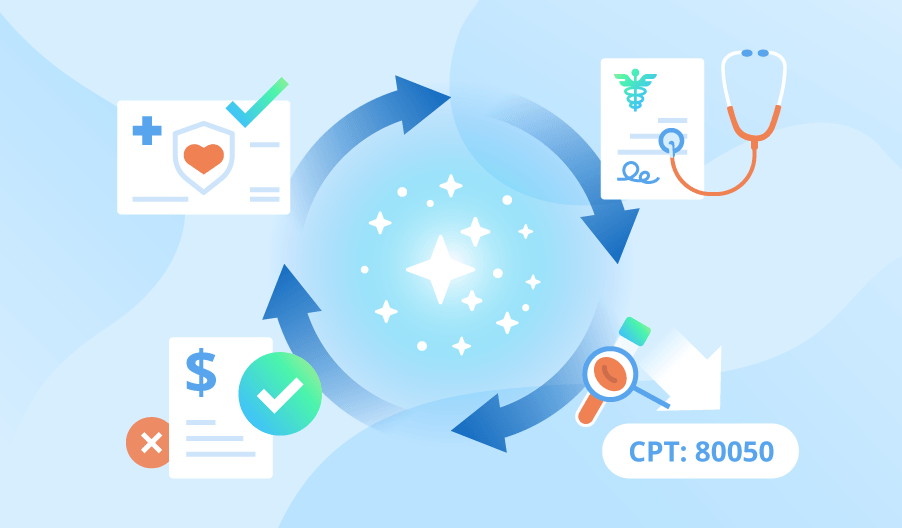
The State of RCM Before AI and Why It Broke
Most RCM failures are predictable. They cluster around a small number of recurring problems that manual processes handle inconsistently:
- Eligibility mismatches are among the most common sources of front-end denials. When insurance coverage is verified manually at registration, often against a single payer response without cross-checking current plan rules, prior encounter history, or authorization requirements, errors pass through to claim creation. Experian Health's 2025 State of Claims data found that at least one in ten denials at 26% of practices trace directly to intake errors: wrong policy numbers, outdated insurance cards, and missed eligibility rechecks.
- Prior authorization creates a different kind of drag. A 2025 AMA survey found that physicians and staff spend an average of nearly 13 hours per week managing prior authorizations, time spent navigating payer-specific portals, compiling clinical documentation, and following up on pending requests, often for services that could have been flagged and resolved before the appointment.
- Coding and documentation gaps create revenue loss that is harder to detect. A missing diagnosis code, an unsupported modifier, or a procedure documented in clinical notes but not captured in the billing system all result in underpayment without generating an obvious denial. Leveraging cloud-based medical billing software can help ensure that all documented services are accurately captured and translated into billable codes, reducing the risk of silent revenue leakage.
- Unworked denials represent the largest avoidable loss. Research cited by Becker's Hospital Review indicates nearly 65% of denied claims are never reworked. With a typical first submission denial rate of 10–15% as per HFMA, a substantial share of revenue is written off not because it was unrecoverable, but because staff lacked bandwidth to pursue it.
Where AI Is Making the Biggest Impact in 2026
Front end: eligibility verification and prior authorization
Problem
A single eligibility check at registration does not catch mid-cycle coverage changes, plan-specific authorization requirements, or coordination-of-benefits issues. Errors identified only after claim submission require full rework.
How AI is applied
AI-powered eligibility tools cross-reference the scheduled service against real-time payer eligibility responses, current plan rules, and the patient's prior encounter history simultaneously, before the appointment occurs. Rather than returning a binary "covered/not covered" result, they flag specific mismatches: a service that requires authorization under the patient's current plan, a coverage change since the last visit, or a coordination-of-benefits conflict with a secondary insurer. Staff receive an exceptional queue of actionable issues rather than reviewing every case from scratch.
For prior authorization, AI tools analyze payer-specific documentation requirements by service type, predict approval likelihood from historical submission patterns, and auto-populate authorization forms using data already in the EHR, reducing manual composition.
Operational result
Issues are corrected before claim creation, eliminating the rework cycle entirely. Staff time shifts from full case review to resolving flagged exceptions only.
Business result
Practices implementing AI-supported eligibility verification have reported cutting denial rates by as much as 42%, according to Experian Health case data. The 2024 CAQH Index places the industry-wide savings opportunity from automating eligibility and prior authorization transactions at $20 billion annually.
Mid-cycle: coding and clinical documentation
Problem
Coders translating physician notes into ICD-10 diagnoses, CPT procedure codes, and modifier combinations work under volume pressure that creates errors in both directions: overcoding that invites audit and undercoding that leaves revenue on the table. When clinical documentation is incomplete or ambiguous, coders either query the physician (adding delay) or make a conservative assignment that may not fully capture the care provided.
How AI is applied
NLP-based coding tools parse physician notes, operative reports, and discharge summaries to surface relevant billing codes and flag documentation gaps before the claim is built. Specifically, they identify ICD-10 codes supported by documentation the coder may not have reached; CPT codes for procedures documented in clinical notes but not explicitly ordered in the billing system; inconsistencies between diagnoses across a patient encounter; and documentation gaps that are likely to trigger a denial or audit under a specific payer's rules. The coder reviews and confirms rather than building from scratch.
Operational and business result
Auburn Community Hospital, a 99-bed independent rural access hospital in New York, implemented AI-assisted coding using NLP and machine learning and, without adding staff, achieved a 50% reduction in “discharged not final billed” cases, a 40%+ improvement in coder productivity, and a 4.6% increase in case mix index. The financial impact exceeded $1 million, a more than 10x return on investment.
Back end: denial prevention and management
This is where AI has the highest ceiling, and where most organizations are furthest from realizing it.
Problem
A 10–15% first-submission denial rate is common across the industry. As per HFMA research, the majority are never reworked, not because they are unrecoverable, but because staff cannot triage and prioritize fast enough to pursue every case before payer timelines close.
How AI is applied (prevention)
Machine learning models trained on historical claims data score incoming claims for denial risk before submission. Critically, they distinguish between denial categories that are suitable for automated prevention and those that require human judgment:
- Eligibility-related denials (wrong plan on file, lapsed coverage, missing authorization) are detectable at preservice and highly automatable.
- Technical denials caused by billing format errors, missing fields, or incorrect modifiers are detectable with pre-submission claim scrubbing.
- Payer-specific pattern denials, where a specific payer consistently rejects a CPT code without a particular modifier or denies a service category when documentation does not match its internal criteria, are learnable from historical remittance data and can be flagged before submission.
- Clinical denials based on medical necessity criteria still require physician documentation and clinical expertise to appeal. AI can surface relevant documentation and flag the case, but the appeal judgment belongs to the clinician.
How AI is applied (rework prioritization)
When denials do occur, AI can score them by recovery likelihood and financial value, allowing denial management teams to work on the highest value, most recoverable cases first, rather than processing them in arrival order. Generative AI tools can draft payer-specific appeal letters from denial codes and clinical documentation, reducing the manual composition burden on billing staff.
Business result
McKinsey estimates that advanced automation in denial management can reduce the cost to collect by 30–60% at scale. A community health network in Fresno, California, deploying pre-submission AI review, achieved a 22% decrease in prior-authorization denials and an 18% decrease in coverage-related denials, saving 30 to 35 staff hours per week in back-end appeals without adding headcount.
Technologies Powering the Transformation
Four technologies do most of the work, each mapped to a specific RCM workflow:
NLP
Extracts relevant medical billing information from unstructured clinical documentation, physician notes, discharge summaries, and operative reports, and converts it into structured codes and documentation gap flags. Its primary RCM application is coding support and clinical documentation integrity.
Machine learning
Analyzes historical claims, remittance data, and payer adjudication patterns to predict denial risk, score recovery likelihood, and detect payer behavior shifts. It is the core engine behind denial prediction and claims prioritization.
RPA
Handles high-volume, rule-based tasks with no clinical content: submitting claims to payer portals, retrieving claim status, posting payments, and routing work based on claim characteristics. McKinsey estimates that AI-driven automation improves productivity in these administrative workflows by 15–30%.
Generative AI
Drafts appeal letters, prior authorization narratives, and patient communications based on denial codes and payer-specific requirements, converting what was a 30–60-minute manual task into a human-reviewed draft generated in seconds.
Challenges and Considerations
Data quality undermines model performance at the source
AI denial prediction models are only as accurate as the historical claims data they train on. In health systems with inconsistent coding practices or data that varies across EHR migrations, the model trains on patterns reflecting past process failures rather than actual payer behavior. Auditing and standardizing historical claims data should be a prerequisite, not an afterthought.
Payer fragmentation increases deployment complexity
A denial prediction model that performs well against one payer's claims may not generalize to another without retraining on payer-specific adjudication data. Different portal formats, documentation thresholds, and modifier tolerance across payers raise integration costs and extend time to value.
Model transparency is non-negotiable in financial decisions
When an AI model flags a claim as high denial risk or recommends withholding a prior authorization submission, the rationale must be auditable. Black-box recommendations are hard to trust, difficult to appeal if wrong, and potentially non-compliant with HIPAA's data governance requirements. Governance protocols need to specify which recommendations require human sign-off before action.
Certain decisions should not be automated
Medical necessity determinations, clinical denial appeals, and disputed patient financial liability all require human accountability. The most effective implementations treat AI as a decision-support layer here, surfacing relevant documentation and flagging risk, while keeping qualified staff responsible for the final judgment.
What Leading Health Systems Are Doing Differently
The pattern across health systems seeing measurable results is consistent: they start with a bounded use case, measure against a baseline, and expand only from demonstrated outcomes.
Banner Health (Arizona, California, Colorado) automated insurance coverage discovery using AI bots that integrate coverage data directly into patient accounts. Separate bots manage payer documentation requests, generate appeal letters from specific denial codes, and run a predictive model to assess whether a write-off is justified –– discrete, measurable use cases rather than enterprise-wide transformation.
Auburn Community Hospital (New York) began with AI-assisted coding during the ICD-10 transition and expanded from there, adding service lines without adding coding staff and generating a $1M+ financial impact with a more than 10x return on investment.
What's Next and Where to Start
The three highest value entry points today are front-end eligibility verification, NLP-assisted coding, and pre-submission denial prediction. Each has a documented failure mode, published results, and a clear ROI case. None requires enterprise-wide transformation to deploy.
The next layer is agentic AI, systems that execute multi-step workflows autonomously, without a human handoff between stages. McKinsey's January 2026 analysis puts the near-term focus on back-end functions: AR follow-up, denial management, and underpayment recovery. TechTarget reports that major vendors are already shipping agentic features, though full end-to-end autonomy remains three to five years out. CMS's January 2027 FHIR mandate should reduce payer fragmentation, which currently slows deployment.
The conditions for success are the same at every stage: clean data, clear governance over what AI decides versus what humans must, and staff repositioned toward judgment rather than processing. Organizations treating this as a software purchase rather than a workflow redesign consistently underperform. The gap is widening, and it compounds.
References
- American Hospital Association
- AMA Prior Authorization Survey 2025
- Becker's Hospital Review
- CAQH Index 2024
- Experian Health / Medical Economics 2025
- HFMA – Denials Management
- HFMA – Applying AI to RCM
- McKinsey – Transforming Healthcare with AI
- McKinsey – Agentic AI and the Touchless Revenue Cycle
- AHA Center for Health Innovation
- AGS Health – Auburn Community Hospital Case Study
- TechTarget – Agentic AI in Revenue Cycle
