 ScienceSoft Global



Practical Ways to Speed Up Insurance Policy Administration Workflows
Policy administration delays can stem from manual data processing and communication, slow task handoffs, or poor PAS performance. As an AI transformation and software engineering company serving the insurance industry since 2012, ScienceSoft can help insurers identify the causes of slow policy processing and address them through practical technology solutions.

ScienceSoft: Making Policy Administration Work Faster Despite the Friction
- Delivering digital transformation for the insurance industry since 2012.
- Proficiency in technologies driving faster policy administration (AI/ML, RPA, BPM).
- Insurance IT, AI, and compliance consultants with 5–20 years in their fields.
- 30+ principal and senior architects with hands-on experience in designing complex policy administration solutions.
- 45+ certified project managers (PMP, PSM I, PSPO I, ICP-APM) who succeeded in large-scale projects for Fortune 500 firms.
- Expertise in insurance regulations (NAIC, state DOI rules), data exchange and interoperability standards (incl. ACORD), and data protection frameworks (GLBA, HIPAA, GDPR, and more).
- Established delivery practices to ensure the high quality of policy service AI transformation programs and their delivery on the agreed timelines and budget.









Business Costs of Slow Insurance Policy Administration
Manual data and document processing, repeated back-and-forth with customers and brokers, and employee-led task handoffs can significantly prolong policy transaction cycle times. PwC describes these routines as a “hidden tax”: necessary activities that consume time and effort without adding comparable business value. This operational drag limits policy administrators’ capacity and drives up staffing costs: some insurers that have turned to ScienceSoft for help with persistent process bottlenecks said they had to add staff simply to keep up with growing policy transaction backlogs. Slow policy processing also means longer waits for customers and brokers, eroding their experience and increasing lapse risk.
Inefficient or legacy policy administration systems (PAS) often act as another source of friction because they force administrators to handle unsupported transactions manually, re-enter data across systems, and repeat failed operations. Industry studies illustrate the scale of the problem: a 2026 report by RSM US LLP estimates that manual workarounds and resulting data latency in software-supported policy workflows can cost midsize specialty P&C insurers more than $1 million annually. The same report found that 52% of policy administration processes at midmarket specialty P&C still require manual intervention.
Why Insurance Policy Administration Still Takes So Much Time
From ScienceSoft’s experience, manual policy work usually accumulates in non-standard or exception-heavy workflows that legacy PAS platforms do not handle well. This challenge is widespread across the industry, as 74% of insurance companies still use outdated technology in core operations.
Below, ScienceSoft’s consultants outline six bottlenecks commonly found in legacy or fragmented policy administration setups:

Manual data processing
Policy administrators need to read and interpret policy requests, reconcile data against policy records, and prepare policy documents. Much of this routine still requires manual processing, especially when data comes in unstructured or semi-structured formats.

Staff-led communications
Policy requests arriving through email or call centers often require administrators to manually capture and register the details. If a request is incomplete or needs clarification, even a routine transaction can turn into several rounds of manual back-and-forth with the customer or broker.

Rules not supported by PAS
Packaged policy systems may not support an insurer’s specific products, coverage terms, or transaction variations. Even relatively simple tasks that fall outside standard digital workflows may therefore require manual handling.

Scattered policy data
The data, rules, and knowledge needed to process a policy transaction may sit across multiple servicing and enterprise systems. Without unified access to this information, teams have to search across sources and manually piece together context.

Double data entry
Policy platforms and surrounding systems may not exchange data automatically, forcing employees to enter the same data in multiple systems and reconcile records after updates. Poor integration can also delay data syncing and force teams to manually check policy task statuses and ownership.

Manual task coordination
Software may support individual policy administration tasks, but coordination between them remains manual. Administrators still have to define what happens next, assign work, notify other teams, monitor progress, and follow up. As a result, time is lost between otherwise automated steps.
First, Find Out Where the Policy Administration Time Goes
Improving task automation may bring little value when delays mainly occur at handoffs, just as improving handoffs won’t help if individual tasks are the bottleneck. Identifying exactly where policy processing slows down is therefore essential to make targeted fixes and avoid unnecessary investments.
ScienceSoft’s consultants recommend starting with one representative type of slow policy transaction — for example, customer-requested changes or renewals — and breaking its total turnaround time into individual stages. Timestamps from workflow and communication systems for a small sample of historical cases can usually provide the necessary timing data.
Look at four key metrics:
- End-to-end turnaround time: Time from receiving a policy servicing request to completing the transaction.
- Active handling time: Time administrators spend working on the case, ideally broken down by intake, data entry, decision-making, and communication to pinpoint the most labor-intensive tasks. Also measure processing time for automated steps to identify software performance bottlenecks.
- Waiting time: How long a case sits between processing steps or waits for another team or system.
- Exception and rework rates: How often cases require manual intervention, overrides, or repeat processing.
Compare these measurements with your standard workflow time estimates to see where delays concentrate. Depending on the findings, consider investigating improvement options across the following technology areas:
| What the measurements show | First area to investigate |
|---|---|
|
What the measurements show
High manual handling time at case intake |
First area to investigate
|
|
What the measurements show
Frequent exceptions, lengthy case decision-making |
First area to investigate
|
|
What the measurements show
Repeated data entry and reconciliation |
First area to investigate
|
|
What the measurements show
Slow automated processing, frequent system errors |
First area to investigate
|
|
What the measurements show
Long idle periods between otherwise quick steps |
First area to investigate
|
Practical Paths to Faster Insurance Policy Administration
Below, ScienceSoft outlines four common starting points and the technology strategies we typically recommend for accelerating policy workflows in each case.
1. Introduce policy self-service for customers and brokers
Best when: Administrators spend a lot of time on policy request intake because requests mostly arrive through email, call centers, or in-person visits.
In ScienceSoft’s insurance transformation projects, we’ve seen customer self-service move up to 50% of routine request intake outside employee workload. Instead of needing staff to manually enter request details and answer status inquiries, customers and brokers can do that themselves through guided workflows.
Strong early directions for customer self-service include checking transaction status, retrieving policy documents, changing contact or address details, and submitting requested documents. These high-volume interactions consume a lot of policy administrators’ time but are standardized enough to handle through forms and rules.
If you already have customer self-service platforms (portals, apps), ScienceSoft can add missing policy workflows there. If you don’t yet offer digital self-service, we can implement a suitable white-label solution or build a custom one where packaged products don’t fit your workflows. In either case, we connect the self-service layer to your policy recordkeeping platform. This lets submitted data enter policy workflows without manual re-entry and gives customers and brokers access to current policy information.
For brokers, the priority is often efficient bulk submissions and compliant electronic exchange of policy data. To enable this, ScienceSoft can integrate your policy platform with broker systems and implement system-to-system data exchange using industry standards such as ACORD.
Key challenge: Users may still need assistance to complete self-service requests correctly
Customers and brokers may still have additional questions or encounter unexpected problems during self-service, no matter how convenient your submission forms and workflows are. Policy administrators may still need to step in and assist.
Mitigation strategy
Mitigation strategy
Consider adding an AI assistant. It can guide customers through available policy services, help them navigate forms and policy data, and immediately answer simple questions. Insurance organizations relying on AI assistants to handle routine customer inquiries achieve, on average, 60% faster response times. The assistant can also fill out policy request forms based on free-form inquiries and prompt users for missing information, minimizing time-consuming follow-ups. If the assistant cannot confidently answer a question or the user requests human assistance, it can transfer the case with the conversation context to the appropriate specialist.
ScienceSoft can connect the assistant to your policy servicing knowledge through retrieval-augmented generation (RAG) and to structured policy data through APIs. This grounds responses in your internal knowledge and data sources without retraining the underlying AI models. AI monitoring tools and clear human escalation processes help keep the assistant within defined service boundaries.
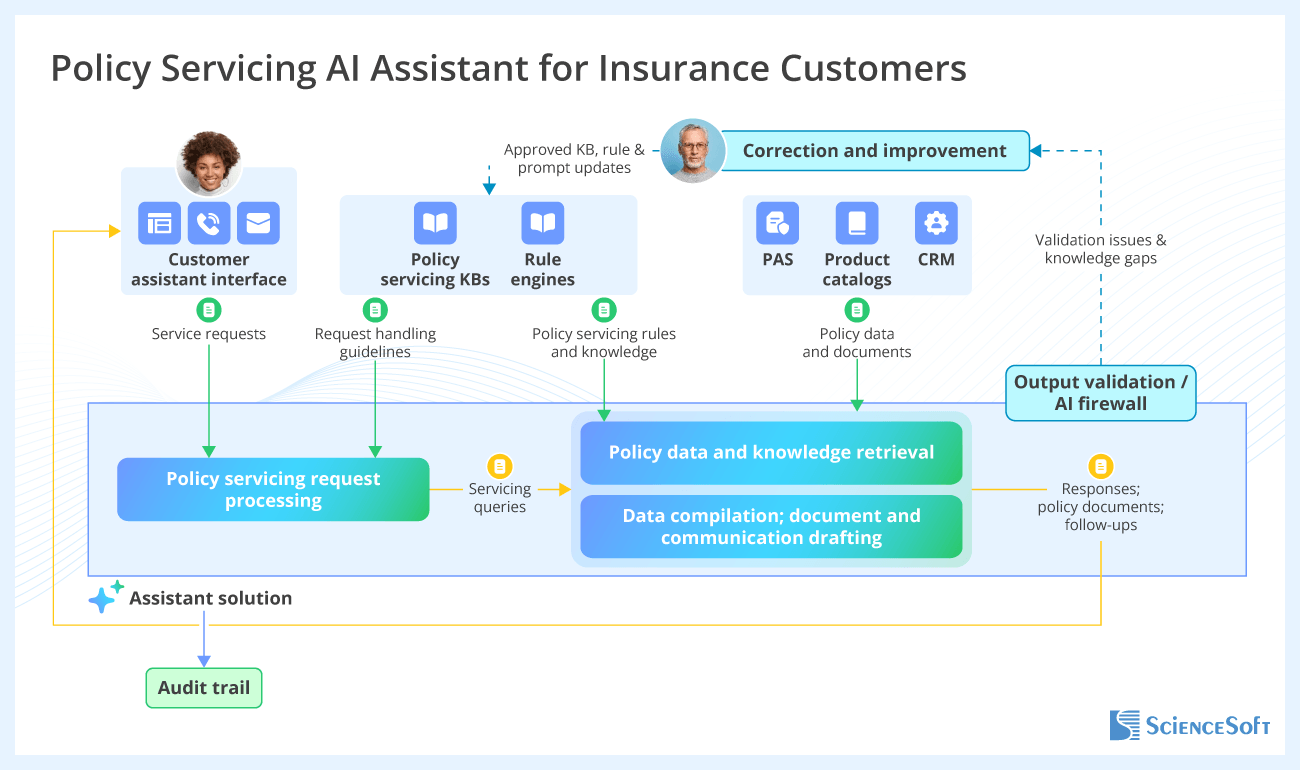
Sample business architecture for a customer-facing policy servicing AI assistant. For the underlying technical architecture, see our dedicated page.
Hide
Implementation timelines: 6–12 weeks to add a focused set of policy self-service workflows to an existing portal or app; 3–8 months to implement a new self-service solution with PAS integration. A self-service AI assistant can be introduced within 2–6 months once the required policy data and knowledge sources are accessible.
2. Add tailored policy admin workflows to your PAS
Best when: Policy processing requires manual workarounds because the PAS doesn’t support specific products, processes, or integrations.
One common source of manual policy administration work is specific lines of business, products, and transaction types that aren’t represented in the current PAS setup. For example, a PAS may support commercial P&C broadly but lack dedicated workflows for niche lines like inland marine or energy E&O, or it may struggle to accommodate insurer-specific eligibility and referral checks for non-standard products like parametric insurance. For these predictable policy tasks, ScienceSoft can build rule-based automation features. This frees administrators from time-consuming calculations, routing, approvals, document generation, and other predefined processing steps.
If employees still have to manually transfer data between systems, ScienceSoft prioritizes integration. This automates policy data and transaction updates, eliminating repeated data entry, reconciliation, and associated wait times. ScienceSoft can connect a PAS to CRM, underwriting platforms, billing tools, payment utilities, and other required systems. We use APIs and event-driven integrations where the systems support them and apply middleware and custom integration layers to connect legacy platforms.
Another common problem is time-consuming processing of unstructured data — policy requests, documents, communications — which older PAS platforms typically cannot handle. Where the existing PAS falls short, ScienceSoft can add the necessary AI capabilities. Depending on the task, we can implement large language models (LLMs) to extract and validate information from documents and media files, machine learning (ML) models to classify and triage policy requests, or specialized AI algorithms like computer vision to analyze images and e-signatures. Early adopters of such tools in insurance policy administration report up to 98% quicker policy data intake and 55%+ faster turnaround for customer-initiated policy adjustments.
When adding new functions to a PAS, ScienceSoft’s architects usually keep them modular and loosely coupled to the core platform. This design limits changes to the software core, reduces the risk of disrupting existing automation logic and data flows, and makes individual components easier to modify and replace as your requirements change. It also lets you introduce new capabilities incrementally and realize benefits earlier than with a full-scale software rebuild. This is part of ScienceSoft’s broader approach to improving the accuracy and extending the useful life of high-stakes financial applications.

Don’t build what your PAS can already do
Packaged PAS platforms are quite capable today. Depending on the product, you may already have configurable rules, ML models, generative AI tools, and so on. So if we needed to speed up policy administration, our first step would be to look at what the client’s existing PAS provides and whether we can use it better. That’s usually the quickest and least disruptive route.
Fully custom development is justified when a commercial PAS can’t accommodate your workflows well enough through configuration — for example, when its ML models don’t work reliably on your documents, or its rule engine can’t handle your specific compliance logic. But even then, we don’t have to build a lot from scratch. If there are mature technology frameworks, reusable components, commercial LLMs, or third-party APIs that fit the job, we use them. It cuts engineering effort and gets the new capability into production faster.
And some capabilities really don’t need to be custom-built. For fairly standardized functions like e-signing, identity verification, or document generation, integrating a specialized service is often more practical. Similarly, when the bottleneck sits between systems, we typically integrate an external DPA/RPA platform. That gives us a cost-effective automation layer that handles cross-system routines without pushing more custom logic into the PAS.
Key challenge: Policy administrators may still lose much time on complex cases
Complex policy transactions may still require administrators to interpret the case and decide how to proceed. This often means finding the necessary context across multiple sources, which can take significant time, especially when information is scattered.
Mitigation strategy
Mitigation strategy
Adding an AI copilot for policy administrators can help employees get the context they need faster while retaining control over decisions and policy-changing actions. The copilot can retrieve relevant policy terms and transaction history from insurance systems, find applicable product and servicing rules in connected knowledge bases, summarize prior communications, flag conflicting data, and recommend possible next steps. AI assistance can potentially free up to 60% of policy administrators’ daily work time — the median share insurance teams spend searching for data.
Like customer-facing AI assistants, employee copilots need RAG and API layers to access up-to-date policy knowledge and structured data. For copilots, however, ScienceSoft puts extra emphasis on output verification. We instruct the copilot to provide source links for its answers, flag missing evidence, and distinguish retrieved facts from AI-produced suggestions; prompt engineering provides a cost-effective way to do that. We also implement validation tools that independently check the AI’s output for accuracy and relevance before showing it to employees. These controls help policy administrators verify the information behind the copilot’s recommendations before acting on them, reducing the risk of inaccurate or non-compliant decisions.
Hide
Implementation timelines: 4–10 weeks to add or configure a small automated workflow in the existing PAS; 6–16 weeks for an AI-powered data processing pipeline; 4–12 weeks for a contained integration. Launching a policy administration AI copilot typically takes 3–6 months. An automation program spanning several additional workflows is usually rolled out incrementally over 5–9+ months.
3. Modernize your slow policy software
Best when: Routine policy transactions take too long because of poor PAS performance.
If your PAS is becoming noticeably slower at processing data, loading policy records, generating documents, or completing other routine tasks, consider modernization before these issues turn critical.
For packaged PAS platforms, ScienceSoft pursues performance enhancements that don’t require access to the source code. Depending on vendor restrictions and the environment you control, we may optimize infrastructure, improve integrations, adjust system configuration, or implement vendor-supported extensions.
When working with custom PAS systems, ScienceSoft first audits the software’s codebase, architecture, integrations, and technology stack. Based on the findings, our experts identify performance constraints and prioritize targeted improvements. Depending on the root cause, we may refactor inefficient code, modernize the tech stack, optimize database structures and queries, or upgrade individual features. Where issues stem from fundamental limitations in the technical design, the PAS may require broader transformation, such as rearchitecting or infrastructure migration (explore what we do across different revamp directions).
In ScienceSoft’s projects, even narrow-scoped software modernization has delivered measurable speed gains across insurance workflows. One of our P&C clients experienced frequent operational delays due to the degrading performance of its custom insurance platform. Targeted improvements to data querying and caching, database design, document indexing, and data processing logic alone made software-supported operations 2.5–75x faster.
Key challenge: poor modernization estimates may lead to excessive spending
PAS performance problems that initially seem isolated may stem from deeper issues in the architecture, code, or infrastructure. If you miss these dependencies at the planning stage, the required scope and budget may expand mid-project. By then, PAS replacement, which might have been cheaper, may no longer be a practical option because too much money already went into modernization.
Mitigation strategy
Mitigation strategy
To scope and estimate a custom PAS revamp realistically, ScienceSoft factors in both explicit modernization work — code refactoring, component upgrades, rearchitecting, and so on — and less apparent expenses. The latter may include adapting existing integrations, cleaning up technical debt, running regression testing, and operating old and modernized components in parallel during transition. We then compare the costs of PAS revamp to replacement and pinpoint the better path.
The replacement estimate should be equally comprehensive. From ScienceSoft’s experience, implementing a new PAS may look cheaper at the software level but introduce substantial costs for data migration, integrations, configuration, and parallel operation during cutover. For realistic coverage, our feasibility assessments typically compare revamping the existing PAS, replacing it with a custom-built system, and implementing a packaged PAS.
Where the modernization case still carries much uncertainty, ScienceSoft may start with a proof of concept (PoC) focused on a representative performance bottleneck. This helps validate the assumed technical solution and check real speed gains before scaling the revamp. In the project described above, starting with a PoC for insurance reporting speed improvements gave the client confidence to commit to broader system modernization.
Hide
Implementation timelines: targeted performance improvements can take 4–12 weeks; broader PAS revamp involving multiple components is typically delivered incrementally and may take 3–15+ months, depending on the modernization scope.
4. Implement policy workflow orchestration
Best when: Policy transactions face long delays between processing steps because task handoffs and follow-ups are coordinated manually.
If all your individual systems and policy processing steps work efficiently but the connected workflow still takes too long, you likely need to automate some of the transitional work between steps. An orchestration layer can help coordinate policy work across systems and employees, reducing idle time between activities. It can automatically create and assign tasks, trigger the next system action, request approvals, notify responsible employees, enforce deadlines, and escalate overdue work. Depending on how predictable a policy workflow is, you can use rule-based automation or agentic AI orchestration.
ScienceSoft recommends rule-based orchestration wherever the sequence of actions and conditions is known in advance. From our experience, the biggest early time savings come from orchestrating standard endorsements, policy renewals, and cancellations. These are high-volume transactions that involve frequent handoffs between multiple teams and systems before completion. You can effectively configure rule-based orchestration using established enterprise business process management (BPM) platforms (e.g., Camunda, Appian) or process automation platforms like Microsoft Power Automate.
Agentic orchestration, which uses AI agents to plan and coordinate workflow actions, makes sense for coordinating workflows where the next action depends on the evolving case context, exceptions, and results of prior actions. Examples include non-standard policy requests, exception-heavy commercial endorsements and renewals, and complex policy changes in bespoke specialty programs. Here, AI agents can dynamically assess the current case state, select an appropriate action from an approved set, execute or initiate it, evaluate the result, and decide what to do next. Agents rely on LLMs for contextual reasoning and can use rule-based engines, ML models, LLMs, and specialized tools to perform tasks.
For example, if a policy change request arrives with incomplete or inconsistent data, AI agents can identify the gaps, retrieve available information, request clarification or specialist review where needed, and resume processing once the issues are resolved. Early adopters of agentic orchestration report handling up to 80% of policy servicing inquiries automatically end to end.
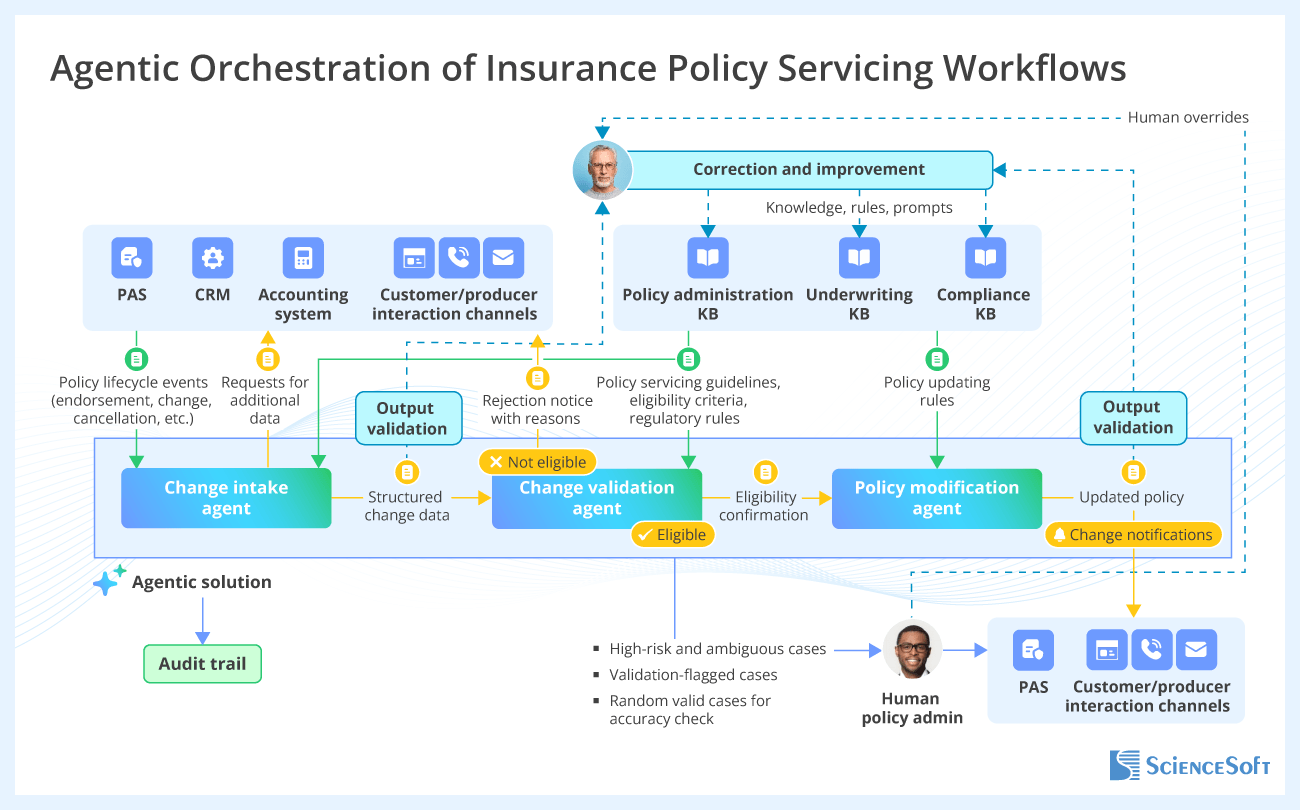
Sample agentic orchestration workflow in insurance policy servicing; visit our dedicated page for a detailed breakdown of the components and workflows.
For agentic orchestration, ScienceSoft typically builds specialized policy AI agents using agentic frameworks and AI services from major cloud providers (e.g., Amazon Bedrock AgentCore or Microsoft Agent Framework) and reuses their managed infrastructure to run and coordinate agents. Splitting the workflow across task-specific agents, with a separate orchestration agent coordinating their work, makes agent behavior easier to control and limits the impact of errors (learn more).
Key challenge: Too little control over agentic orchestration creates operational risk; too much human approval curbs workflow speed gains
Policy administration AI agents may reason and act largely autonomously, which calls for tight governance. However, making human administrators the default approval gate for every agent action can largely negate the time savings from agentic orchestration.
Mitigation strategy
Mitigation strategy
First, define rules that restrict what each AI agent can do and what data, systems, and tools it can access. These controls can largely build on your existing policy administration guidelines, authorization rules, and compliance requirements (in a way, you can treat AI agents as new employees that need to be given limits and permissions). ScienceSoft’s consultants translate those controls into rule-based guardrails, which engineers then turn into agent instructions, permissions, and control mechanisms.
Inside the agentic workflows, ScienceSoft uses deterministic validation as the main control gateway. A validator service can check proposed agent actions against predefined business rules, permissions, and transaction constraints and uses available confidence and risk signals to decide whether to allow, escalate, or block an action. This keeps the final control decision rule-based rather than leaving it to probabilistic AI reasoning.
The validator’s decisions can feed into a three-tier agentic AI governance model:
- If an agent-proposed action scores low on risk and high on validation confidence based on extraction accuracy, data completeness, and rule matches, the agent proceeds automatically.
- If an action fails a check, falls outside expected parameters, or does not meet the required confidence threshold, the validator routes the transaction to a policy administrator for review.
- Policy actions with material financial, contractual, or regulatory impact (e.g., policy cancellations or substantial coverage or limit changes) remain outside the agent’s authority. The validator routes such cases directly to manual processing.
This tiered approach lets routine agent actions proceed at machine speed while retaining human controls where they add material value. Vital Soupel, ScienceSoft’s Insurance IT & AI Consultant, recently discussed this model and its controls at an industry conference — watch the video for a practical walkthrough.
As an additional validation layer, ScienceSoft can configure the validator to randomly sample AI-handled cases for policy administrator review. Administrators can correct or override AI decisions where a case could have been handled better. You can then use their overrides and feedback to refine prompts, policy servicing rules, and knowledge bases.
We also implement audit trail mechanisms to record agent workflows, AI outputs, validation decisions, and human actions. You need that to support internal governance and demonstrate compliance with applicable regulatory requirements (e.g., the NAIC AI Model Bulletin in the US, the EU AI Act and DORA in the EU). In ScienceSoft’s experience, existing enterprise monitoring tools can often be extended to log agent activity as well.
Hide
Implementation timelines: 2–5 months to add rule-based orchestration across a limited set of systems and handoffs, given that the internal rules on the insurer’s side are already documented. An agentic orchestration workflow for one policy administration function (e.g., policy changes, renewals) can typically be piloted within 3–6 months.
Need the Right Strategy for Your Specific Case?
ScienceSoft’s architects and consultants can assess your current policy administration setup and suggest technology options that balance measurable business gains with controlled implementation risk. The initial consultation is free and non-binding.

Our Clients Say

ScienceSoft transformed our underwriting platform into a well-oiled machine. They identified and fixed several longstanding issues that had been causing us persistent difficulties. Their communication was exemplary; unlike our previous experiences with outsourcing, we never had to chase them for updates, and they were always prompt in responding to our queries.



ScienceSoft doesn't just execute on a task list. They're genuinely invested in understanding what we're building and why it matters. Their team communicates well with our people, moves quickly when we need them to, and they've consistently brought smart, practical solutions to the table. We'd recommend them to anyone looking for a technology partner they can count on.

Damien Sewell
Head of IT Projects

At Capital IM, we constantly improve our insurance systems to make employee and customer experience the very best it can be. Engaging ScienceSoft this way saved us a lot of precious time and resources. Their quick buy-in and readiness to take the initiative made the project faster and less stressful for everyone involved. We couldn’t have asked for a better IT partner.
Insights From ScienceSoft's Insurance AI & IT Experts

Vital Soupel
Senior Insurance IT & AI Consultant, ScienceSoft
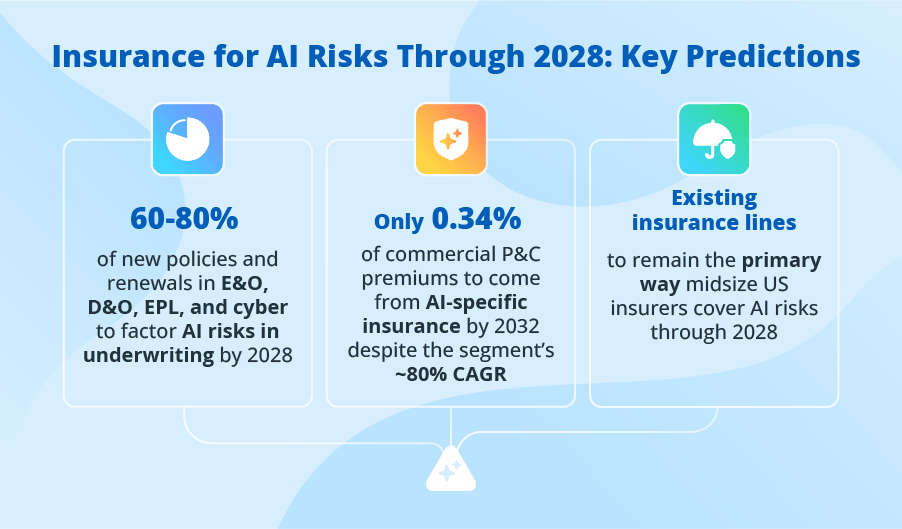
60–80% of Liability and Cyber Insurance Underwriting to Include AI Risks by 2028, ScienceSoft Predicts
Vital Soupel
Senior Insurance IT & AI Consultant, ScienceSoft
Trend watch
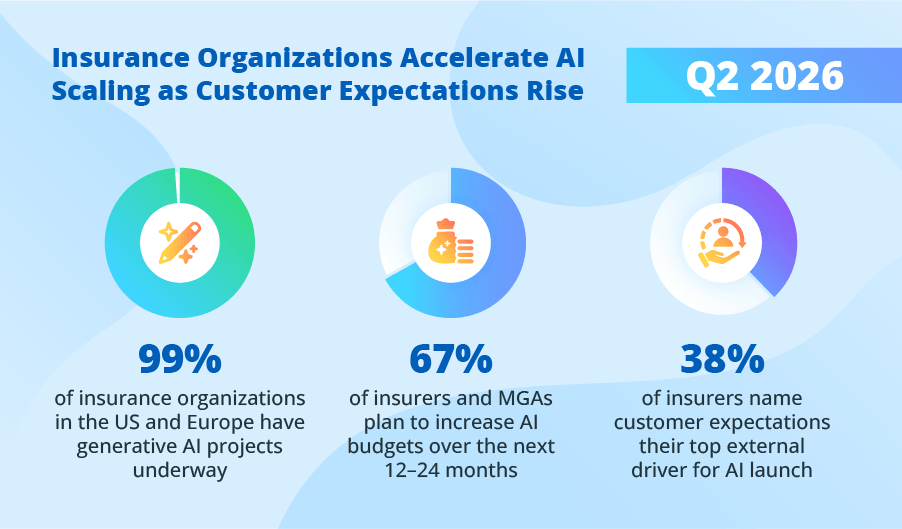
Q2 2026 Insurance AI Trends: Assistive AI Outpaces Agentic AI in Enterprise Deployments, Market Players Invest Heavily in AI Scaling Infrastructures

Stacy Dubovik
Financial Technology & AI Researcher, ScienceSoft

Case study
Fully Digital Insurance Is Already Here. See How It Boosts Sales, Underwriting, and Claims
