 ScienceSoft Global



Patient Portals for Mental and Behavioral Health
Features, Development Process, Costs
With a portfolio of over 150 successful healthcare IT projects, ScienceSoft delivers intuitive portals for mental and behavioral health patients, boosting convenience and engagement.

Behavioral Health Portals at a Glance
Mental and behavioral health portals are digital hubs that allow patients to conveniently and securely access their mental health information, schedule appointments with mental health professionals, and manage insurance and payments. A study published in Telemedicine and e-Health shows that having access to mental health data helps patients better understand their conditions and the contents of their counseling or therapy sessions, which results in better engagement in the treatment process.
Custom patient portals enable mental health practices and psychiatric hospitals to smoothly exchange data between multiple systems (including legacy software), provide enhanced accessibility features for patients with cognitive disabilities, and can be augmented with telehealth capabilities for remote counseling and therapy sessions.
Implementation time: 4 to 12+ months.
Valuable integrations: mental health EHR/EMR, telehealth platforms, billing systems.
Costs: $120,000–$350,000+. Use our online calculator to get a tailored ballpark estimate for your project.
Essential Features of a Mental Health Portal
While the exact feature set will differ for each mental health practice, ScienceSoft typically delivers the following functionality:

Patient profiles with access to visit histories and psychiatric care information
Enables patients to view their session summaries and treatment details: diagnosis, test results, care plans, and medication prescriptions. Where supported, clinical data elements are displayed with standard codes to ensure consistent exchange (e.g., SNOMED CT/ICD-10 for diagnoses, LOINC for lab results). Patients can also download these records (including CCDA visit summaries where offered) to share with other mental health care providers and/or legal guardians and view curated mental health notes where available.

Enables scheduling, canceling, and rescheduling in-person and online consultations, group or individual therapy sessions, etc. Additional features may include pre-visit symptom questionnaires and post-visit satisfaction surveys as well as automatic SMS or email notifications for upcoming appointments.

Virtual communication with mental health professionals
Integration with telehealth platforms allows mental health professionals to hold encrypted audio and video consultations online. All sessions are recorded and made available for review afterward. Additionally, a portal can offer secure patient-therapist messaging and file exchange.

Enables automation of routine tasks such as appointment booking, pre-visit collection of the patient’s contact information and initial complaints, and answering FAQs. Specialized mental health chatbots may also provide a limited scope of self-management tools for low-risk situations (e.g., mindfulness exercises, coping mechanisms). If an emergency is detected, the chatbot will immediately escalate the patient to a human counselor or crisis hotline.

Self-help resources
Patient portals for mental health can offer questionnaires (e.g., PHQ-9 or GAD-7) for individuals to determine if they should potentially seek help from a licensed mental health professional. Another useful feature involves a library of educational articles, videos, and podcasts about mental health conditions and their treatment, self-help strategies, and more. Relevant resources can be recommended to patients based on their diagnoses or past interactions with the portal. For urgent situations, the portal provides quick access to crisis lines and emergency resources for both registered and unregistered individuals.

Psychiatric medication management
Allows mental health patients to receive prescriptions and request refills directly via the portal. Medication names and dose forms can be displayed using RxNorm for clarity and consistency across connected systems. Mobile portals can also send automatic notifications to remind patients to take their medications and enable them to confirm intake or report a missed dosage.

Payment management
Provides access to insurance information, including explanations of benefits and mental health service coverage (for therapy sessions, psychiatric consultations, and medications). If service-line details are shown, billed services can include their CPT descriptors for transparency. Additionally, the portal enables patients to view and pay their medical bills online using credit cards, bank transfers, Apple Pay, Google Pay, and more.

Valuable Integrations for a Mental Health Portal
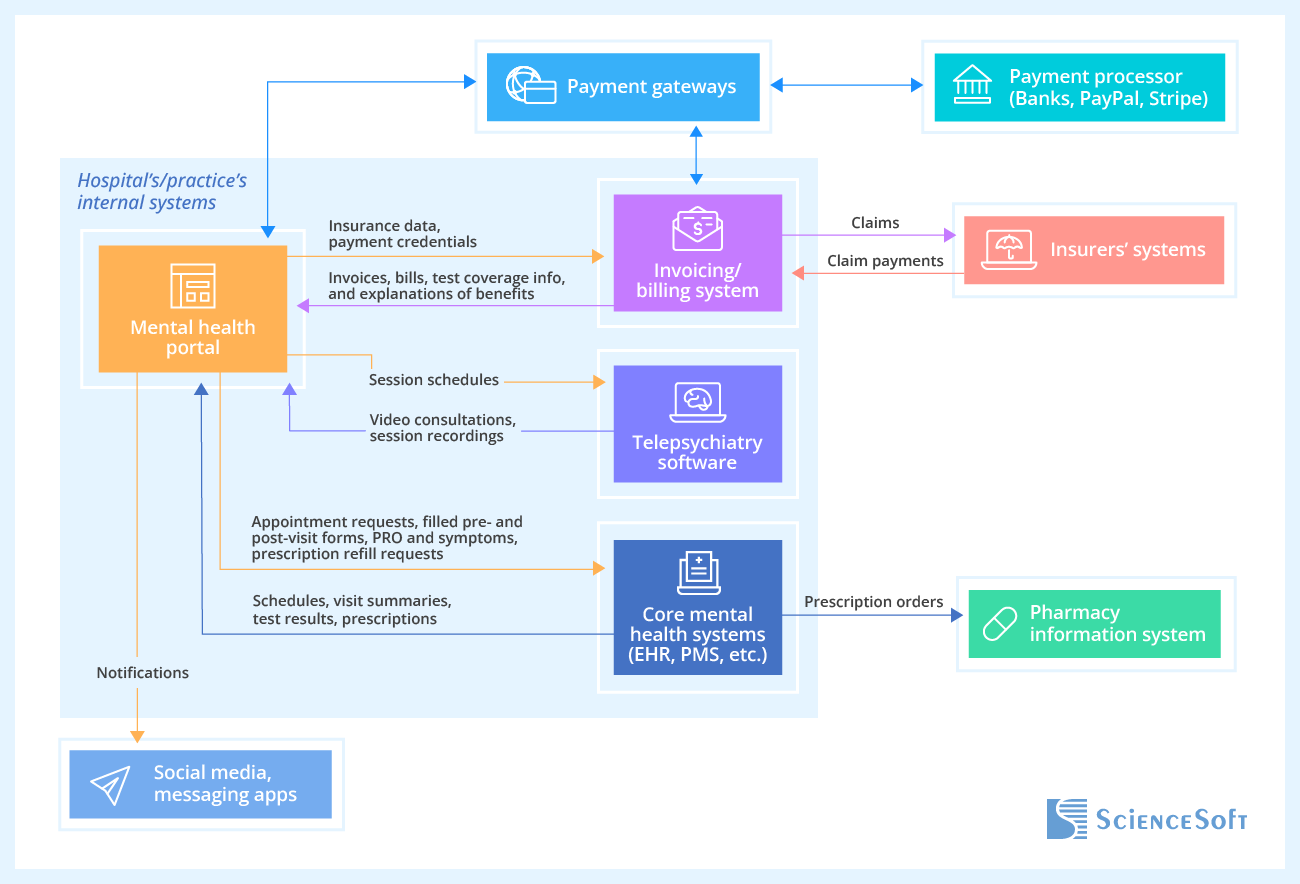
- Core healthcare systems (e.g., mental health EHR, practice management systems) — to streamline appointment scheduling and provide access to visit summaries; to store patient-reported outcomes and symptoms that are submitted via the portal.
- Telepsychiatry software — to enable remote psychiatric consultations and therapy sessions and secure patient-doctor messaging.
- Billing and invoicing systems — to streamline payment processing and ensure accurate billing for mental health services via the portal.
- Payment gateways — to enable online payments.
- Messaging apps — to provide notifications that an appointment has been scheduled/canceled/rescheduled, remind about an upcoming session or drug intake time, etc.
How to Build a Patient Portal for Mental Health
Below, we provide a high-level overview of the key steps required to develop patient portals for behavioral health. This plan can be adjusted according to the mental health organization’s requirements and specifics.
1.
Discovery and requirement gathering

Business analysts collaborate with the mental health practice’s employees (counselors, therapists, admin staff) to define functional and non-functional requirements for the portal. It’s essential to plan security measures (e.g., end-to-end encryption, multi-factor authentication, obligatory consent forms) early at this stage to ensure compliance with applicable regulations, such as HIPAA and 42 CFR part 2, and to account for 21st Century Cures Act patient-access requirements.
When defining the functional scope and the sequence in which portal features will be implemented, I recommend starting small. For instance, the initial focus of a mental health portal can be on secure patient profiles containing session summaries, appointment scheduling, direct messaging with mental health professionals, and emergency support. Later on, more advanced capabilities like an AI-powered chatbot can be added.


2.
Architecture design

Software architects review the systems already in use (e.g., mental health EHR, telepsychiatry platforms), define optimal integration scenarios for secure data exchange, and decide on the appropriate architectural components for the mental health portal. They also suggest a technological stack (frameworks, libraries, etc.) that satisfies the requirements while maintaining the cost-efficiency of the solution, select FHIR resources, and align data mapping with USCDI to support patient access.
3.
UX/UI design

At this stage, UX/UI designers define user personas (patients, counselors/therapists, admins) and scenarios and design intuitive UIs. You will need designs for different screen sizes, as patients will access the portal from various devices. A good patient portal for mental health should accommodate the needs of individuals with varying levels of technological proficiency, so the designers make sure it has a simple registration process and easy navigation. Accessibility features, such as high-contrast mode, adjustable text sizes, or text-to-symbol translation, are often added to accommodate users with cognitive impairments.
4.
Development and testing

ScienceSoft’s project managers usually recommend taking an iterative approach to portal development, as it helps get value early and act on early user feedback. For example, during the initial release, mental health patients may report struggling to navigate counselor profiles and availability. A filtering system allowing users to search for mental health professionals based on the preferred parameters (e.g., therapy methods used, insurance coverage, available time slots) can help address this inconvenience.
Our teams typically run functional, usability, and security testing in parallel with development. That helps to minimize the number of bugs before the deployment and avoid their propagation in later software versions.
5.
Deployment and support

Finally, the portal is set live, and developers monitor system performance to identify and fix remaining issues, if any. At this stage, they also gather the final version of software documentation (complete with all changes and fixes made during the development). Prompt and thorough training on features like telepsychiatry helps ensure the solution is smoothly adopted by therapists and counselors.
Patient Portal for Mental Health Costs
The development costs of a custom mental health portal range from $120,000 to $350,000+. Typical cost drivers include:
- Functional scope, presence of advanced features like telepsychiatry.
- The number of integrations (e.g., mental health EHR, telepsychiatry software, billing systems).
- Platform (web, mobile).
- User roles (counselors, therapists, mental health patients, admins) and expected number of users.
- Non-functional requirements (performance, security, etc.).
- Compliance requirements (e.g., HIPAA, 42 CFR part 2).
Estimate the Cost of Your Healthcare Portal
These questions will help our healthcare IT consultants better understand your needs. Within 24 hours after completion, you’ll receive a free and non-binding custom cost estimation.

Why ScienceSoft
- Since 2005 in healthcare software development.
- 150+ successful healthcare IT projects.
- Hands-on experience with HIPAA and GDPR regulatory requirements.
- Mature security and quality management systems backed by ISO 27001, ISO 9001, and ISO 13485 certifications.
Certifications and awards
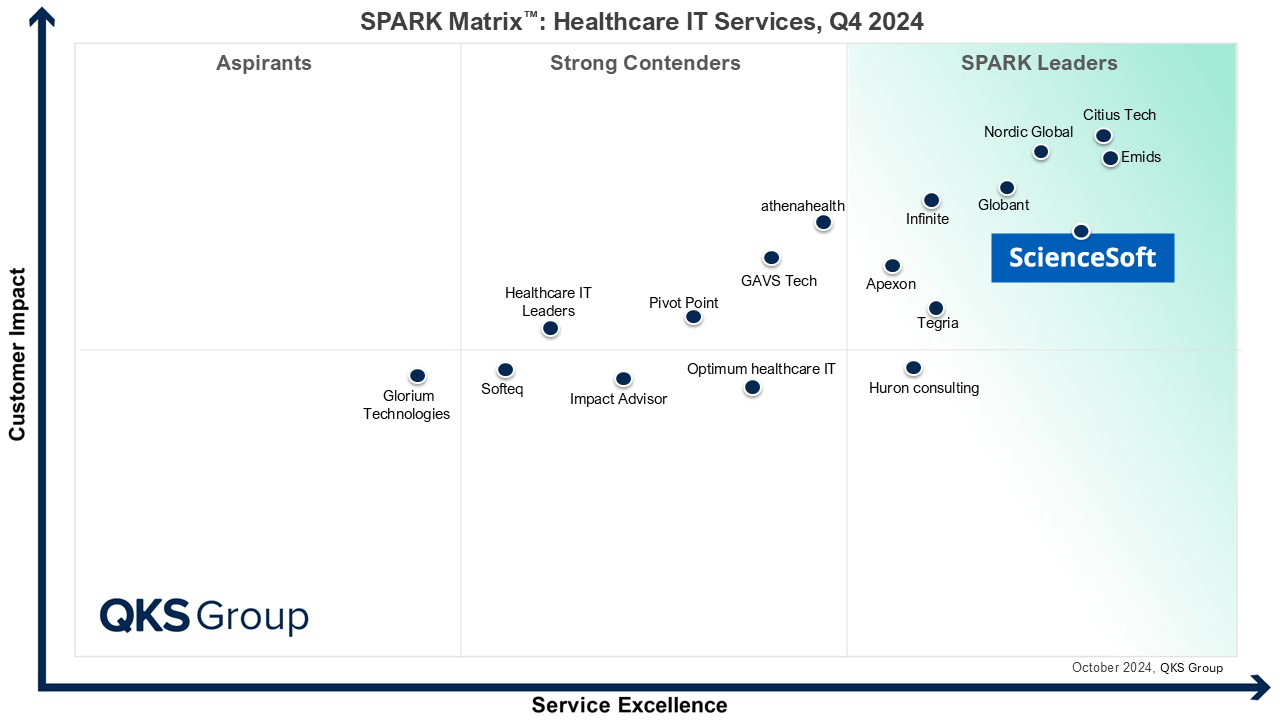
Featured among Healthcare IT Services Leaders in the 2022 and 2024 SPARK Matrix

Recognized for Healthcare Technology Leadership by Frost & Sullivan in 2023 and 2025

Named among America’s Fastest-Growing Companies by Financial Times, 5 years in a row

Four-time finalist across HTN Awards programs
Named among Becker’s Telehealth Companies to Know in 2026

Named Leading Healthcare Software Provider 2026 at GHP’s Healthcare & Pharmaceutical Awards

HIMSS Gold member advancing digital healthcare

ISO 13485-certified quality management system

ISO 27001-certified security management system
Our Clients Say


They delivered a fully customized AI medical chatbot PoC in just two weeks, which was unbelievable.
It's not often that you find a team that moves this fast without sacrificing quality. I’m genuinely grateful to ScienceSoft for their hard work and would absolutely recommend them to anyone looking for top-notch results in health tech.


Todd Nilson
MD

We are thankful for the meticulous and value-driven approach of ScienceSoft's team. They created comprehensive project documentation, feature lists, and worked out thorough recommendations to help us improve the stability and performance of our solution. ScienceSoft proved to be a reliable vendor with a solid healthcare background.
