ScienceSoft Global
 ScienceSoft Finance



Real Estate Investment Management Software
Features, development steps, and costs
ScienceSoft’s clients get custom real estate investment solutions that address the functional, integration, and flexibility constraints of ready-made tools. We focus on software logic accuracy from day one, bake regulatory requirements into solution design, and apply API-first modular architectures to create interoperable software that will evolve in line with your business needs.

Real Estate Investment Software: Key Aspects
Real estate investment management software is used as a centralized platform for managing investor relationships, capital raising activities, portfolios, and deals. ScienceSoft can build a REIMS for property portfolio tracking. Such software automates processes like opportunity research, portfolio construction, deal execution, risk control, and reporting.
Custom real estate investment management software is the preferred choice for companies that want to orchestrate and automate multi-step workflows across proprietary capital formation, investment, and hedging strategies. Custom solutions can be built to support any required real estate types (residential, commercial, industrial, land), as well as emerging investment vehicles like tokenized real estate. They can be designed to cover the functionality of full-fledged property management software and provide a toolset for managing real estate capital projects.
Real estate investment firms often opt for custom software to implement artificial intelligence (AI) without the privacy and quality tradeoffs of market-available AI tools. Tailored AI solutions can autonomously screen opportunities, spot high-yield investments, handle due diligence, and suggest portfolio reallocations based on projected returns and market moves.
Another advantage of custom software is that it can be integrated with any required systems, including legacy software, third-party fintech tools, and IoT-supported asset tracking systems. Moreover, custom solutions can be natively designed in compliance with the local regulations (e.g., SEC for the US, CMA for the KSA). When your needs or regulatory rules change, such software can be quickly upgraded with new features or security measures.
- Key integrations: real estate brokerage platforms, market data platforms, asset tracking systems, custodians’ systems, and more.
- Implementation time: a pilot with core modules — 9–15 months on average; company-wide rollout — around 18–24 months.
- Development costs: $150,000–$3,000,000+, depending on solution complexity. Use our free calculator to estimate the cost for your case.
Companies That Benefit From Custom Real Estate Investment Software







Real estate developers

Real estate operating companies
ROI of Automation in Real Estate Investment Management
The Alternative Investment Management Association suggests that intelligent automation can become a key ROI driver for real estate investment firms, removing tedious routines and streamlining complex tasks that historically required deep human involvement. According to recent research by Morgan Stanley, traditional and AI-powered tools can fully automate 37% of REITs’ workflows across property management, trading, and investor administrative support.

In my experience, automated tools have the most visible impact on the speed and scale of real estate investing operations. Over the past few years, my investment clients and connections who had gone for intelligent automation in some shape or form have reported 2.5–10x faster servicing workflows, 30–75% higher operational efficiency, and as much as 50% employee time savings. For large investment managers with over 25,000 property units under management, freeing up so much human capacity can mean an up to 3x increase in capital formation.
Key Functionality of a Real Estate Investment Management System
Below, ScienceSoft’s consultants list the features of real estate investing software. Our team can engineer an all-in-one system from scratch or develop separate functional components to upgrade the software you currently use.

- Real-time and scheduled aggregation of market data from connected sources (MLS databases, local real estate registries, market data platforms, etc.).
- Property data scraping from public web sources (e.g., real estate news outlets, property developers’ websites, investment forums) using robotic process automation (RPA).
- Rule-based data segmentation (by property type, industry, source, geography, etc.).
- Automated property profiling based on user-defined criteria (type, age, location, pricing tier, amenities, etc.).
- Opportunity data presentation in configurable dashboards.
- Shared data organization and report co-creation workspace for collaborative research.
- Continuous market data screening and instant event alerts (e.g., property listing below market value, development permits, neighborhood rating upgrades).
Value-adding features:
- Automated extraction of research-relevant data points (real estate market stats, property fundamentals, investor sentiment, etc.) from sourced documents and public platforms using large language models (LLMs).
- LLM-powered generation of research reports, briefs, portfolio memos, etc.
- AI-supported sourcing of off-market and emerging real estate investment opportunities (e.g., pre-foreclosed and distressed properties, lots in under-the-radar locations with improving ratings).

Real estate valuation
- Property appraisal models (sales comparison, cost, income) and capitalization rate estimation methods (build-up, market-extraction, band-of-investment).
- Support for condition-based valuation models that factor in field inspection reports, maintenance and renovation needs, and compliance risks.
- Analytics-driven real estate valuation with custom adjustment criteria like:
- Market prices for the real estate asset or similar assets.
- Property’s time on market and income-generating potential.
- Property location: zone, infrastructure, crime rate, etc.
- Calculation of model-specific value metrics (cap rate, cash-on-cash return, IRR, NOI, GRM, DCF, etc.).
Value-adding features:
- Automated property image processing and condition diagnostics (e.g., curb appeal, interior quality, signs of structural issues) using image analysis and machine learning.
- Intelligent suggestions on the best-fitting reference assets for valuating properties with limited market data.
- Forecasting of real estate asset value based on alternative factors like:
- Neighborhood development trends (transit expansion, rezoning, gentrification).
- Location-specific occupancy and rent demand.
- Opportunities and legal constraints for real estate and infrastructure development across target zones.
- Real estate price fluctuations across macroeconomic cycles.

- Customizable investment models for various real estate types and sectors (healthcare, hospitality, logistics, etc.).
- User-defined model input parameters: property type and location, investment horizon, financing structure (equity vs. leveraged), development and renovation CapEx, rental and lease terms, return targets, and risk limits.
- Automated calculation of the projected investment metrics (time-framed income and expenses, property appreciation/depreciation, portfolio yield, risk, etc.).
- Scenario modeling and what-if analysis for single-property investments, portfolios, investment strategies (e.g., buy-and-hold, fix-and-flip, BRRRR), property management strategies, and financing terms.
- Scenario stress testing against adverse conditions like cap rate compressions, reduction in tenant demand, tenant defaults, construction delays, and growth in property OpEx.
- Monte Carlo simulations to evaluate the impact of uncertainty factors like real estate regulation changes and macroeconomic shifts.
- Automated conversion of model outputs into mid- and long-term investment strategies that specify real estate lots, acquisition timelines, and disposition points.
Value-adding features:
- Predictive analytics to forecast real estate investment returns and exposures.
- Dynamic updating of model assumptions based on real-time property investment data feeds.

Investment underwriting
- Automated evaluation of properties and portfolios against user-defined dimensions, such as projected capitalization, return stability, appreciation potential, liquidity, and operational complexity.
- Scoring of unit- and portfolio-level profitability and risks.
- Analysis and scoring of property-level environmental, social, and governance (ESG) performance.
- Side-by-side comparison of various real estate investment options and investment strategies.
- Rule-based selection matching against investor policy statements (IPS) and disqualification of out-of-policy real estate assets.
- Automated evaluation of real estate acquisition readiness based on asset liquidity, current portfolio exposure, and capital availability for go/no-go decisions.
- Automated workflows for collaborative investment opportunity review and approval.
- Underwriting sensitivity analysis showing how changes in cap rate, rent growth, and debt terms affect real estate deal score and priority.
- Automated generation of underwriting reports for internal use, audit, and investor presentation.
Value-adding features:
- AI-supported suggestions on the optimal real estate investment strategies and portfolio structures based on the investor’s profile (asset preferences, capacity, goals, risk tolerance), market trends, and projected property value.
- Intelligent flagging of potential investment deal-breakers, e.g., legal encumbrances, zoning risks, unreliable tenant bases.

Capital stack planning and formation
- Trend-based forecasting of cash, liquidity, and financing needs for real estate investments.
- Creating custom capital stack structures with user-defined capital types and layers (common and preferred equity, mezzanine debt, senior debt, capital loans, alternative financing, etc.).
- Adding and configuring capital sources, such as self-funding, limited partners (LP), syndicates, and crowdfunding.
- Setting up liquidity limits in accordance with redemption, operational, and jurisdiction-specific compliance requirements.
- Investor participation modeling with simulations of real estate ownership dilution, return structures, profit waterfalls, and promote splits across limited and general partner arrangements.
- Equity vs. debt sensitivity analysis to evaluate the impact of capital choices on project returns, cash flow distribution, and investor exposures.
- Scenario modeling for various leverage options, including phased capital injections for real estate development projects.
- Automated calculation of leverage metrics like due principal and interest amounts, LTV, DSCR, etc.
- Automated generation and tracking of capital call, debt amortization, and dividend distribution schedules.
- Scheduled and ad hoc distribution of capital call notices and payment instructions to investors, custodians, and leverage providers (enabled by the integration with investor- and partner-side systems).
Value-adding features:
- AI-supported suggestions on the optimal capital structures based on investment risk profile, funding availability, leverage rates, and investor expectations.
- Real estate tokenization is an emerging way to boost asset liquidity and attract more capital from domestic and foreign investors.

Investment deal management
- Centralized logging of real estate deal proposals, including direct acquisitions, broker offerings, auction opportunities, off-market lots, and development partnerships.
- Template-based creation of letters of intent (LOIs), NDAs, investment memoranda (PIMs), purchase agreements, and closing checklists.
- Auto-submission of LOIs, bids, and selling offers to the connected real estate trade venues.
- Deal pipeline monitoring and deal progress tracking by status.
- Rule-based deal segmentation (by real estate type, geography, deal size, expected yield, risk score, etc.).
- Automated workflows for investment due diligence, including requests for title records, ESG assessments, sustainability certifications (e.g., LEED, Energy Star), and legal vetting.
- A collaborative workspace for real estate investment committees to review, qualify, and approve prospective deals.
- A virtual data room (VDR) for secure multi-party sharing and access to deal-related documents.
- Notifications to investment managers about scheduled deal negotiations, submission and bidding deadlines, documents pending approval, etc.
- Calculating and monitoring the required deal funnel KPIs (conversion rates, deal velocity, win/loss reasons, average time-to-close, and more).
Value-adding features:
- LLM-supported retrieval and summarization of real estate details, property development plans, and requested funding details from proposals and attached documents.
- AI-powered deal assessment and prioritization based on historical acquisition performance, market conditions, and investor-specific risk-return thresholds.
- Deal document e-signing using digital signatures.

- Customizable portfolio structures with user-defined hierarchies, real estate types, and performance metrics.
- Setting up financial targets (e.g., IRR, cash-on-cash return), property hold periods, exposure limits, leverage caps, and diversification rules.
- Analytics-driven construction of multi-asset real estate portfolios.
- Real-time portfolio allocation and performance dashboards.
- Tracking real estate portfolio performance metrics (total value, NOI, weighted average returns, dividend yield-on-cost, etc.)
- Configurable visual formats for portfolio data presentation (default dashboard view, drill-up and drill-down options, map-based views for geographic distribution, trend charts for appreciation, etc.).
- Portfolio performance benchmarking against real-estate-specific indices.
- Real-time asset contribution and performance attribution analytics.
- Portfolio performance forecasting based on historical performance and market data.
- Alerts on portfolio income dips, underperforming real estate assets, deviations from target allocations, asset price spikes, and more.
- Automated portfolio rebalancing based on user-defined rules.
Value-adding features:
- Intelligent forecasting of portfolio- and property-level KPIs.
- AI-driven suggestions on portfolio right-sizing and restructuring (e.g., increasing exposure to high-performing regions or sectors, trimming overleveraged assets).

Risk management
- Continuous monitoring of property and portfolio-level risk exposures and market trends (real estate price volatility, asset-specific deal volumes, investor sentiment, etc.).
- Tracking real estate investment risk indicators like NOI deviation, risk-adjusted return, tenant concentration, property and project-level OpEx and CapEx variance, exposure to interest rate changes on floating-rate and maturing debt.
- Alerts on investment performance deviations, e.g., based on allocations and exposures reaching preset levels.
- Dynamic monitoring of capital structure risks (assessing exposures from high leverage, refinancing challenges, covenant breaches, and investor redemption windows).
- Tracking property-level utility, energy usage, and carbon footprint metrics, matching them against investors’ ESG mandates, and flagging misalignments.
- Modeling, testing, and comparing risk hedging strategies (portfolio diversification, asset disposition, geographic exits, etc.).
- Automated workflows for risk-based actions, e.g., reallocation or refinancing planning.
- Monitoring hedging transaction progress and efficiency.
Value-adding features:
- AI-powered risk analytics and intelligent suggestions on pragmatic hedging strategies.
- Data-driven suggestions on the optimal disposition tactics, e.g., the optimal timing for real estate sales or refinancing to maximize IRR and reduce portfolio volatility.

- Automated recording of real estate investment transactions in an investment book of record (IBOR).
- Multi-book accounting with books configured by legal entity (e.g., LLC, fund, REIT), jurisdiction, base currency, accounting standards (US GAAP, IFRS, local GAAP), and reporting methods (accrual vs. cash basis).
- Automated calculation of realized and unrealized capital gains, cash flows, positions, returns on capital, rental and operating income, expense accruals, interest, and management fees based on custom formulas.
- Jurisdiction-specific real estate tax calculations.
- Multi-tier distribution waterfall calculations with support for complex partner structures with preferred return hurdles, catch-up clauses, promote splits, and clawbacks.
- Equity recalculations and ownership updates based on capital contributions, redemptions, and profit/loss allocations.
- Automated depreciation scheduling, with asset-by-asset breakdown and reclassification tracking.
- Rule-based allocation of shared expenses (e.g., insurance, property management fees) across properties, entities, and investors.
- Automated investor payouts.
- Automated transaction reconciliation and exception handling.
- Business intelligence (BI) dashboards.
- Automated generation of balance sheets, income statements, cash flow statements, and tax filings in compliance with relevant standards (e.g., GAAP, FASB, IRS, SEC).
- Compliant disclosure reporting forms (form ADV, form PF, form D with blue sky filings, etc.).
Value-adding features:
- AI-assisted tax-lot accounting (e.g., identifying optimal timing for capital expenditures, refinancing, and real estate asset sales to enhance after-tax returns).
- Consolidated financial reporting across multiple entities, funds, and regions.

- Rule-based workflows for investor onboarding, accreditation checks, and profiling.
- Geography-based KYC/AML and OFAC verification for investors.
- Automated investor segmentation, e.g., based on real estate preferences, capital commitment size, investment horizons, risk appetite.
- Configurable dashboards displaying real-time data on investor commitments, deal flows, account activities, portfolio performance, projected income streams, and distribution schedules.
- Investor interaction planning and scheduling.
- Automated generation and distribution of:
- Investment documents (e.g., prospectuses, subscription agreements).
- Investor reports (account statements, deal updates, portfolio snapshots, fee summaries, K-1 forms, etc.).
- ESG reports in compliant formats (GRESB, SASB, TCFD, and more).
- Notifications to investors (e.g., about capital calls, funding deadlines, property updates).
- Calculating and tracking the chosen investor-related KPIs (by period, location, investor segment, etc.), such as investor acquisition, committed capital, retention, churn, referral sources, and more.
- Centralized investor data repository.
- An investor portal allowing real estate investors to self-register, review opportunities, commit capital, and monitor portfolio performance.
Value-adding features:
- Data-driven optimization of real estate fundraising strategies based on the analysis of investor demand and commitment patterns.
- Intelligent detection of inconsistencies in investor data, e.g., mismatched identities, billing details, and tax info.

- Centralized storage for real estate investment data and documents.
- Automated integration of investor, portfolio, transactional, market, property, and capital project data from diverse sources.
- Rule-based workflows for data validation, cleansing, unification, enrichment, segmenting, and lineage.
- Automated coding of real estate investment vehicle, issuer, investor, and currency names using investment-specific conventions (e.g., ISIN, CUSIP, ISO 4217) and the investment firm’s custom identifiers.
- Automated indexing and version control for investment documents.
- Investment data presentation in diverse formats (hierarchical structures, directory-based views, dynamic dashboards, etc.).
- Data search by filters, tags, and metadata.
Value-adding features:
- AI-powered pre-processing, validation, classification, and indexing of unstructured data (investor documents, real estate images, media recordings, etc.).
- LLM-supported natural language search against real estate investment data and documents.

Security and compliance
- Role-based permissions to view, edit, and share granular real estate investment data.
- Multi-factor authentication, including location-based, certificate-based, and biometric authentication.
- Encryption of stored and transferred investment data.
- Automated workflows for data backup and recovery.
- Automated data deletion according to preset retention and deletion rules.
- Full audit trail of user activities.
- Monitoring compliance of real estate investment operations with AML/CFT, OFAC, SEC, FINRA, GLBA, IFRS, CMA rules, and more.
- Automated detection of non-compliant activities.
- Notifications to the responsible specialists about compliance breaches.
Value-adding features:
- Intelligent user behavior analytics (UEBA) for investment fraud detection (e.g., insider fraud, embezzlement, fee churning).
- AI-powered flagging of potential compliance breaches and intelligent suggestions on corrective actions.
- Investment data hashing, timestamping, and recording in an immutable blockchain ledger.
Adjacent modules

Property management
- Automated workflows for tenant application processing, screening, lease generation, and deposit intake.
- Centralized storage for lease terms, agreements, escalation clauses, co-tenancy provisions, and more.
- Interactive rent roll dashboards providing visibility into rent status, renewal cycles, occupancy trends, and income projections.
- Automated tenant billing based on lease and utility terms.
- Calculation, allocation, and reconciliation of CAM fees.
- Automated rental debt collection.
- Priority-based planning of scheduled and reactive real estate maintenance.
- Tracking property-associated expenses at the lot and portfolio levels.
- Rule-based sourcing of property maintenance vendors.
- Self-service portals for tenants and vendors.
- Automated tenant and vendor communication, triggered by events like rent due dates, lease renewals, and inspection notices.
Value-adding features:
- Intelligent identification of high-risk tenants, underperforming leases, and upcoming vacancy exposures.
- IoT-supported monitoring of occupancy patterns, utility and energy usage, HVAC performance, and property maintenance progress.
- AI-powered property condition analytics for preventive maintenance.

Capital project management
- Collaborative planning and tracking of real estate capital projects (ground-up developments, renovations, major system replacements, etc.).
- Template-based generation of project schedules and budgets.
- Support for project visual control models like Gantt charts.
- Rule-based workflows for capital project contractor sourcing with user-defined qualification and compliance criteria.
- Interactive dashboards for project budget utilization, funding source allocation, and milestones.
- Calculating and tracking contractor performance metrics (e.g., quality, sustainability, adherence to construction and engineering standards).
- Automated progress status updates with alerts for delays, budget overruns, critical path disruptions, and compliance breaches.
- Configurable processing workflows for real estate capital project documents and change orders.
Value-adding features:
- Predictive risk analytics for real estate capital projects.
- Vendor performance scoring based on past delivery, cost adherence, and quality metrics.
- IoT-enabled monitoring of construction health based on real-time site data.
Important Integrations for Real Estate Investment Software
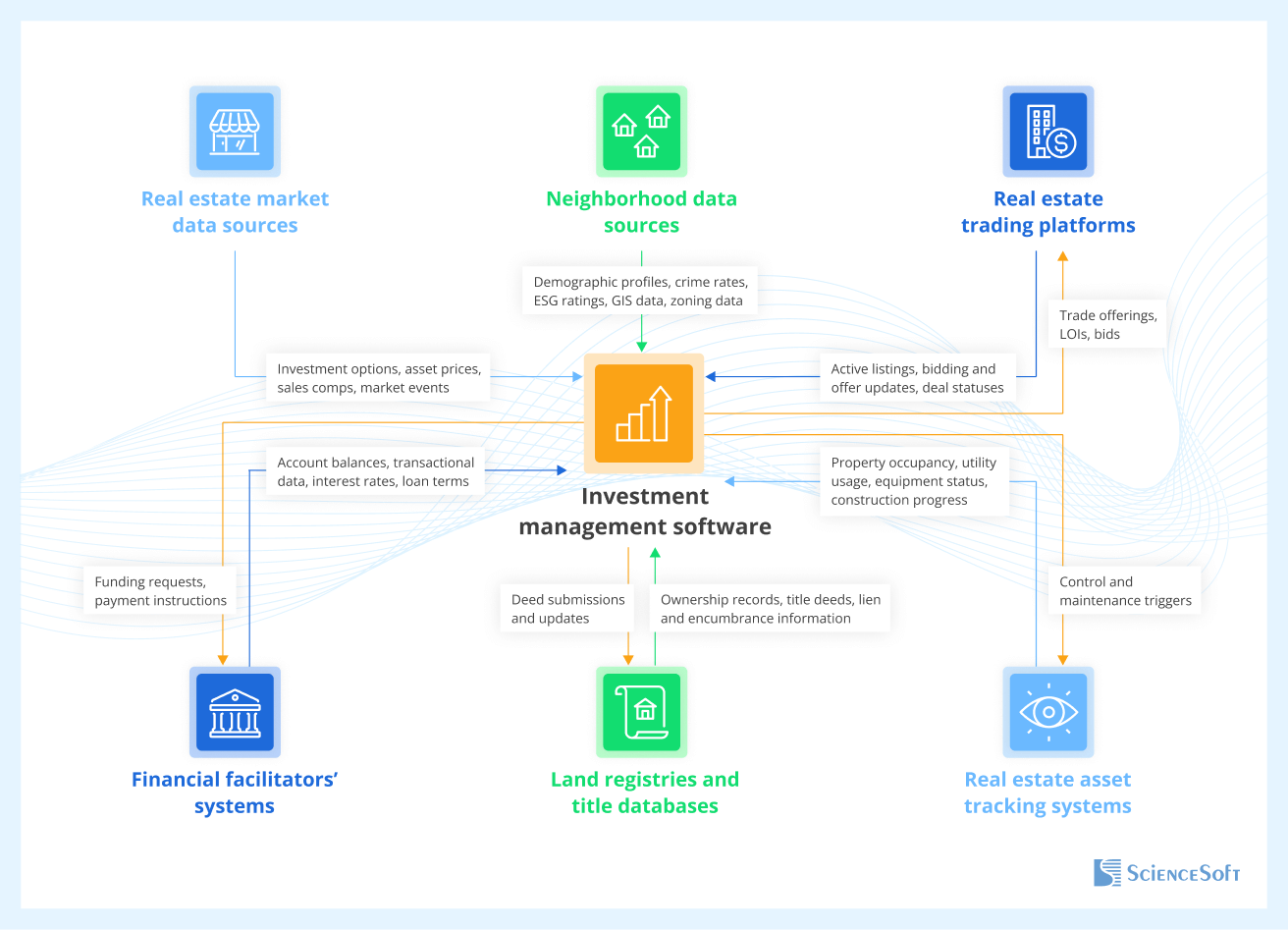
Real estate market data sources
E.g., MLS platforms (CRMLS, Bright MLS), aggregators (Zillow, Realtor, ATTOM), segment-specific databases (Bloomberg REIT & Real Estate Indices, CoStar for commercial property)
- To automatically fetch current market data for investment opportunity research, underwriting, asset and portfolio valuation, and risk prediction.
Neighborhood data sources
E.g., geospatial data platforms (Esri, MapInfo), socioeconomic databases (of census bureaus), ESG databases (GRESB, Sustainalytics)
- To quickly gather insights for accurate location scoring, off-market opportunity sourcing, fair property valuation, and predicting long-term real estate investment yield and risks.
Real estate trading platforms
E.g., brokerage platforms (eXp Realty, Compass), auction platforms (Auction.com, Bid4Assets), marketplaces (LoopNet, Fundrise)
- For streamlined real estate deal sourcing, origination, and execution.
- To track progress in deal execution and analyze investment outcomes.
Financial facilitators’ systems
Internal systems of custodians, banks, lenders, capital brokers, etc.
- To simplify and speed up capital raising, allocation, distribution, and loan repayment workflows.
- For streamlined reconciliation of real estate IBOR records against custodians’ records.
Land registries and title databases
E.g., federal and state registries, independent databases (ProTitleUSA, Cotality)
- For faster title verification and due diligence on real estate deals.
- To simplify the registration of deeds and transfer of title.
Real estate asset tracking systems
E.g., construction management systems, utility systems
- To continuously monitor real estate asset state, quickly reveal issues, and rapidly address them.
- For data-driven, proactive real estate management and identification of cost-saving opportunities.

The actual list of necessary integrations will vary for each company, depending on the firm’s needs and tool set. For example, you may choose to keep your current CRM or use a separate solution for property management. In such scenarios, specialized tools would require integration with your core real estate investment system to centralize operational data and avoid redundant manual entries.
Steps to Develop Real Estate Investment Management Software
Below, ScienceSoft’s Project Management Office shares a roadmap and best practices for implementing custom real estate investor software within predictable timelines and budget limits.
1.
Engineering software requirements

At this stage, investment IT consultants discover the real estate investment firm’s unique business needs and compose a software requirements specification (SRS).
- Make sure to interview the business users of the software (investor relations specialists, acquisition analysts, portfolio managers, property asset managers, etc.) alongside project sponsors. Doing this helps better grasp the employees’ daily operational needs and pain points that may require specialized software features. By understanding on-the-ground challenges, you ensure the software’s functional scope targets real bottlenecks from the start.
- By defining regulatory compliance requirements for the solution at this early stage, you ensure compliant software design from the outset. Missing this step may entail expensive rework at later stages, as some compliance mandates (e.g., providing audit trails for investment transactions and permissions for data access) are addressed at the architecture level. Compliance consultants at ScienceSoft analyze and map both the relevant data protection standards (e.g., GLBA, SOC 2) and domain-specific operational regulations (SEC, FINRA, SOX, etc.), including local ones like CMA rules for the KSA investment firms and niche ones like Reg CF guidelines for trading fractionalized real estate.
- Early auditing of the firm’s currently used software helps identify improvement opportunities and optimize the implementation strategy. For example, in a software project for a US hospitality investment manager, this approach helped ScienceSoft’s team reveal persisting issues in the client’s old reporting tool. Thanks to the quick fixes we introduced to that tool, the company got 2x faster reporting well before the new solution went live. A deep look into the firm’s IT landscape allowed us to plan a budget-friendly rollout roadmap: the new software was initially deployed on-premises to speed up business gains, then gradually transitioned to the cloud to cut its operational costs.
2.
Technical and UX/UI design

This stage focuses on designing software business logic and architecture, selecting the tech stack, and composing UX and UI prototypes for the real estate investment management system.
- Multi-functional real estate investment software typically offers vast opportunities for business logic reuse. For instance, the same property valuation models can feed both underwriting and risk analytics, yield calculation formulas might apply to different real estate asset classes with minimal tweaks, and back-office portfolio performance assessment logic can be reused in the investor portal dashboards. Sharing logic components where feasible is how ScienceSoft drives investment software accuracy, trims development efforts, and preserves the integrity of software logic during its future iterations.
- Software for real estate would benefit from modular architectures (SOA, microservices, modular monolith) that support logic reuse and enable independent development, scaling, and upgrading of functional components. Modular design lets you speed up delivery, ensure smooth software performance, and extend the solution’s useful life. Plus, modularity means you can establish fine-grained access controls, which is crucial for REITs and real estate investment advisors, who face heavy regulatory scrutiny. Hybrid architectures often strike the right balance: for example, latency-sensitive valuation processes can be kept in a modular monolith for speed, and investor reporting can be offloaded to microservices for cost-effective scalability. Check how ScienceSoft’s architects select the best approach for each particular case.
- The tech stack is one of the major points for project cost optimization. By using low-code platforms (e.g., Microsoft Power Apps), proven APIs (e.g., the MLS API for market data, the Attom API for property fundamentals), ready-made logic building blocks (e.g., QuantLib formulas, TensorFlow’s ML components), OOTB UI components (e.g., Zillow’s pre-built charts), and reusable deployment scripts, you can cut down on costly custom code and speed up development.
- Real estate investment processes are data-intensive and time-sensitive, so good UX/UI design must minimize friction at every step. Designing straightforward, linear workflows that let users switch effortlessly between deal docs, property data, and investment performance dashboards fosters operational efficiency. By applying adaptable layouts (context-aware interfaces, customizable dashboards, configurable modal windows, etc.), you can accommodate the needs of different user groups within a single platform without inflating design efforts.
Given the complexity of inputs and calculations in real estate investing, UX and UI design should be tightly aligned with back-end logic. Here at ScienceSoft, UX/UI designers always work together with data engineers to ensure the solution’s analytical models, dashboards, and document templates surface the right data mappings and calculations, with no disconnect between interfaces and source data.


3.
Project planning

Project managers map the scope of development tasks, define the resources needed to deliver real estate investment software, and estimate project timelines and budget.
- Developing a fully-featured real estate investment platform is typically a lengthy endeavor with a high degree of uncertainty. Applying an Agile project management approach allows you to accelerate delivery, adjust priorities on the fly, and adapt to changing requirements without derailing the entire plan. Over 90% of ScienceSoft’s investment software projects have been managed under Agile frameworks and were delivered within the agreed timelines and budgets.
- A solid risk response plan is a must to prevent project disruptions and software degradation during development. PMs at ScienceSoft proactively plan mitigation steps and contingencies for both known and potential risks, including regulatory shifts that affect digital investment operations and evolving investor expectations, which may entail changes in functional and UX/UI design.
It’s natural for stakeholders to request changes as they see the software take shape, but there’s a danger of new ideas diffusing project focus and slowing down progress. We’ve observed the consequences of poor change control in our practice: in one project, the investment market regulator had no formal mechanism to filter new requirements for their software, and the result was uncontrolled scope creep that derailed the schedule and budget (ScienceSoft’s PM consultants later stepped in to get the project back on track). The lesson is clear: agreeing on a change budget and a structured procedure for scope adjustments from the start will protect your project from runaway expansion.


4.
Development and testing

At this stage, developers code the back end of real estate investment management software (including specialized components like ML models for portfolio performance forecasting or smart contracts for real estate tokenization). They also create user interfaces and set up scalable data storage. Comprehensive testing is carried out to ensure the software functions as intended.
- Implementing DevOps (CI/CD pipelines with infrastructure as code, container orchestration, etc.) helps speed up development, testing, integration, and deployment operations. It also eliminates manual errors and minimizes bug and regression risks in production releases. Engineers at ScienceSoft selectively automate development tasks to optimize costs and prevent software quality issues. We also integrate security into DevOps at every development phase. Explore our DevOps best practices for deeper insight.
- At ScienceSoft, we tailor the QA approach for each project, yet apply the parallel testing strategy in all cases. By running QA activities in parallel with coding, you can catch and fix potential issues early, when they are easier and cheaper to resolve. In unit testing, prepare test data and scenarios that mimic real-world usage and aim at a test coverage threshold of 95%+ to ensure sufficient testing for edge cases (overlapping lease periods, tiered promote structures, etc.). For solutions that deal with sensitive data and transactions, security testing is a must to ensure there are no exploitable vulnerabilities left in the code and infrastructure.
- Well-organized collaboration between the project stakeholders keeps development efficient and transparent and prevents priority drift. In ScienceSoft’s practice, a formalized approach with clearly defined collaboration touchpoints, responsibilities, communication channels, and meeting cadences has always benefited complex investment software projects. We also set up regular knowledge sharing sessions to avoid the leakage of tacit development expertise.
5.
Integration and data migration

This is the stage where back-end engineers integrate the real estate investment management solution with the necessary systems. Additionally, you may need to migrate investment data from your existing system or spreadsheets to the new software.
- Most real estate data providers, brokerage venues, and finance facilitators offer ready-to-use APIs so that you can quickly integrate your investment management system with their platforms. If a certain system doesn’t have an API (say, if you plan to connect to your legacy in-house database of property appraisals), it’s possible to build custom connectors and dedicated ETL (extract-transform-load) pipelines. Integration testing is critical to verify that data is correctly transferred and that security (data encryption, access controls) is intact across systems.
- Consider migrating real estate investment data in small increments (e.g., one real estate class or one year of transactional data at a time) and during off-peak hours. This way, if anything goes wrong, it’s easy to roll back that slice of data without workflow disruptions. At ScienceSoft, data engineers establish automated pipelines for data migration and reconciliation (verifying record counts, key financial metrics, asset-portfolio relationships, etc.) to speed up the process and prevent manual migration errors.
6.
Pilot deployment (MVP)

At this stage, the real estate investment software’s core modules are released for a pilot run. Development teams configure the software infrastructure (servers, cloud services, security measures), execute final quality checks, and deploy the solution to the live environment.
- Regulatory frameworks can evolve during the course of a large-scale development project, especially in technology areas like AI and blockchain. Running a pre-launch compliance audit will let you double-check software adherence to the latest real estate investing regulations.
- Deploying the pilot for a limited group of users first offers safe solution testing in live settings. For example, you might initially enable the system for the commercial real estate portfolio team, while others continue with existing tools. The dual run of the legacy and new software lets engineers quickly spot data and functional gaps. From ScienceSoft’s experience, this approach also effectively combats user adoption issues. Check our real estate investment analysis software project to discover how deploying a new system to tech-savvy employees first helped gradually foster adoption among resisting teams.
- You need to establish robust network security solutions to protect your production environment. ScienceSoft’s security specialists recommend firewalls to control network traffic, IDS/IPS to monitor and block malicious activities, SIEM systems to aggregate and flag suspicious events, and intelligent UEBA to catch behavioral anomalies as a minimal robust tool set.
- Launch is not the end of the journey — after deployment, your real estate investment management software will require continuous support, maintenance, and evolution. Check out ScienceSoft’s dedicated page for ways to organize efficient L1–L4 support operations both for outsourced and in-house scenarios.
7.
Full-scale rollout

After the pilot is proven successful, development teams proceed with gradually deploying the real estate investment system across the entire organization. Testing procedures from the pilot phase are repeated here, but at a larger scale and across multiple environments. ScienceSoft also conducts role-specific employee trainings in the client’s preferred format (face-to-face, remote, hybrid) to foster wide adoption. The entire stage may take 3–10+ months, depending on solution complexity and the company’s scale.
Tech Stack for a Real Estate Investment Management System
Here are some of the technologies and tools engineers at ScienceSoft apply to create reliable investment management software:
Programming languages
Front end
- HTML5
- CSS
- JavaScript
Front end Javascript frameworks
- Angular JS
- React JS
- MeteorJS
- Vue.js
- Next.js
- Ember.js
Mobile
- iOS
- Android
- Xamarin
- Apache Cordova
- Progressive Web Apps
- React Native
- Flutter
- Ionic
Low-code development
- Microsoft Power Apps
- Microsoft Power Automate
- App Engine Studio (ServiceNow)
- Bubble.io
Databases / data storages
SQL
- Microsoft SQL Server
- Microsoft Fabric
- MySQL
- Azure SQL Database
- Oracle
- PostgreSQL
NoSQL
- Apache Cassandra
- Apache Hive
- Apache HBase
- Apache NiFi
- MongoDB
- Microsoft Fabric
Cloud databases, warehouses, and storage
AWS
- Amazon S3
- Amazon Redshift
- Amazon DynamoDB
- Amazon DocumentDB
- Amazon RDS
- Amazon ElastiCache
Azure
- Azure Data Lake
- Azure Blob Storage
- Azure Cosmos DB
- Azure SQL Database
- Azure Synapse Analytics
- Kinect DK
- Azure RTOS
Google Cloud Platform
- Google Cloud SQL
- Google Cloud Datastore
Other
- Microsoft Fabric
Big data
- Apache Hadoop
- Apache Spark
- Apache Cassandra
- Apache Kafka
- Apache Hive
- Apache ZooKeeper
- Apache HBase
- Azure Cosmos DB
- Amazon Redshift
- Amazon DynamoDB
- MongoDB
- Google Cloud Datastore
AI
Machine learning platforms and services
- Azure Machine Learning
- Azure Cognitive Services
- Microsoft Bot Framework
- Amazon SageMaker AI
- Amazon Transcribe
- Amazon Lex
- Amazon Polly
- Google Cloud AI Platform
Machine learning frameworks and libraries
- Apache Mahout
- Apache MXNet
- Apache Spark MLlib
- Caffe
- TensorFlow
- Keras
- Torch
- OpenCV
- Theano
- Scikit Learn
- Gensim
- SpaCy
Platforms
DevOps
Containerization
- Docker
- Kubernetes
- Red Hat OpenShift
- Apache Mesos
Automation
- Ansible
- Puppet
- Chef
- Saltstack
- HashiCorp Terraform
- HashiCorp Packer
CI/CD tools
- AWS Developer Tools
- Azure DevOps
- Google Developer Tools
- GitLab CI/CD
- Jenkins
- TeamCity
Monitoring
- Zabbix
- Nagios
- Elasticsearch
- Prometheus
- Grafana
- Datadog
Blockchain
Smart contract programming languages
- Solidity
- Rust
- Vyper
- Wasm
Frameworks and networks
- Ethereum
- Hyperledger Fabric
- Graphene
- Parity Substrate
- EOSIO
- Cosmos SDK
- POA Network
- Polkadot
- Solana
Cloud services
- Amazon Managed Blockchain
- Oracle Blockchain
- IBM Blockchain
Costs of Real Estate Investment Solutions
Developing custom software for real estate investment management may cost from $150,000 to $3,000,000+, depending on the solution’s functional scope, the number and complexity of integrations, as well as performance, scalability, security, and compliance requirements.
Here are ScienceSoft’s sample cost ranges:

$150,000–$400,000
Basic real estate software for investors built on a low-code platform like Microsoft Power Apps. It offers RPA-supported automation and statistical analytics across key operations like capital raising, portfolio management, accounting, and reporting.

$400,000–$800,000
A custom solution that automates the whole spectrum of real estate investment and management operations. It features intelligent data processing capabilities, rule-based automation for multi-step workflows, and ML-powered predictive analytics.

$800,000–$3,000,000+
A large-scale custom system that handles complex real estate investment workflows across deal, portfolio, trading, and operating areas. It offers AI-supported automation, optimization, and analytics features, including capabilities powered by IoT, big data, and generative AI.
Why Build Real Estate Investment Software With ScienceSoft
-
Since 2007 in engineering custom solutions for the investment industry.
- Investment IT and compliance (SEC, FINRA, GLBA, GDPR, SOC 2, etc.) consultants with 5–20 years of experience.
- 45+ certified project managers (PMP, PSM I, PSPO I, ICP-APM) with experience in large-scale projects for Fortune 500 companies.
- Principal architects with hands-on experience in designing complex investment solutions and driving secure implementation of value-adding technologies like AI/ML and blockchain.
- 350+ software engineers, 50% of whom are seniors or leads.
- Quality-first approach based on an ISO 9001-certified quality management system.
- Robust security management supported by ISO 27001 certification.
Partnerships and recognitions









ScienceSoft’s Approach, As Seen Through Our Clients’ Eyes

Our collaboration was a true partnership. The team was open, attentive to our requirements, and accurate in addressing them. The delivered solution is exactly what we needed.


Sultan Masad
Group IT Manager

The DMS developed by ScienceSoft helped us ensure document integrity and security and accelerate document-related business processes. We are satisfied with the project results.


We were impressed by the smooth communication, attention to our requests, and the team's expertise in web security. We really liked how comprehensive but to-the-point their reports were.