 ScienceSoft Global
 ScienceSoft Finance



Tokenized Real Estate to Become a $3 Trillion Market by 2030, Making Up 15% of Real Estate AUM — ScienceSoft





Related topics:
5 min read
Last updated:
ScienceSoft, an AI transformation and software engineering firm working with the investment industry since 2007, released non-sponsored research on how tokenization will reshape real estate asset management and investing through 2030.
By 2030, the global market for tokenized real estate will reach up to $3 trillion and represent 15% of the real estate assets under management across professional investment firms, ScienceSoft's research team predicts. Although the market is relatively young in 2026, real estate owners and managers are increasingly investing in tokenization technology, and investor demand is sufficient to justify the launch of tokenized real estate offerings.
At a glance:
- Demand for real estate tokenization continues to strengthen. Investors and real estate firms are showing growing interest in tokenized assets and tokenization initiatives.
- Commercial real estate is expected to lead tokenization adoption. Fractional ownership and investment-focused use cases are likely to drive adoption ahead of residential real estate.
- Market conditions are improving, but key barriers remain. Underdeveloped secondary trading markets and regulatory uncertainty continue to limit the growth of the tokenized real estate market.

Why Watch the Real Estate Tokenization Market
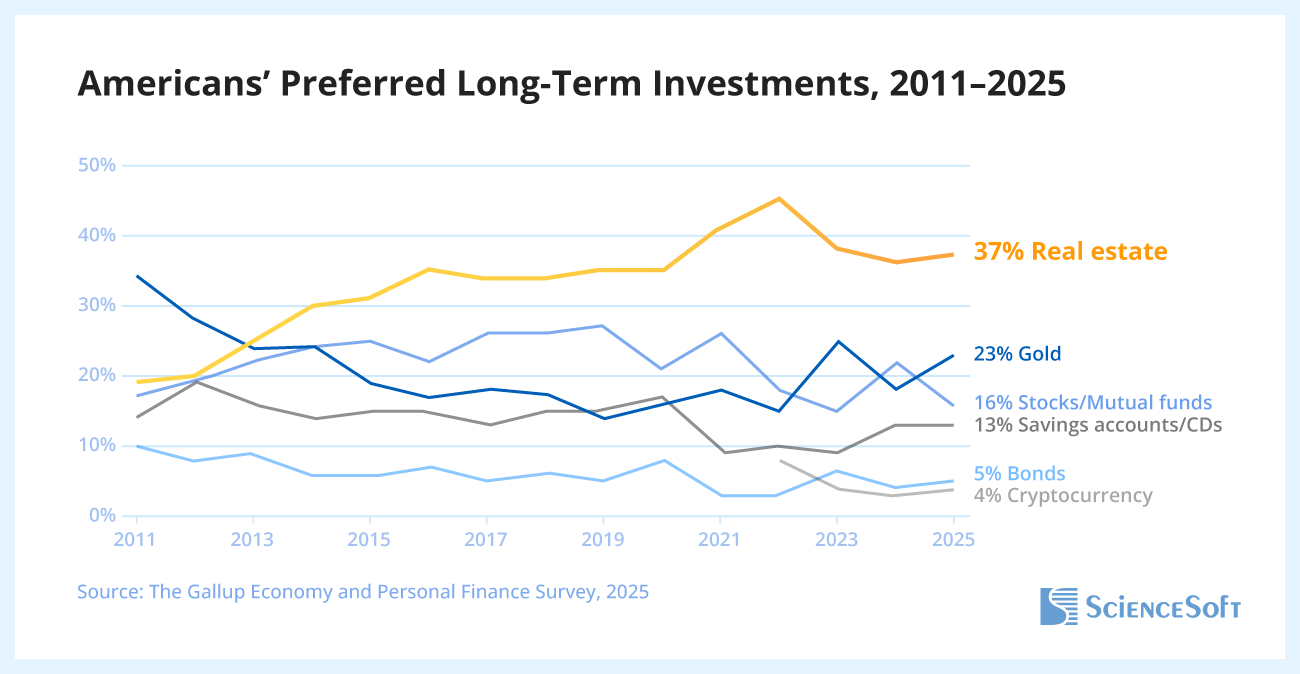
Real estate remains Americans' preferred long-term investment. In 2025, 37% of US adults ranked real estate as the best long-term investment, marking its 12th consecutive year in first place. Still, high costs and low liquidity of real estate historically hindered real investor demand. Costly settlement of real estate deals posed additional barriers to investing. It’s no surprise tokenization technology enabling partial asset sales and lower-cost deal closing quickly gained traction among the real estate investment domain players.
Tradeable blockchain tokens can represent any required portion of the property, which enables fractional asset sales and shared ownership. Tokenizing real estate gives sellers an opportunity to broaden the investor pool and improve asset accessibility, while creating a new capital-raising channel. Tokenization solutions can automate parts of real estate financial and investment servicing processes, reducing reliance on some administrative and settlement intermediaries and cutting settlement costs for deal participants.
As of 2026, the US market for tokenized real estate is still at an early stage but continues to expand, offering rewarding opportunities for real estate investment market players and tokenization technology providers. Some asset management firms have already invested in tokenization solutions and are planning to invest more in the coming years. Early pilots by Elevated Returns and RealT proved the technical and economic feasibility of real estate tokenization. ScienceSoft expects that regulatory support for tokenized real estate and the development of secondary markets will speed up further market growth.
Real estate tokenization isn’t just a trend. It’s a shift in how we think about ownership, access, and value. It’s where finance meets technology, and the future belongs to those ready to combine both.
Mary Zayats, Financial IT & AI Principal Consultant at ScienceSoft (check the full video interview “Tokenizing Real Estate: Revolution or Hype?”)
Tokenized Real Estate Market Size and 2030 Outlook
The market of tokenized real estate is growing rapidly, but from a very small base. According to ScienceSoft's findings, the market was worth approximately $0.2–0.3 trillion in 2024. This represents just 0.05–0.08% of global real estate value, or 1.49–2.40% of professionally managed real estate assets.
Based on ScienceSoft's analysis of market projections from leading consultancies, including Deloitte, BCG, and Roland Berger, the tokenized real estate market could reach $1.3–3.2 trillion by 2030. ScienceSoft considers the upper end of this range — approximately $3 trillion — the optimistic but achievable scenario. Reaching this level of adoption will require clearer regulation, active secondary markets, interoperable settlement infrastructure, and sustained institutional demand.
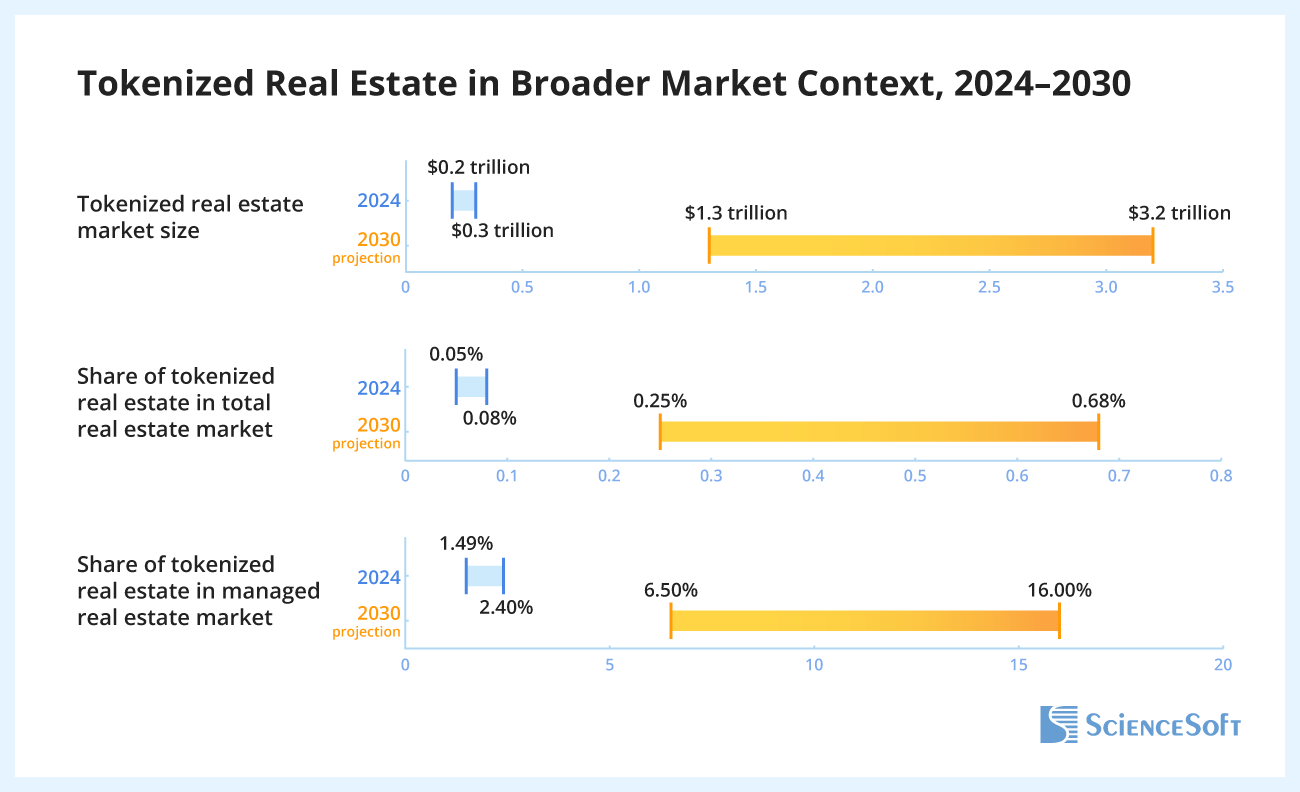
In ScienceSoft's most optimistic scenario, tokenized real estate would be equivalent to around 16% of professionally managed real estate assets, but it would still represent less than 1% of global real estate value. This points to strong market growth, but not mass tokenization of the overall real estate market. ScienceSoft expects tokenization to gain traction in selected use cases, primarily across professionally managed commercial real estate, fractional ownership, and cross-border investments, rather than replace traditional property ownership.
Key Drivers and Barriers to Real Estate Tokenization
Demand for tokenized real estate among investors
Investor demand continues to justify the launch of real estate tokenization solutions. The 2023 Tokenization in Asset Management survey by EY-Parthenon found that 80% of high-net-worth (HNW) investors and 67% of institutional investors were already investing in or planning to invest in tokenized assets.
More recent research confirms that investor interest remains strong. In the 2025 Institutional Investor Digital Assets survey by EY-Parthenon and Coinbase, 57% of institutional investors said they were very interested in investing in tokenized assets. Portfolio diversification was the leading motivation (65%), followed by fractional ownership and lower investment minimums (48%).
Demand for tokenization among real estate owners and managers
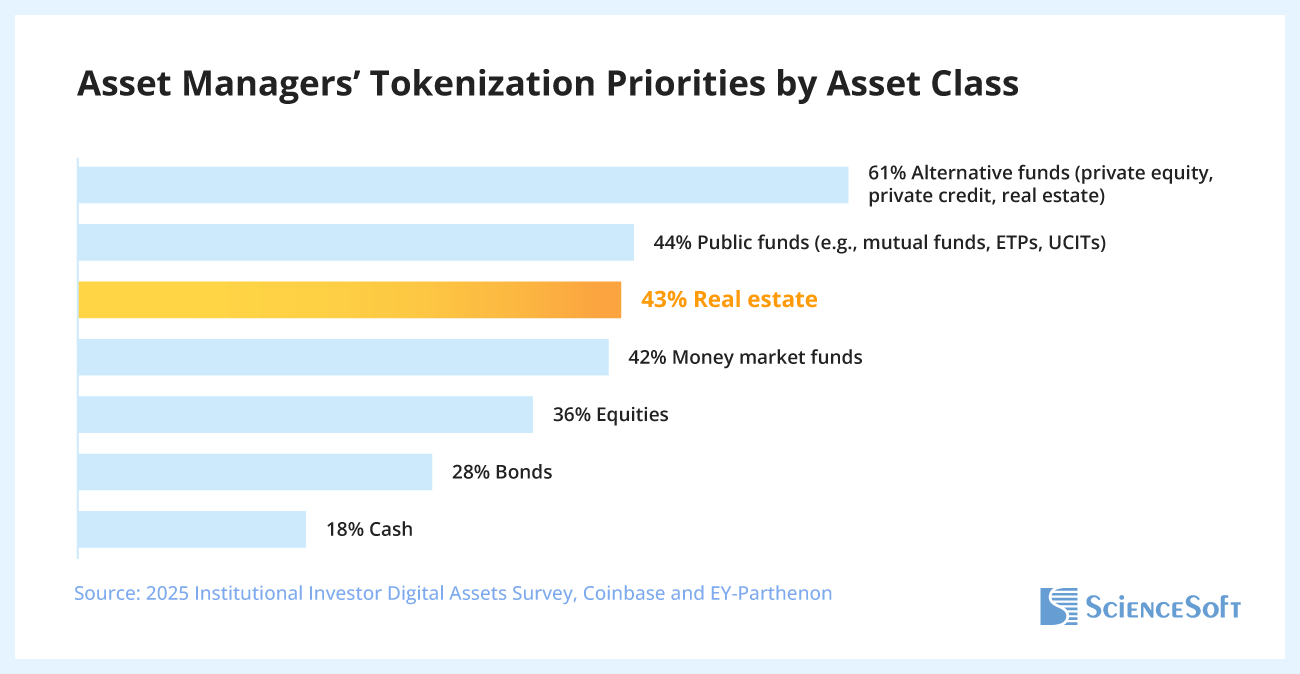
Although the market for tokenized real estate remains relatively young, interest in tokenization among real estate owners and managers continues to grow. According to the 2025 EY-Parthenon and Coinbase survey, 40% of asset managers are considering tokenizing their assets, while another 44% are exploring asset tokenization. 43% of firms identified real estate as one of the primary asset classes they would tokenize.
The broader real estate industry shows similar momentum. Deloitte found that, as of June 2024, 58% of real estate firms globally had already implemented or were piloting asset tokenization solutions.
The long-term outlook is also positive. A 2025 study by State Street and Oxford Economics revealed that 61% of North American institutional investment professionals expect 10–24% of institutional investments to be conducted through tokenized instruments or digital assets by 2030. In the same study, 46% of respondents named physical assets, including real estate, among the first asset classes to be widely tokenized and digitally traded or custodied.
Regulatory impact on market growth
Regulatory uncertainty remains the biggest barrier to scaling tokenized real estate. Analysts at KPMG and EY note that, under the current US regulatory framework, real estate tokens are generally treated as securities, requiring compliance with securities regulations that can limit investor participation and increase implementation complexity. This view is echoed by the market: the 2025 Tokenization Survey by Broadridge found that for 73% of private asset managers across North America and Europe, unclear or insufficient regulation is the biggest challenge to scaling tokenized offerings.
The US regulatory environment became more defined in 2025–2026. The GENIUS Act established a federal framework for payment stablecoins, while the CLARITY Act, aimed to define digital asset classifications and regulatory responsibilities between the SEC and the CFTC, advanced through Congress, signaling progress toward clearer digital-asset regulation. However, the legal framework for tokenized real estate remains incomplete. Key questions around securities regulation, property ownership, taxation, mortgages, and investor eligibility have yet to be fully addressed.
Based on ScienceSoft's experience working with investment clients, broader adoption of tokenized real estate will depend on further regulatory clarity, particularly regarding investor access and compliance requirements. More flexible rules could expand the potential investor base and support market growth.
Tokenization technology maturity
Blockchain tokenization technology is mature enough to develop solutions for secure and cost-effective real estate token offerings. Research by industry analysts supports ScienceSoft's view. For example, in its Hype Cycle for Web3 and Blockchain 2024, Gartner classified tokenization as an adolescent technology. At the same time, ScienceSoft's 2026 expert follow-up suggests that the technology itself is no longer the primary barrier to adoption. Instead, broader adoption over the coming years will depend on regulatory clarity, operating governance, interoperability, and the development of active secondary markets.
Tokenization software offering
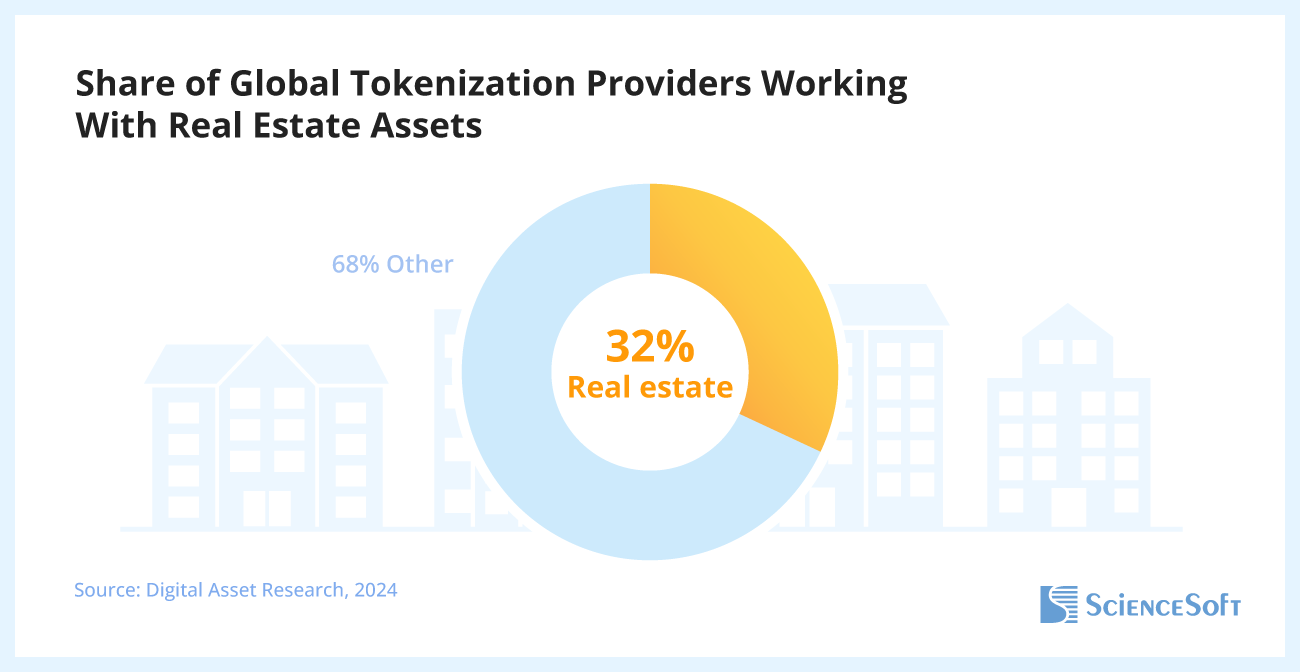
The availability of real estate tokenization software is an important factor influencing how quickly sellers can launch tokenized offerings. Based on ScienceSoft's findings, the market offers a growing number of platforms that enable fast and cost-effective real estate tokenization. Digital Asset Research identified 148 real-world asset tokenization platform providers worldwide in April 2024, up from 73 in June 2023. 32% of these companies supported real estate assets (e.g., SolidBlock, Tokeny, RealT, and Polymath).
The expanding vendor landscape gives real estate sellers a choice between off-the-shelf platforms and custom software. Off-the-shelf platforms can reduce time to market and provide ready-made issuance, investor onboarding, compliance, and servicing functions. They can be a practical fit for standardized offerings and early validation.
At the same time, many larger real estate companies still prefer custom tokenization software for more complex projects. ScienceSoft’s clients from the domain name tailored compliance, flexible token economics, integration with internal systems, direct control over investor data, and fewer long-term technology constraints as the major advantages of custom solutions.
Opportunities for secondary trading
One concern ScienceSoft's investment clients commonly raise is the limited availability of interoperable secondary markets for real estate tokens. As of 2026, most tokens are still traded primarily within the platform where they were issued, limiting investor reach and restricting secondary-market liquidity. The International Organization of Securities Commissions (IOSCO) also noted in its 2025 Tokenization of Financial Assets report that secondary markets for tokenized assets remain underdeveloped, limiting the scalability and broader benefits of tokenization.
At the same time, the market is moving toward greater interoperability. Recent initiatives have focused on enabling token transfers across blockchain networks and traditional financial infrastructure. For example, Swift, in collaboration with Chainlink and major financial institutions including BNY Mellon, BNP Paribas, Citi, and Lloyds Banking Group, piloted a solution for cross-network transfers of tokenized assets. Such initiatives could support future secondary trading of tokenized assets, including real estate, across multiple centralized and decentralized marketplaces.
ScienceSoft's consultants note that interoperability alone will not create active secondary markets. Broader liquidity will also depend on regulatory clarity, investor demand, market participation, and sufficient trading volume. Until these factors develop together, secondary trading is likely to remain a market constraint.
Industry Players’ Perspective or Market Development
ScienceSoft interviewed business and IT leaders from the US real estate industry to understand their expectations for the future of real estate tokenization, including whether more than 50% of real estate could be tokenized by 2030.
The participants agreed that real estate tokenization has strong long-term potential but didn’t expect mass adoption by 2030, arguing that nowhere near half of all real estate would be tokenized by then. Respondents noted that residential properties, which make up the largest share of the real estate market and typically involve full title ownership, do not offer the same compelling tokenization use cases as commercial real estate. As a result, they do not expect residential real estate to adopt tokenization at the same pace and believe this will prevent tokenization from becoming dominant across the overall real estate market in the medium term.
Some respondents also noted that tokenizing residential properties may conflict with current US mortgage regulations, particularly where mortgage agreements restrict changes in property ownership.
How Tokenization Reshapes Real Estate Investments
Real estate sellers (developers, owners, managers)
By fractionalizing and tokenizing their assets, real estate sellers will benefit from enhanced asset liquidity and the possibility of attracting a broader range of domestic and foreign investors, including individuals with smaller portfolios. As an alternative form of funding, token offering have helped real estate owners quickly raise considerable capital volumes. For example, a New York-based asset management company Elevated Returns raised $18 million in investments within two years by tokenizing the equity of the St. Regis Aspen Colorado resort.
As demand for liquid assets is traditionally higher, tokenization may drive the growth in property value through secondary trading. In Elevated Returns’ case, the value of its token increased by 30% within 18 months of issuance. The token was listed on the secondary trading platform tZero and continued to trade strongly despite broader market uncertainty, reaching a market capitalizaion of more than $48 million in 2026. The token price increased by 2.8x throughout 2022–2026.
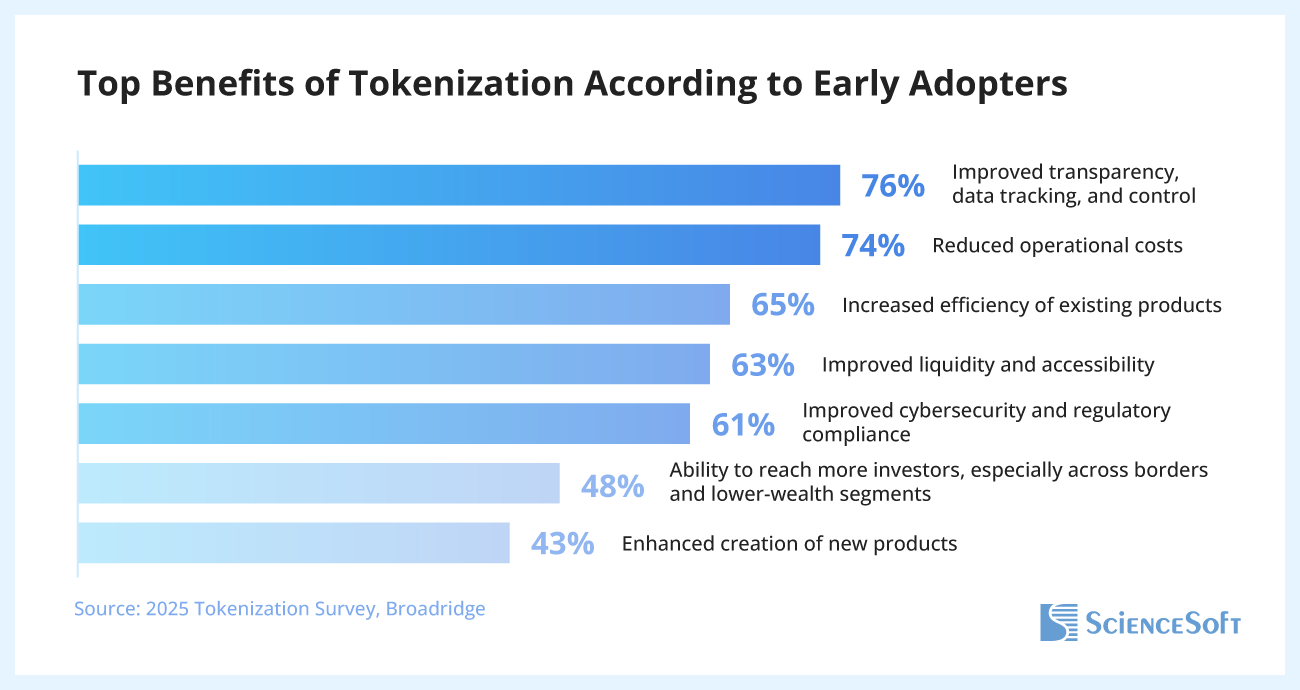
Real estate tokenization also improves the transparency and traceability of property transactions. Smart contracts can automate selected transaction and servicing processes, helping real estate sellers optimize employee workloads and reduce operational costs over time. Evidence from early adopters supports these benefits: in Broadridge's 2025 survey, 76% of financial institutions already using tokenization cited improved transparency, data tracking, and control, 74% reported reduced operational costs, and 65% highlighted greater operating efficiency.
While the sellers reap the biggest financial gains from real estate tokenization, they also bear the biggest upfront expenses. Launching a token offering requires designing the token model, implementing compliant smart contracts, deploying a custom or off-the-shelf tokenized asset management solution, and partnering with tokenization and secondary trading platforms. From ScienceSoft’s experience, a real estate tokenization project of average complexity may cost around $200,000–$500,000.
Moreover, real estate sellers should be prepared for evolving regulatory requirements. As the market matures, changes to legislation governing tokenized real estate may require additional compliance efforts and increase implementation costs.
Most of ScienceSoft's clients in real estate investment cite regulatory uncertainty as the primary barrier to adopting tokenization. One way to de-risk tokenized offerings in a shifting legal landscape is to issue real estate tokens on compliance-native platforms like Securitize or SolidBlock. Major platform vendors are well aware of regulatory hurdles and typically offer built-in compliance features aligned with SEC and other relevant frameworks. And since they actively monitor legal developments, they can accommodate regulatory changes quicker and more effectively than most in-house teams. — Dennis Taului, Blockchain & AI Consultant and Project Manager, ScienceSoft
Real estate investors
Individual and institutional investors will benefit from broader opportunities for investing in real estate due to significantly lower minimum investment amounts. For example, a real estate token marketplace RealT, which tokenized over 700 US properties valued at $130 million as of 2025, sells tokens starting from just $81. 88% of platform users invested less than $5,000. Early adopters of RealT, Lofty AI, and similar say that the marketplaces operate and pay dividends as advertised.
As blockchain allows for seamless cross-border transactions with tokenized assets, investors will be able to access a broader range of properties worldwide and diversify their portfolios more easily, bypassing currency and jurisdictional barriers. Automated direct settlement using smart contracts will eliminate fees for traditional intermediary services, driving a reduction in transactional costs.
At the same time, increased accessibility of real estate assets may lead to higher volatility and lower predictability of the real estate market, which means enhanced investment risks.
Real estate brokers and agents
As real estate tokenization becomes more widely adopted, some real estate transactions may require fewer traditional intermediaries, particularly in standardized investment offerings. However, ScienceSoft does not expect tokenization to eliminate the role of real estate brokerages and agencies. Instead, their responsibilities are likely to evolve as investors seek guidance on tokenized assets, regulatory requirements, and digital transaction processes.
To stay competitive, brokerages and agencies should develop new capabilities and adapt their business models to evolving investor preferences. One strategy is to offer consulting services related to the creation and management of tokenized real estate. A step further would be to invest in a real estate tokenization platform or expand into tokenization-related services.
Technology providers
Since operations with real estate tokens rely heavily on blockchain and traditional technologies, technology vendors should expect increased demand for specialized solutions in the next 2–5 years. The growing adoption of tokenized real estate will indirectly benefit custom tokenization software vendors and the providers of tokenization platforms, secondary trading infrastructure, blockchain networks, and cryptocurrency wallets.
Broader investment and credit markets
Looking ahead, the growing use of tokenization in real estate will likely affect the demand for conventional vehicles like real estate investment trust (REIT) investments and mortgage loans and push investors to reconsider their portfolio structures. At the same time, enhanced asset liquidity will drive the volatility of the entire real estate market, potentially reducing its attractiveness for long-term investing.
