 ScienceSoft Global
 Healthcare
 Insurance
 Investment



AI for Customer Service
Use Cases, Architecture, Guardrails
With AI engineering experience since 1989, ScienceSoft helps enterprises make customer service AI a source of gradual, sustainable business improvement: less manual work, fewer repeat contacts, faster resolution, and lower service costs. We design enterprise AI ecosystems integrated with CRM, contact center, knowledge, order, and billing systems, with centralized data governance and human oversight controls.

AI for Customer Service: The Essence
AI solutions for customer service help organizations automate the processing of routine customer requests, accelerate issue resolution, and gather operational insights (e.g., customer sentiment, recurring issues, and bottlenecks) to improve the customer experience and service performance. These capabilities enable organizations to deliver high-volume customer support faster, with greater consistency and quality, and to significantly reduce the cost of handling repetitive, low-value requests.
Custom AI solutions for customer service can adapt to an organization's unique service processes, business rules, and enterprise systems, achieving significantly higher response accuracy and reducing the risk of hallucinations, policy violations, and inconsistent customer guidance.Here are some of the key components that enterprises choose to build custom:
- AI modules for existing CRM, contact center, or customer portal software to support case handling inside the tools service teams already use.
- A governed AI knowledge layer that lets AI use approved policies, product information, manuals, service scripts, and case history.
- Agentic AI workflows that can follow predefined service steps and perform actions in approved systems (e.g., update CRM records).
- Integration components that connect AI with CRM, ERP, billing, telephony, ticketing, and analytics systems.
- Operational controls that define what data AI may access, which actions it may perform, when it must escalate to a human rep, which outputs require approval, and how AI activity is logged and monitored.
AI for Customer Service: Adoption
In 2026, AI has turned from an experimental tool to standard infrastructure in customer service. According to Intercom, 82% of senior leaders have already invested in AI for customer service, and 87% plan further investment in 2026, with 85% of organizations now using at least one AI capability. Looking ahead, Gartner expects 70% of customers to start service journeys via conversational AI by 2028.
The strongest adoption momentum is in agentic AI, where adoption grew from 39% to 66% in one year (a 1.7x increase). At the same time, Gartner states that today the strongest ROI comes from AI copilots, case summarization, personalization, and agent assistance. In contrast, more advanced use cases, such as autonomous AI agents, real-time translation, and automated customer communications, represent higher-risk, higher-value opportunities that are still scaling.
However, Gartner warns that by 2030, AI-driven customer service resolution costs may exceed offshore human agent costs. As a result, investment decisions are increasingly driven not only by cost efficiency, but by scalability, speed, and experience quality.
Why Businesses Invest in AI for Customer Service

Higher customer satisfaction
AI has become the primary driver of customer experience improvement in service organizations, with customer satisfaction ranked as the #1 improved KPI by AI, ahead of productivity, handle time, retention, and first-response time (Salesforce, 2026 survey of 3,075 professionals). By grounding responses in approved knowledge and giving agents real-time guidance, AI improves first-contact resolution, reduces errors, and supports more consistent service quality.
Faster resolution and higher throughput
AI significantly accelerates service delivery by removing manual effort from core workflows such as searching knowledge, writing responses, and summarizing cases. Microsoft reports a 12% reduction in average handling time, while deployments such as Wonolo show up to a 20% reduction in request handling time after introducing AI-assisted responses.
Lower customer service costs
AI reduces customer service costs across three major levers: resolving routine requests before they reach agents, accelerating resolution once they do, and reducing the operational overhead of training and supervision. In typical implementations, 40–60% of savings come from automation and self-service, 20–40% from faster agent handling, and a further 10–20% from reduced agent training and QA effort.
AI Applications in Customer Service-cases

AI chatbots
AI chatbots can be deployed across web, apps, email, SMS, and messaging platforms. They can handle common questions like order status and policy explanations by pulling data from CRM and knowledge bases. Powered by LLMs and OCR, they can understand different types of business documents — including invoices, contracts, receipts, claims, and identity documents — whether provided as PDFs, Word documents, or images. While they do not typically perform complex back-end operations themselves, they collect customer requests, maintain conversational context, and route tasks to the appropriate systems or agents when further action is required.

AI voice assistants (contact center automation)
AI voice assistants handle customer support over the phone through natural conversation rather than IVR menus ("Press 1, press 2"). They can confirm customer identity, understand customer intent, collect the information needed to resolve the request, and provide answers or guidance during the call. When supported by an autonomous request resolution agent (see below), they can also complete routine requests such as bookings, delivery issue resolution, or subscription changes without human involvement. For complex or high-risk cases, they escalate the conversation to a human agent with a complete summary of the customer's request, the information already collected, and any actions already attempted.

Autonomous request resolution agents
These agents receive structured requests from customer-facing assistants or business applications, call external APIs, and complete workflows such as returns, order changes, refunds, bookings, claims, and account updates. Before doing anything, they check business rules (for example: eligibility, limits, approvals) and either complete the action automatically or ask for confirmation if there’s a risk or exception. If something cannot be fully automated, they create a hand-off package for a human agent with all required data already filled in.

Customer engagement and outreach agents
These agents automatically initiate communication with customers, rather than waiting for customers to contact support. They can handle onboarding, delivery updates, payment reminders, renewal notifications, and post-service follow-ups. Communications are triggered by real events and signals, such as failed payments, missing information, repeated issues, or specific customer actions. Based on the customer’s reaction, these agents can switch the message flow: e.g., go from a reminder to a retention offer or escalation to a human agent.

Employee copilots for customer service teams
Customer service representatives can get help from AI assistants embedded in CRM systems, help desk platforms, or contact center tools. AI can translate and summarize conversations in real time, retrieve relevant customer and request context, and suggest next steps based on company policies and past cases, so agents don’t need to search across multiple systems or read long histories. They can also help with routine work like filling in case fields in CRMs and drafting responses to customers.

Intelligent request routing and service orchestration engines
These tools support user-facing AI assistants by deciding what happens to every incoming customer request: whether it is automatically handled by AI, sent to a human agent, or split into multiple steps that go through different systems or teams.
Orchestration uses signals like request type, urgency, customer value, sentiment, and company rules to choose the fastest and safest resolution path. When a request is escalated, the tools automatically prepares everything the human agent needs (summary, customer context, extracted details, and suggested next actions) so no time is spent re-triaging the case.

Customer identity & context management
AI can build a unified portrait of each customer by combining information scattered across CRM systems, orders, subscriptions, support history, digital behavior, preferences, and other customer-facing systems. It can also identify behavioral patterns, preferences, risk signals, and lifecycle changes that may not be explicitly recorded in source systems. The insights are used to personalize interactions, prioritize service, tailor offers and recommendations, detect unusual activity, and make more informed decisions throughout the customer lifecycle.

Quality assurance & compliance management
AI can automatically review customer conversations and service interactions (both handled by AI assistants and human agents) to evaluate whether they were handled correctly, consistently, and in accordance with company policies and regulatory requirements. It can also identify incorrect responses, missed process steps, policy violations, poor service quality, and interactions that may require supervisor review. The insights help organizations improve agent performance, maintain service standards, reduce compliance risks, and ensure consistent customer experiences across channels.

Continuous learning and service optimization
AI can analyze customer interactions, social media, service outcomes, and operational data to identify recurring customer needs, service bottlenecks, process inefficiencies, and opportunities for product or service improvement. This helps organizations understand why customers contact them, where customer journeys break down, and which changes can reduce service demand, improve customer experience, and increase automation effectiveness. The insights are used to optimize workflows, knowledge bases, routing logic, automation coverage, and even underlying products, services, pricing, and customer journeys.

Workforce management and staffing optimization
These AI tools help customer service leaders anticipate demand and allocate the right resources before service levels are affected. By analyzing historical interactions, customer behavior, operational events, seasonality, marketing activities, product releases, billing cycles, and other business drivers, AI can forecast contact volumes by channel, request type, customer segment, and skill group.
AI can also predict potential bottlenecks, staffing shortages, and SLA risks before they occur. Based on these forecasts, it recommends schedule adjustments, skill allocation, queue balancing, and automation opportunities to maintain service quality while optimizing labor costs.
Sample Architecture of a Customer Service AI Agent
Below, ScienceSoft's solution architects present a sample architecture of an AI customer service agent for insurance. This agent can interpret customer requests (policy updates, claim status inquiries, document requests, etc.) decide whether they can be handled automatically, and coordinate their execution across enterprise systems.
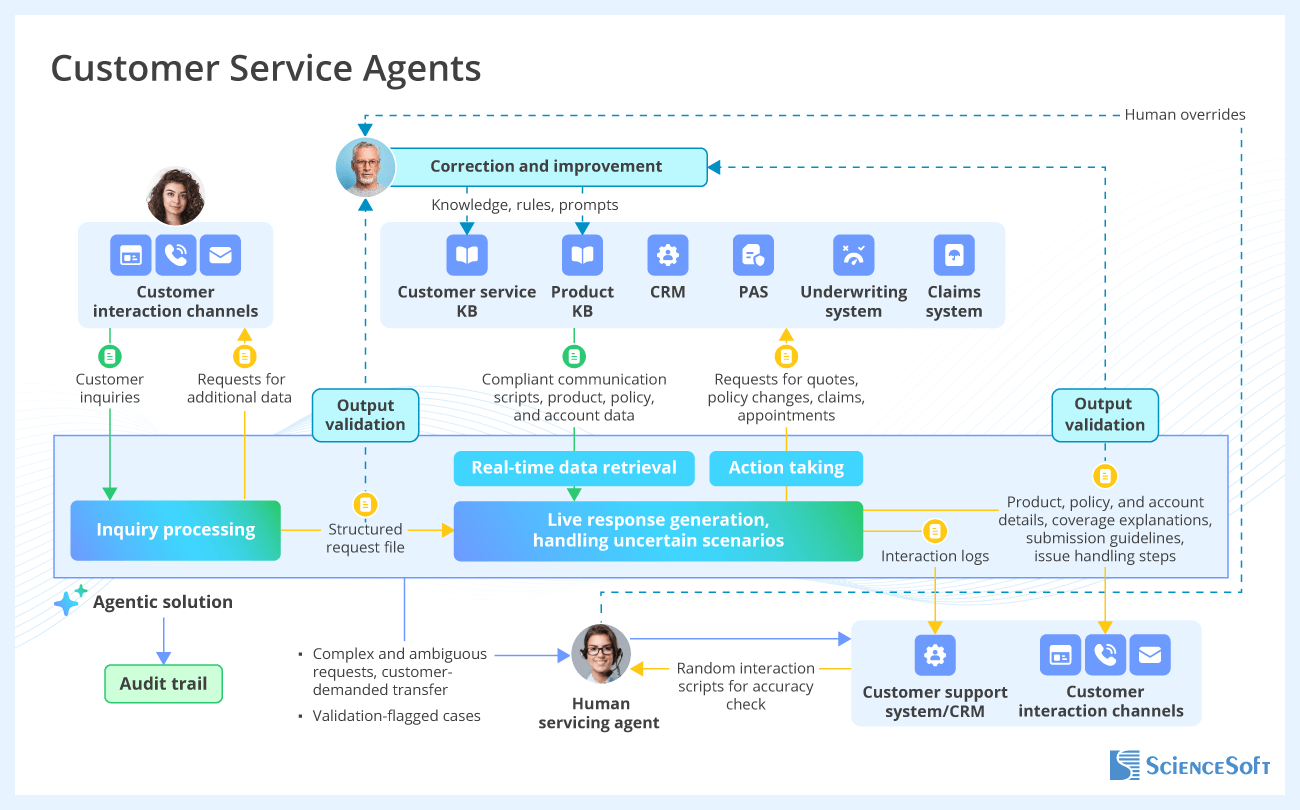
The agent entry point is a multi-channel interaction layer exposing APIs for web chat, mobile applications, messaging platforms, email, and voice interfaces (via speech-to-text and text-to-speech services). All customer interactions are normalized into a unified conversation state, allowing the agent to maintain context across channels, sessions, and handoffs.
The request is then processed by an inquiry understanding and decisioning layer. It identifies the customer's intent, extracts key entities, determines what information is still required, and decides whether the request can be handled autonomously or requires human intervention based on business rules, confidence thresholds, and predefined risk conditions.
Once the request is understood, the agent retrieves real-time information from enterprise knowledge sources and executes approved actions across enterprise apps, such as updating customer information, initiating claims, processing policy changes, scheduling appointments, or generating documents.
When autonomous resolution is not appropriate, a human handoff layer transfers the interaction together with a complete case package containing the conversation history, identified intent, extracted entities, retrieved evidence, business data, completed workflow steps, validation results, and the reason for escalation, allowing the human agent to continue the conversation without repeating previous work.
Before executing business actions, an output validation component verifies that the requested operation complies with business rules, regulatory requirements, permissions, and operational constraints. For sensitive scenarios, the workflow can require human approval before completion. The same layer can also validate generated responses to ensure they are based on approved information, follow defined communication guidelines, and do not contain unsupported claims.
The response generation layer produces real-time customer-facing replies using validated data, retrieved knowledge, workflow results, and approved dialogue patterns. When information is incomplete, conflicting, or uncertain, the agent requests clarification, applies predefined fallback scenarios, or escalates the interaction instead of generating unsupported responses.
Throughout the process, an audit trail records every interaction, AI decision, retrieved source, validation result, and business action. Conversation transcripts, summaries, case notes, and execution logs are automatically synchronized with CRM and other enterprise systems to support compliance, operational reporting, and future customer interactions.
Technologies and Tools We Use to Build AI for Customer Service
Generative AI
Models
- Large Language Models (LLMs)
- Small Language Models (SLMs)
- Multimodal models
- Computer vision models
- Image generation models
- ASR speech models
- TTS speech models
- Audio models
- Real-time
Model adaptation and efficiency
- Fine-tuning
- Instruction tuning
- LoRA adapters
- RAG
- Graph RAG
- Agentic workflows
AI platforms and services
- Azure OpenAI Service
- Amazon Bedrock
- Hugging Face Inference
- Oracle Cloud
- G42/Core42
Agents and Orchestration
- OpenAI Agents SDK
- OpenAI Agents
- AWS Agents
- LangChain
- LangGraph
- smolagents
- LiveKit
- Dify
- n8n
- Faiss
- ChromaDB
- Qdrant
- Weaviate
- OpenSearch
- Pgvector
- Amazon Neptune
- Graph RAG Toolkit
- Neo4j
Traditional ML
Platforms and services
- Azure Cognitive Services
- Azure Machine Learning
- Microsoft Bot Framework
- Amazon SageMaker AI
- Amazon Transcribe
- Amazon Lex
- Amazon Polly
- Google Cloud AI Platform
- Google Vertex AI
Frameworks and libraries
- Apache Mahout
- Apache MXNet
- Caffe
- TensorFlow
- Keras
- Torch
- OpenCV
- Apache Spark MLlib
- Theano
- Scikit Learn
- Gensim
- SpaCy
Data platform
- Azure Data Lake
- Amazon S3
- Google Cloud Storage
- Snowflake
- Databricks
- PostgreSQL
- Apache Kafka
- Apache Spark
Data integration and processing
- Azure Data Factory
- Apache Airflow
- Apache Kafka
- Apache Spark
Analytics and reporting
- Power BI
- Tableau
Common Challenges in Implementing AI-Assisted Customer Service
Challenge: Hallucinations in responses
AI models may generate confident but incorrect answers when knowledge bases are incomplete, outdated, or poorly structured, leading to wrong policy explanations, incorrect order information, or inconsistent service guidance across channels.
Solution:
ScienceSoft connects AI assistants to approved knowledge sources using retrieval-augmented generation (RAG), so responses are based on the latest knowledge base articles, CRM records, policy documents, and other authorized business content rather than the model's internal knowledge alone.
However, retrieving the right information does not guarantee a correct response. The AI may still misinterpret the retrieved content, combine information incorrectly, or generate an answer that conflicts with business rules. To reduce this risk, we add hard validation rules that verify responses against structured business data, such as pricing, eligibility criteria, refund policies, and other operational constraints, before they are delivered to customers.
For sensitive scenarios, we further restrict generation by allowing the AI to answer only within defined knowledge sources and approved response patterns. This helps ensure customers receive responses that are accurate, consistent, and aligned with company policies.
Challenge: Unclear decision boundaries between AI automation and human escalation (triage problem)
AI agents often struggle to determine when they can safely resolve a request versus when it requires human intervention. Incorrect autonomy can lead to policy violations or poor customer outcomes, while excessive escalation reduces the value of automation.
Solution:
ScienceSoft designs AI-powered customer service workflows with explicit decision rules that define which requests can be resolved automatically and which must be handed over to a human agent. These rules can consider factors such as the customer's intent, the type of request, applicable business policies, and predefined risk conditions.
Predefined rules alone are not always sufficient. Some requests are ambiguous, fall outside expected scenarios, or require judgment that AI should not make. To address this, we can implement an orchestration and decisioning layer that combines business rules with AI signals, such as intent classification, response confidence, customer sentiment, and detected uncertainty, to determine whether a request can proceed automatically or should be escalated.
When a case is handed over, we provide the human agent with the customer's intent, the information collected during the conversation, the conversation history, and recommended next steps so they can continue handling the request without asking the customer to repeat the same details.
Challenge: Conflicting, outdated, or incomplete business policies across systems
Policies often differ between departments, regions, legacy systems, and documentation layers. This leads to situations where AI retrieves multiple “valid” but contradictory instructions, resulting in inconsistent or non-compliant customer responses.
Solution:
ScienceSoft prepares knowledge bases for retrieval-augmented generation (RAG) so they are governed rather than populated with every available document. During knowledge preparation, we identify authoritative sources, remove duplicate or obsolete content, and apply versioning so that superseded policies are excluded from retrieval. This reduces the likelihood that the AI will rely on outdated information while keeping knowledge maintenance practical as policies evolve.
Even with a well-governed knowledge base, multiple applicable policies may still exist. For example, global, regional, and department-specific guidance can all be valid for different business contexts. Instead of relying only on semantic similarity during retrieval, we configure the system to evaluate governance metadata, such as policy version, effective dates, ownership, jurisdiction, and approval status, to identify the most relevant content.
If several valid sources remain, we apply explicit precedence rules that determine which policy takes priority (for example, legal requirements over regional policies, or regional policies over operational guidelines). When the conflict cannot be resolved automatically, the AI requests clarification, escalates the case to a human agent, or applies the safest permitted policy instead of attempting to reconcile contradictory guidance on its own.
How Much Does AI-Driven Software for Customer Service Cost?
The development costs of AI solutions for customer service typically range from $15,000 to $120,000+ for small, single-function solutions, while multi-agent, multi-system platforms can exceed $300,000–$1,000,000+, depending on integration depth, channels, and autonomy level. Other cost drivers include:
- Use case complexity and risk level.
- Required extent of data cleaning and preprocessing.
- Number of data sources and data volume and diversity.
- Non-functional requirements (usability, performance, security, etc.).
- Compliance with specific laws and regulations.
Here are ScienceSoft’s sample cost ranges for common development scenarios. These ranges cover the design and implementation work and exclude third-party component licenses, network fees, cloud hosting, and AI model usage:

$15,000–$60,000+
Customer service chatbots (knowledge-based assistants)
AI chatbot that answers common customer questions using FAQs and knowledge bases, handles simple requests, and escalates to human agents when needed.

$20,000–$80,000+
Agent copilots (employee-facing AI assistants)
AI tools embedded in CRM and help desk systems that summarize cases, draft policy-aligned responses, auto-fill standard data fields, and suggest next actions for human agents.

$80,000–$200,000+
Customer service agents (autonomous task execution)
AI agents that can handle customer requests end-to-end and perform independent actions in business systems, such as order management and bookings.

$150,000–$400,000+
Omnichannel AI customer service platforms
Centralized platforms combining AI live chat, voice, email, and messaging assistants with shared context, intelligent task routing, automated handling of selected cases, proactive outreach, and enterprise system integration.

$300,000–$1,000,000+
Enterprise-wide autonomous customer service ecosystems
Full-scale AI ecosystems enabling autonomous request resolution, predictive service, multi-agent coordination, and deep integration across enterprise systems with complex governance and compliance controls.
Want a More Precise Figure?
ScienceSoft's team is ready to provide a quote for your specific case.
What Partner With ScienceSoft for Customer Service AI Initiatives
- 37 years in AI engineering and software development for large-scale business operations.
- 13 years in designing and building customer service solutions.
- Expertise in 30+ industries, including healthcare, insurance, investments, lending, payments, finance, manufacturing, retail, and telecoms.
- 750+ specialists, including AI engineers, data scientists, back-end and front-end developers, DevSecOps, and cybersecurity experts.
- 20+ solution and technology architects who ensure AI can operate reliably and efficiently across real-world enterprise environments, where customer requests often span multiple systems, business rules, approvals, teams, and exceptions.
- 48 certified PMs and an in-house PMO to de-risk complex, rapid AI initiatives.
- In-house compliance consultants to align AI solutions with global standards (e.g., SOC 2, PCI DSS/SSF, NIST), regional privacy rules (e.g., GDPR, Saudi PDPL, CCPA), and sectoral regulations (e.g., HIPAA, SOX, GLBA, NYDFS).
What Our Clients Say



I honestly can’t say enough about how impressed I am with ScienceSoft. They delivered a fully customized AI medical chatbot PoC in just two weeks, which was unbelievable. It’s not often that you find a team that moves this fast without sacrificing quality.



Harding and Carbone has been very pleased with selecting ScienceSoft as our vendor for developing a client portal for our customers. Their professionalism, expertise, guidance, organization, and timing has been wonderful.


The B2B customer portal meets our business needs of enhanced pricing invoicing and contracting and overall client communication. We are fully satisfied with the solution and the assistance of ScienceSoft’s team.
Partnerships and recognitions

Named among America’s Fastest-Growing Companies by Financial Times, 5 years in a row
Winner of two 2026 AI Leader Awards: Best AI Solution for Financial Services and Best AI Solution for Insurance
HTN Now Awards 2025/26 finalist in the Best AI Scribe Solution category

Shortlisted in the Best Use of AI for Healthcare category at The 2026 A.I. Awards
Semifinalist in Amazon Nova Partner Demo Competition for real-time AI voice scheduler

Microsoft Solutions Partner for Data & AI

AWS Partner since 2017

ISO 9001-certified quality management system

ISO 27001-certified security management system, extended with ISO 27701 privacy controls
