 ScienceSoft Global
 Healthcare
 Insurance
 Investment



Custom AI Agent Development Services
As an AI transformation company with 21 years of experience in regulated industries, ScienceSoft develops custom AI agents that securely connect to enterprise systems, orchestrate multi-step tasks, and deliver fast, accurate, context-aware assistance at scale.
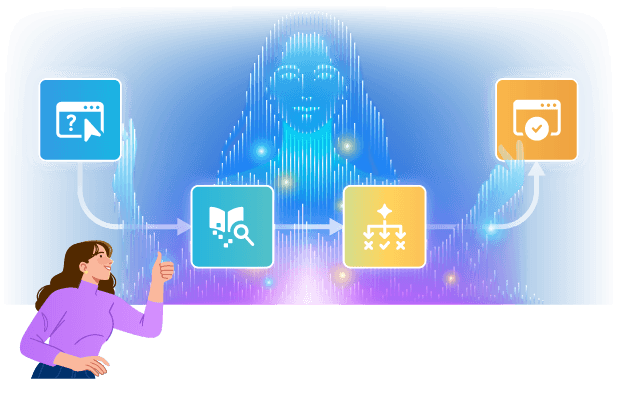

As enterprises scale GenAI adoption, they need solutions that do more than answer questions. An AI agent is an AI-powered software component that can update business records, trigger workflows, and make decisions based on current enterprise data. Custom AI agent development services are needed to build and integrate autonomous AI agents that can reason, make decisions, and execute multi-step business tasks across your systems and data while complying with your business rules and security policies.
Types of AI Agents We Build
ScienceSoft develops custom AI agents tailored to specific business processes and can embed them into existing enterprise systems, build workflow-specific modules, or deliver standalone AI agent solutions.
Healthcare

Prior authorization agent
Collects supporting clinical records, verifies payer requirements, prepares authorization requests, tracks case progress, and routes denials or exceptions for human review.

Patient access agent
Coordinates appointment scheduling, identity verification, patient intake, request confirmations, and status updates by interacting with scheduling, EHR, and patient management systems.

Referral management agent
Collects referral documentation, verifies specialist requirements, monitors referral progress, identifies missing information, and escalates delayed or incomplete referrals.

Care coordination agent
Converts discharge instructions, care plans, and visit summaries into follow-up tasks, monitors completion, sends reminders, and escalates missed activities or protocol deviations.

Clinical work queue agent
Prioritizes incoming clinical tasks, consolidates patient context, detects duplicate cases, routes work to appropriate teams, and prepares draft documentation for clinician review.

Revenue cycle agent
Verifies eligibility, resolves claim edits, requests missing documentation, tracks payer responses, updates case status across systems, and coordinates denial follow-up activities.
Insurance

Underwriting agent
Collects applicant information, retrieves supporting data, evaluates risk factors, prepares underwriting recommendations, and routes high-risk cases for manual approval.

Claims processing agent
Coordinates claims intake, validates claim information, gathers supporting evidence, tracks claim progress, and routes exceptions to claims specialists.

Compliance agent
Monitors business activities against internal policies and regulatory requirements, identifies potential compliance issues, prepares audit evidence, and escalates policy violations.

Fraud detection agent
Analyzes claims, transactions, and behavioral patterns, identifies suspicious activities, prioritizes investigations, and prepares supporting evidence for fraud analysts.

Policy administration agent
Processes policy updates, endorsements, renewals, and servicing requests while validating business rules and coordinating required approvals.

Billing and payment agent
Coordinates invoice generation, payment processing, reconciliation activities, payment reminders, and exception handling across financial systems.
Cross-industry

Customer service agent
Retrieves customer information, resolves routine service requests, updates CRM records, initiates business workflows, and escalates complex or high-value cases to service teams.

IT service desk agent
Diagnoses common IT issues, retrieves diagnostic information, creates and updates support tickets, executes approved remediation actions, and routes unresolved incidents to support engineers.

HR agent
Processes onboarding activities, leave requests, employee data updates, and HR service requests by interacting with HR systems while routing policy exceptions for HR review.

Enterprise knowledge agent
Retrieves information from enterprise knowledge bases, policies, procedures, technical documentation, and business records to support employee workflows and provide grounded recommendations.

Compliance agent
Reviews documents, transactions, and operational activities against internal policies and regulatory requirements, identifies potential violations, prepares audit evidence, and initiates remediation workflows.

Project management agent
Monitors project progress, consolidates updates from project tools, identifies delivery risks, prepares status reports, creates follow-up tasks, and coordinates project activities across teams.
Why Build AI Agents With ScienceSoft
- 37 years in AI, software engineering, and business process automation.
- 21+ years of experience and hundreds of software projects in healthcare and insurance.
- Expertise in investments, lending, payments, finance, manufacturing, retail, telecoms, and 20 other industries.
- 750+ specialists, including senior AI architects, data scientists, machine learning engineers, software developers, security experts, and DevSecOps engineers with 9–20 years of experience.
- An Architecture and Solutions CoE that continuously extracts and enforces best practices for designing AI systems that fully justify investments and remain resilient over time.
- A long-established PMO that applies lessons learned from thousands of our enterprise IT projects to control scope, priorities, quality, and budget in complex, fast-moving AI initiatives.
- In-house compliance consultants that help align AI solutions with global standards (e.g., SOC 2, PCI DSS/SSF, NIST), regional privacy rules (e.g., GDPR, Saudi PDPL), and sectoral regulations (e.g., HIPAA, FDA QMSR, SOX, GLBA, NYDFS).
- In-house compliance consultants to align AI solutions with global standards (e.g., SOC 2, PCI DSS/SSF, NIST), regional privacy rules (e.g., GDPR, Saudi PDPL), and sectoral regulations (e.g., HIPAA, FDA QMSR, SOX, GLBA, NYDFS).
Partnerships and recognitions

Named among America’s Fastest-Growing Companies by Financial Times, 5 years in a row
Winner of two 2026 AI Leader Awards: Best AI Solution for Financial Services and Best AI Solution for Insurance
HTN Now Awards 2025/26 finalist in the Best AI Scribe Solution category

Shortlisted in the Best Use of AI for Healthcare category at The 2026 A.I. Awards

Claude Certified Services Partner

Microsoft Solutions Partner for Data & AI
AWS Partner since 2017

ISO 9001-certified quality management system

ISO 27001-certified security management system, extended with ISO 27701 privacy controls
AI Agent Capabilities We Deliver
ScienceSoft develops custom AI agents that can combine reasoning, knowledge retrieval, tool use, and workflow automation to perform business tasks across enterprise systems. AI agents can be implemented as standalone solutions or embedded into existing applications, employee platforms, customer portals, and business workflows.

Goal understanding and task planning
AI agents analyze user goals, business requests, and operational context provided through natural language instructions, structured business events, system data, API responses, and workflow states. They interpret these inputs to determine the required actions, create execution plans (that can be adapted based on intermediate results), and select appropriate tools.

Enterprise knowledge retrieval and grounding
AI agents can access approved enterprise knowledge sources, including documents, policies, databases, tickets, and business applications, to retrieve relevant information before making decisions or generating outputs. RAG and GraphRAG approaches help keep agent responses grounded in current business data.

Context and memory management
AI agents maintain relevant context about users, tasks, previous interactions, and workflow states. Memory mechanisms enable agents to continue multi-step processes across sessions while preserving necessary information and avoiding repeated data collection.

Tool use and enterprise system integration
AI agents can securely interact with enterprise applications and external services through APIs, MCP servers, and other integration mechanisms. They can retrieve data, create and update records, trigger workflows, and complete approved transactions.

Multi-step workflow execution
AI agents can automate complex business processes by coordinating multiple actions across tools and systems. For example, an agent can validate a request, retrieve required information, apply business rules, update enterprise records, generate documents, and notify relevant stakeholders.

Decision support and business rule execution
AI agents analyze information, compare options, identify inconsistencies, and prepare recommendations based on business rules and available data. For high-impact decisions, agent outputs can be combined with deterministic validation, approval workflows, confidence thresholds, and human review.

Role-based access and action control
AI agents operate within defined permissions and security boundaries. Access controls determine which data sources, tools, and actions are available to each user, while governance mechanisms help prevent unauthorized data access or inappropriate automated actions.

Human-in-the-loop collaboration
AI agents can identify situations requiring human involvement based on confidence levels, business impact, risk thresholds, or predefined escalation rules. Human reviewers can approve actions, provide corrections, or take over complex cases while retaining full task context.

Multi-agent collaboration
Multiple specialized AI agents can work together to complete complex processes. For example, a customer service agent, document analysis agent, and compliance agent can coordinate their activities under a central orchestration layer to solve broader business tasks.

Autonomous monitoring and proactive actions
AI agents can monitor events, system changes, deadlines, and business conditions to initiate predefined actions when required. Examples include identifying overdue tasks, detecting operational issues, initiating follow-ups, or triggering workflow automation.

Agent performance monitoring and optimization
AI agent operations can be monitored through evaluation frameworks and observability tools that track task completion rates, accuracy, tool usage, latency, costs, and failure patterns. These insights help improve prompts, workflows, knowledge sources, and agent behavior over time.
Explore the Most Requested AI Agent Scenarios
Conversational AI Assistant for Appointment Scheduling
See how conversational AI can be leveraged to automate complex interactions like appointment scheduling in healthcare. Deployed in Amazon Cloud and powered by Amazon’s Nova Sonic Speech-to-Speech model, the agent can cut operational costs by 50%.
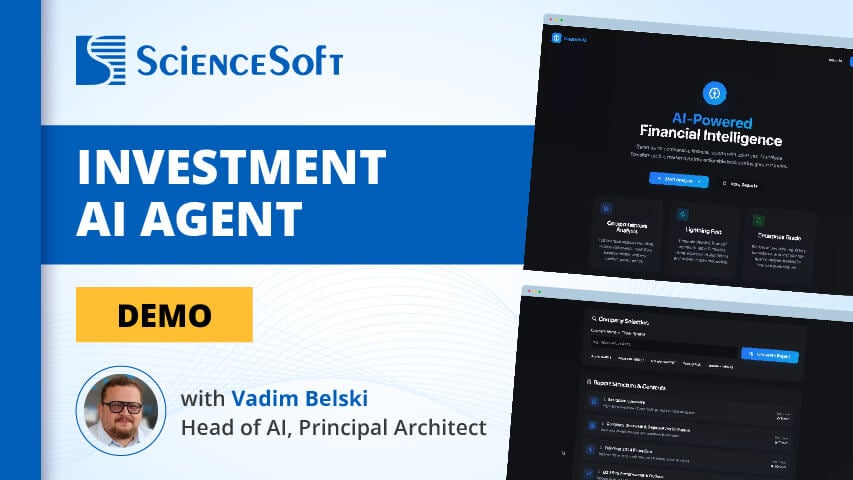
Agentic AI for Transforming Investment Decision-Making
See how agentic AI helps investment teams uncover market insights and make smarter decisions. Built on LangChain and OpenAI LLMs, the agent can speed up investment analysis by up to 70% and boost analyst productivity by over 50%.
Voice AI Agent for Insurance Claim Validation
See how agentic AI helps insurers spot fraudulent claims. Developed on AWS Bedrock AgentCore and OpenAI’s leading LLMs, the solution boosts investigator capacity by over 40% and drives 20%+ higher fraud detection rates through call-based claim verification.
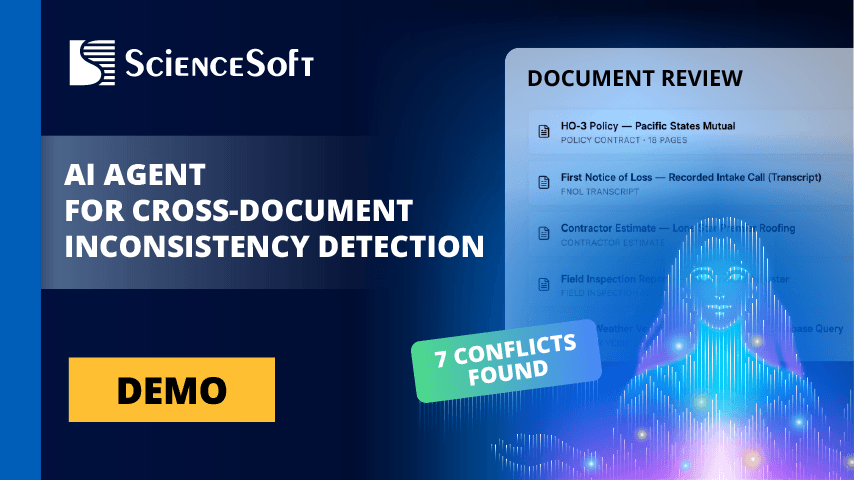
AI Agent for Cross-Document Inconsistency Detection
See how an AI agent speeds up cross-document review during insurance claim investigation. The agent identifies critical conflicts, recommends SIU referral, drafts the outreach email, and keeps the full audit trail ready for review.
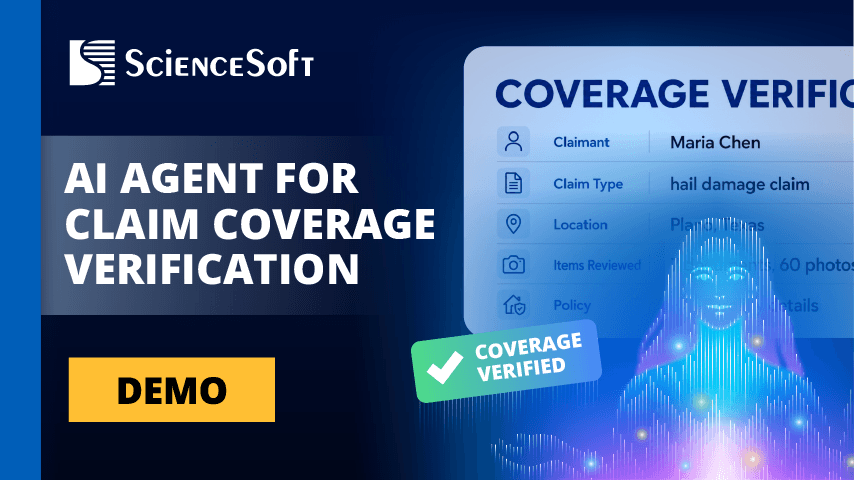
AI Agent for Insurance Claim Coverage Checks
See how an AI agent captures claim details, analyzes policy documents, interprets coverage terms, exclusions, and endorsements, and determines whether a claim is covered.
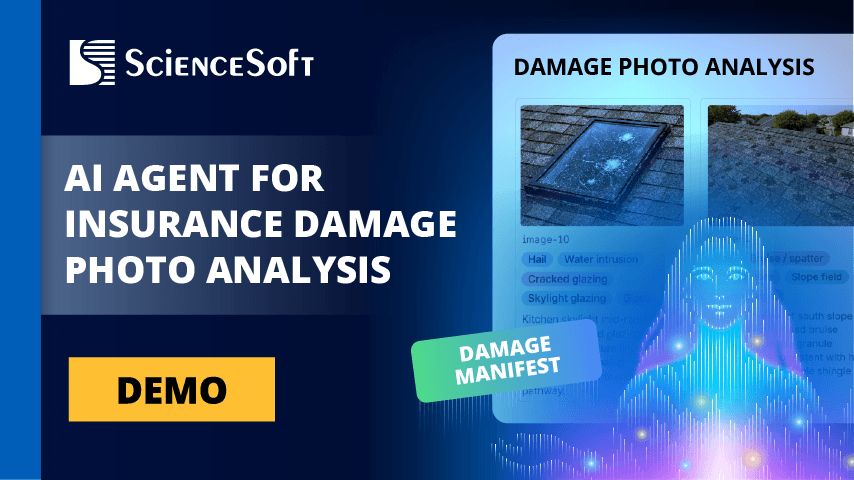
AI Agent for Insurance Damage Photo Analysis
See how an AI agent analyzes damage photos, identifies affected asset components, evaluates damage severity, and generates structured findings that can be integrated into downstream claims workflows within minutes.
AI Agent vs. AI Chatbot vs. AI Workflow
|
|
AI chatbot |
AI agent |
AI workflow |
|---|---|---|---|
|
What it is
|
Conversational interface for users |
Autonomous AI that can reason, plan, and execute tasks |
A predefined sequence of automated steps. AI may be used in one or more steps, but the workflow itself is orchestration. |
|
Can use tools?
|
Sometimes |
Yes |
Often |
|
Can make decisions?
|
Usually limited |
Yes |
No (follows a defined flow) |
|
Example
|
Answers HR questions, helps reset passwords |
Creates a support ticket, gathers logs, updates Jira, notifies the user |
Employee asks for PTO → AI extracts dates → Workflow checks balance → Workflow requests manager approval → HRIS updated → Employee notified |
Sample Architecture for a Customer Support Agent
Below, ScienceSoft’s solution architects describe a real-world architecture for a customer support AI agent designed to automate customer service operations across digital channels. The agent can handle a wide range of post-purchase interactions, including order tracking, returns and refunds, billing inquiries, product troubleshooting, account updates, and proactive customer notifications.
The same architectural principles apply to other customer-facing AI agents, such as insurance claims agents, banking service agents, or healthcare patient support agents. The main differences are the business systems involved, authentication requirements, regulatory controls, and permitted actions. The core design remains consistent: separating agent responsibilities, securely identifying users, controlling access to customer data, enforcing business rules before executing actions, and connecting the agent to trusted enterprise systems through controlled interfaces.
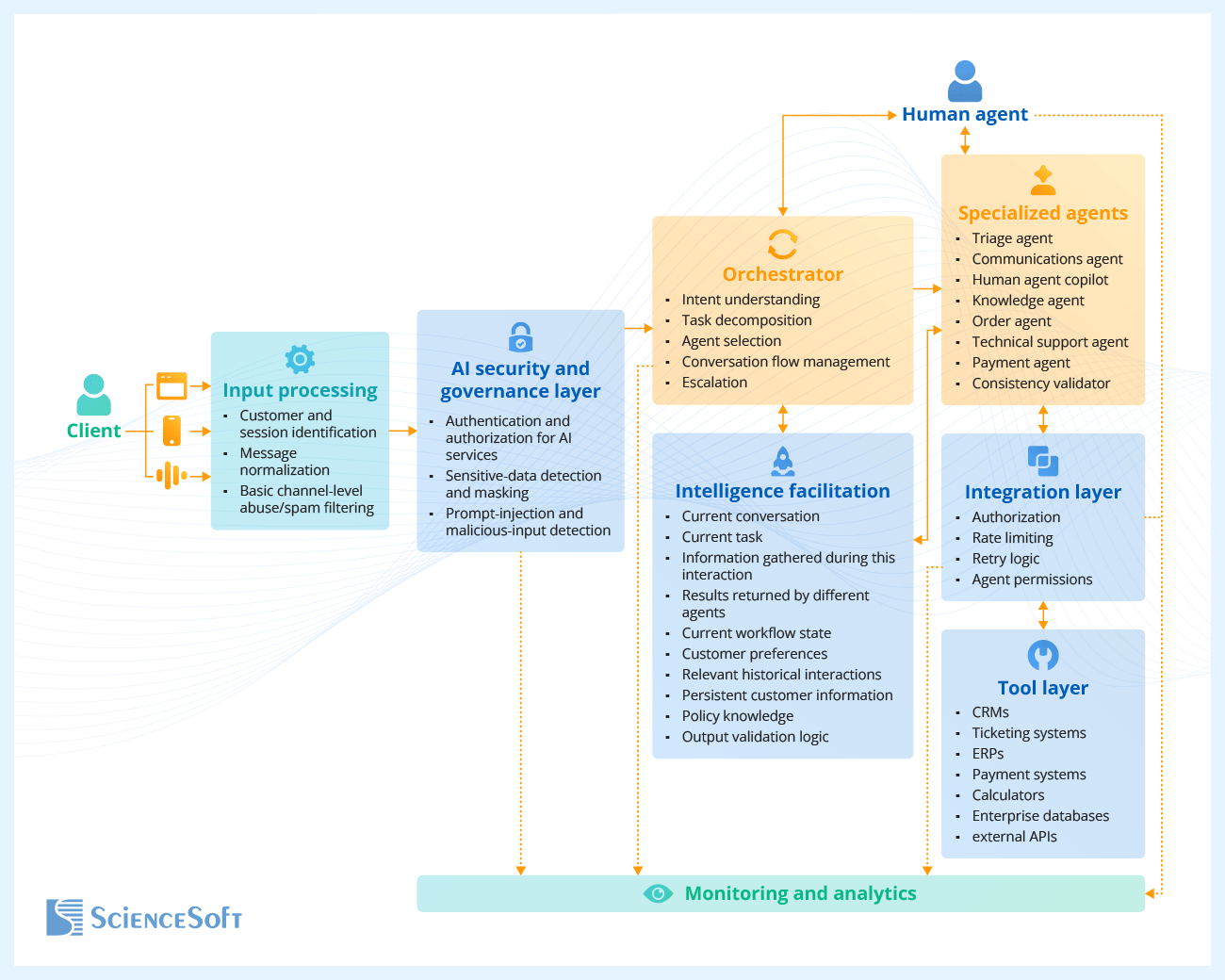
The AI agent is embedded into customer communication channels, including web chat, mobile applications, messaging platforms, and voice interfaces. Each interaction begins with customer identification and context resolution through authentication mechanisms such as OAuth2, JWT-based authentication, customer account lookup, or session-based verification. This allows the agent to determine the customer's account context, available services, previous interactions, and permitted actions before processing a request.
At the center of the architecture is an AI agent orchestrator that coordinates all customer interactions and backend operations. It interprets customer intent, maintains interaction context, selects the appropriate tools, applies business rules, and manages task execution from request to completion. Rather than allowing the LLM to directly access business systems, the orchestrator controls which capabilities are available to the agent, which actions require additional verification, and when human involvement is required. It determines whether a request should be answered from the knowledge base, resolved through a business transaction, or escalated to a support specialist. For example, a request such as “Where is my order?” may trigger a read-only lookup in the order management system, while “I want a refund” may initiate a structured refund workflow with eligibility checks, approval rules, and fraud validation.
Task-specific agents execute narrowly defined customer service operations within controlled boundaries. Each agent is connected only to the systems and tools required for its responsibility and operates with the minimum permissions necessary. For transactional requests, task-specific agents connect to enterprise systems such as:
- Order management systems (Shopify, SAP Commerce, Adobe Commerce) for order tracking, cancellations, shipment status, and fulfillment updates.
- CRM and customer service platforms (Salesforce Service Cloud, Zendesk, Dynamics 365 Customer Service) for customer profiles, cases, interaction history, and escalation management.
- Payment and billing systems (Stripe, Adyen, ERP billing modules) for invoice inquiries, payment status checks, and refund processing.
- Returns management systems for return eligibility checks, RMA creation, and return status tracking.
For information-based requests, the orchestrator routes queries to approved knowledge sources, including product documentation, FAQs, troubleshooting guides, warranty policies, shipping rules, and service procedures. Retrieval combines semantic search, keyword search, metadata filtering, document ranking, and, where required, live system queries. Access controls ensure that the agent retrieves only information appropriate for the customer, region, product type, account status, or support context. For example, the agent may use product documentation to explain troubleshooting steps while simultaneously retrieving account-specific warranty information from CRM or order systems.
A proactive communication module allows the AI agent to initiate customer interactions based on predefined business events rather than waiting for customer requests. For example, the AI agent can notify customer about shipment delays, remind them about incomplete return requests, or inform them about service appointment changes. Events from order management, CRM, logistics, or monitoring systems trigger predefined agent workflows, while business rules determine when and how customers should be contacted.
Certain customer actions require human review based on business rules, financial thresholds, risk indicators, or regulatory requirements. An approval and escalation engine manages these scenarios by routing requests to appropriate support teams and providing the necessary context (customer information, conversation history, requested action, retrieved records, validation results, etc.). Examples include refunds above a configured threshold, account changes with security implications, suspected fraud cases, and unresolved issues after repeated attempts. The AI agent continues to manage the interaction context but does not complete restricted actions until required approval is received.
A guardrails layer protects customer data and controls agent behavior across the entire interaction lifecycle. Before processing requests or executing actions, the guardrails layer verifies:
- Customer identity and authentication status.
- Available permissions.
- Allowed operations for the current context.
- Applicable business policies.
It also enforces technical and data protection controls, including:
- PII detection and masking before information is sent to AI models or stored in logs.
- Removal of payment card details and other sensitive identifiers from prompts and observability data.
- Prevention of unauthorized account changes.
- Rate limiting and abuse prevention.
After execution, the same layer can inspect outputs, verify that responses do not expose restricted information, and attach audit metadata.
An observability layer captures the complete execution trail of customer interactions, including customer requests, detected intent, retrieved information sources, tool calls, business actions performed, approvals and escalations, and final responses. This data is stored in secure audit repositories and used for troubleshooting, compliance reporting, performance analysis, and agent optimization. Operational metrics such as resolution rate, escalation frequency, failed tool calls, response accuracy, and customer feedback help identify where the agent requires improvement and support continuous refinement of prompts, workflows, knowledge sources, and integrations.
ScienceSoft’s Services for Custom AI Agent Implementation

AI strategy and agent architecture
We help organizations identify high-value AI agent use cases, assess their feasibility, and design agent-based solutions that deliver measurable business outcomes. Our consultants and architects analyze your business processes, enterprise systems, data landscape, security requirements, and automation opportunities to define the right level of agent autonomy.
We design the target architecture, select appropriate AI models and technologies, define agent workflows and tool integrations, establish governance and security controls, and create a practical roadmap for implementation and scaling.

Custom AI agent engineering and deployment
We design and build custom AI agents that can understand business goals, reason through tasks, use enterprise tools, and execute multi-step workflows across your systems and data sources.
Our teams handle the full implementation lifecycle — from knowledge preparation and RAG/GraphRAG capabilities to agent orchestration, memory design, MCP/API integrations, workflow automation, access controls, and human-in-the-loop mechanisms.

AI agent testing, monitoring, and optimization
We help organizations ensure that their AI agents are accurate, secure, and effective. Our teams implement agent evaluation frameworks, observability, performance monitoring, and governance mechanisms to track task completion, decision quality, tool usage, costs, and risks.
We continuously improve deployed agents by refining prompts and workflows, optimizing integrations, updating knowledge sources, and adapting agent behavior based on real-world feedback and changing business requirements.
Let’s Discuss Your AI Initiative
Whether you’re exploring your first AI agent use case, looking to automate complex workflows, or scaling an existing AI solution beyond a pilot, we can help. Our experts can discuss your goals, challenges, and opportunities in a practical, non-binding consultation.
AI Agent Development Process
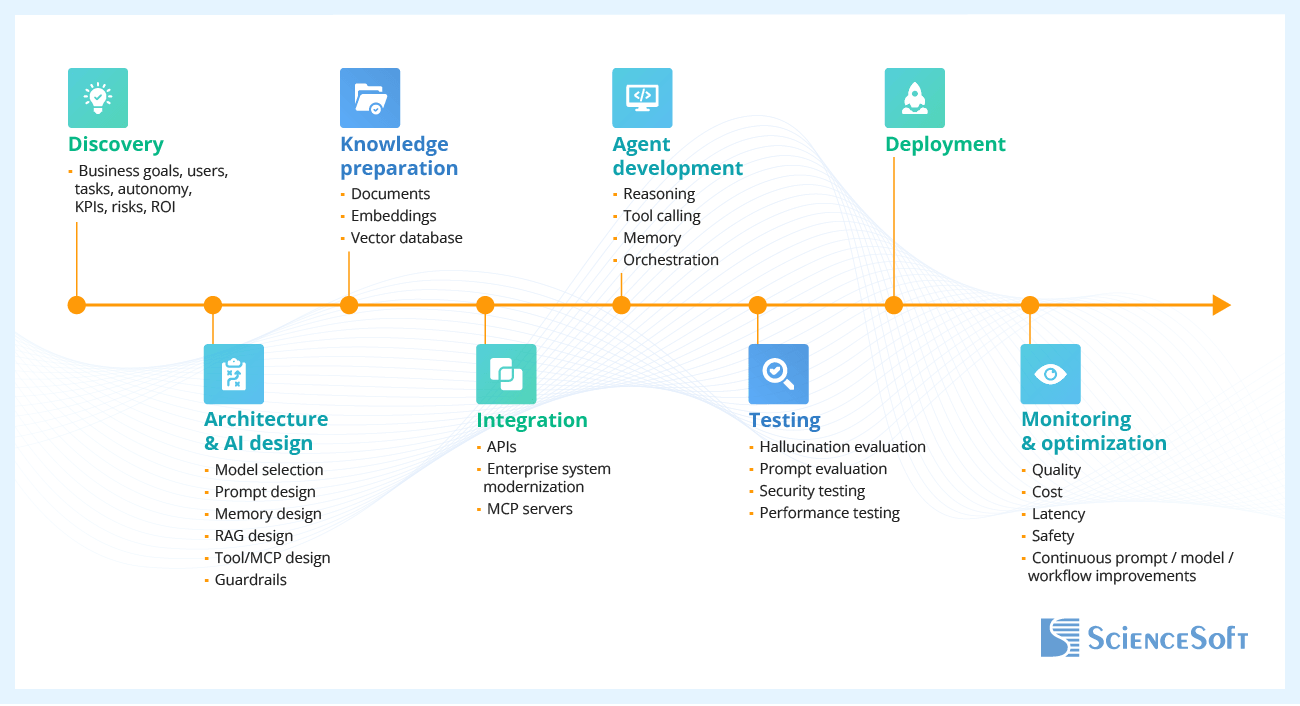
Key Concerns When Implementing AI Agents and How ScienceSoft Addresses Them

Challenge #1: AI agents can take incorrect actions
If an agent relies on incomplete information or unrestricted LLM reasoning, it may select the wrong tool, execute an inappropriate action, or modify business records incorrectly.
Solution by ScienceSoft
Challenge #2: AI agents may act on outdated or conflicting business rules
Enterprise policies, approval rules, pricing models, and operating procedures change continuously. If an AI agent retrieves an obsolete document or encounters multiple conflicting versions of the same policy, it may execute the wrong action or make an incorrect recommendation.
Solution by ScienceSoft
Challenge #3: AI agents introduce governance and security risks
AI agents may expose confidential information to AI providers, retrieve more data than necessary, invoke unauthorized tools, or perform actions that violate business policies or compliance requirements.
Solution by ScienceSoft
How Much Does AI Agent Development Cost?
Custom AI agent development costs typically start at $40,000–$120,000 for domain-specific agents that retrieve enterprise data, invoke a limited set of tools, and automate well-defined business tasks. Enterprise AI agents with extensive system integrations, long-running workflows, human approval mechanisms, and advanced governance typically cost $120,000–$350,000. Highly autonomous, multi-agent systems orchestrating complex business processes across numerous enterprise applications can require $350,000–$1,000,000+, particularly in regulated industries where explainability, security, and operational resilience are essential.
Below are ScienceSoft's indicative implementation cost ranges. The estimates cover design, development, integration, testing, and deployment and exclude software licenses, cloud infrastructure, and AI model usage fees.

$40,000–$120,000
AI agent that automates a well-defined business function, such as knowledge retrieval, document processing, employee support, or CRM updates. These agents typically use RAG, connect to a small number of enterprise systems through APIs or MCP servers, invoke predefined tools, and execute deterministic workflows under human supervision.

$120,000–$350,000
Enterprise AI agent that performs multi-step business processes across several enterprise applications. These agents retrieve and update business data, coordinate actions across systems such as ERP, CRM, ITSM, and HR platforms, manage approvals, and adapt execution based on changing business context while operating under enterprise security and governance policies.

$350,000–$1,000,000+
Enterprise agentic AI platform or multi-agent system coordinating specialized AI agents across departments and business domains. These solutions dynamically plan and orchestrate long-running workflows, collaborate through shared memory and orchestration frameworks, balance autonomous decision-making with human oversight, and maintain reliability, auditability, and compliance while operating across complex enterprise ecosystems.
Disclaimer: The figures shown are indicative only and do not represent ScienceSoft's official pricing. We estimate each project individually based on the client's requirements, existing environment, and business objectives.
Client Review


They are reliable, thorough, smart, available, extremely good communicators and very friendly. We would recommend hiring ScienceSoft to anyone looking for a highly productive and solution-driven team.


They collaborated with our medical professionals with great professionalism and care, respecting the research environment and its unique challenges. We found ScienceSoft to be dependable and forward-thinking, and we would confidently recommend them for high-responsibility projects.

They delivered a fully customized AI medical chatbot PoC in just two weeks, which was unbelievable. The attention to detail in the chatbot design, and especially the pitch deck, was amazing — with this kit on hand, we are ready to go into investor discussions confidently. It’s not often that you find a team that moves this fast without sacrificing quality.


ScienceSoft is dedicated to handling any problem that occurs as a result of hardware or software issues; simply put, they will go the extra mile to support their customers regardless of the time of day these issues arise.


We have cooperated with ScienceSoft on the evolution of our main product, an AI-powered tool that helps detect and fix vulnerabilities in software code. ScienceSoft’s team did a solid job for us. They are extremely competent and committed.
