 ScienceSoft Global



8 Practical Questions Insurance Leaders Should Ask Before Investing in Claims AI

Related topics:
5 min read
Last updated:
Editor's note: Vital Soupel, Senior Insurance IT & AI Consultant at ScienceSoft, shares practical AI use cases for insurance claims, highlights where AI delivers the fastest business value, and addresses the key technical, operational, and governance challenges insurers face when implementing and scaling claims AI initiatives.
Insurers have different questions about claims artificial intelligence (AI) today than they had just a couple of years ago. As early adopters continue to report measurable efficiency and capacity gains from their AI programs, the conversation has shifted from whether AI can create value in claims to how to implement it successfully.
The focus is now on practical things: Where should we start? Which claims tasks are ready for automation, and which should remain under adjuster control? How do we connect AI to legacy platforms? How do we make AI outputs explainable, auditable, secure, and reliable enough for production use?
In my recent conversations with insurance business and technology leaders, these were the questions that came up most often. If you're considering AI for claims, chances are many of these already sound familiar. Below is my practical take on each.
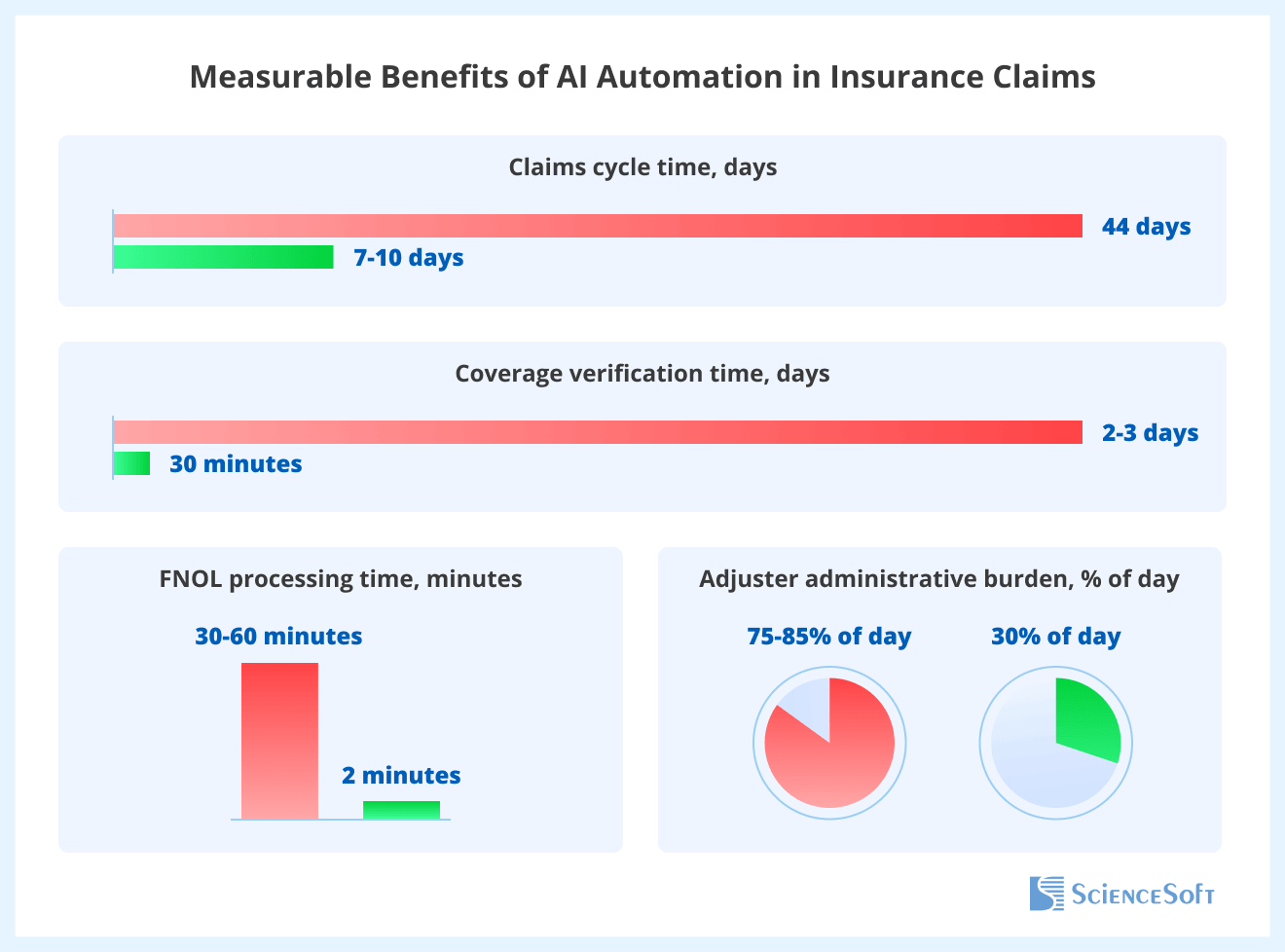
Illustrative figures ScienceSoft prepared for the Insurance Tech & Innovation Conference 2026 in Chicago
What Claims Tasks Are Good as Early Candidates for AI Automation?
Begin where the work is repetitive, document-heavy, and largely rule-driven. Strong starting points are FNOL intake, evidence classification and validation, policy and coverage lookup, estimate extraction, adjuster note generation, status updates, and claim triage.
These tasks are both structured enough for AI to automate reliably with minimal to no human involvement and time-consuming enough for the claims team to feel the impact within the first few weeks after deployment.
My general advice is straightforward: if a task doesn't require adjuster judgment or actual claims decisioning, it's a good entry point for AI. Modern AI can certainly support more complex areas like negotiation, legal interpretation, reserve suggestions, or even settlement decisions. But those are advanced use cases. They require a mature AI control framework, clear authority limits, and well-defined human oversight to support reliable automation. In my experience, insurers get better long-term results when they build the technical foundations and adjuster trust through simpler deployments before moving AI into judgment-heavy parts of claims. Pushing AI into the hardest decisions from day one usually creates unnecessary governance and adoption risks.
Is End-to-End Claims Automation With AI Actually Possible?
Automation rates of 95%+ are real, but only for simple, highly standardized claims and only with the right controls in place.
For example, low-severity property, auto, travel, and similar personal claims can be automated almost entirely. AI can intake the claim, validate policy terms, review evidence, assess claim complexity, route exceptions, prepare communications, recommend payment based on predefined rules, and trigger a payout. Here, we’re looking at an agentic AI system where agents not just automate isolated claims tasks but also own the surrounding workflow: coordinate handoffs, collect claim data, check business rules, call the right tools, and pass the outputs to the next step.
You can already see these use cases in production. Allianz's Project Nemo, for instance, uses AI agents to automate real-life food spoilage claims. However, the insurer still keeps humans in the loop for outstanding cases and final disbursement decisions.
For more complex claims (L&A, commercial, specialty, and litigated are primary examples), the safer model is partial automation with human checkpoints. In this scenario, you need a conversational AI assistant for claims teams rather than autonomous agents. At an adjuster’s request, the assistant can handle intake, document processing, summarization, and decision support, while adjusters remain responsible for judgment, exceptions, direct customer communication, and final claim and payout decisions.
That may sound less exciting than full automation, but in my experience, this is usually where insurers can create value faster and with less risk. From there, you can gradually move to bigger AI autonomy.
Overall, I'd be careful with the phrase end-to-end claims automation. Vendors often use it too loosely and present 100% autonomous claims as the destination, which is a fundamentally wrong objective. The goal should be measurable business outcomes. If AI can automate 50% of your simple claims and help adjusters handle the rest faster and more consistently, that’s already a strong business case. It’s a far more realistic definition of success.
Do We Have to Modernize Our Legacy Claims Systems to Implement AI?
In practice, very few insurers I work with have the luxury of a modern, unified technology stack. Most of organizations operate a mix of core claims and policy platforms, document systems, email, payment platforms, data stores, portals, and specialized legacy apps that everyone complains about but still depends on.
The good news is that none of this needs to be replaced before deploying AI.
A layered AI architecture is usually the most practical way to deal with this reality (sharing ScienceSoft’s reference AI architecture for P&C claims here so you can quickly get the idea). In such an architecture, AI components are enabled through a separate agentic intelligence layer rather than embedded into the core claims platform. The claims platform remains the system of record for claims data and events, while AI automation runs in a dedicated environment with controlled access to the necessary data and workflows.
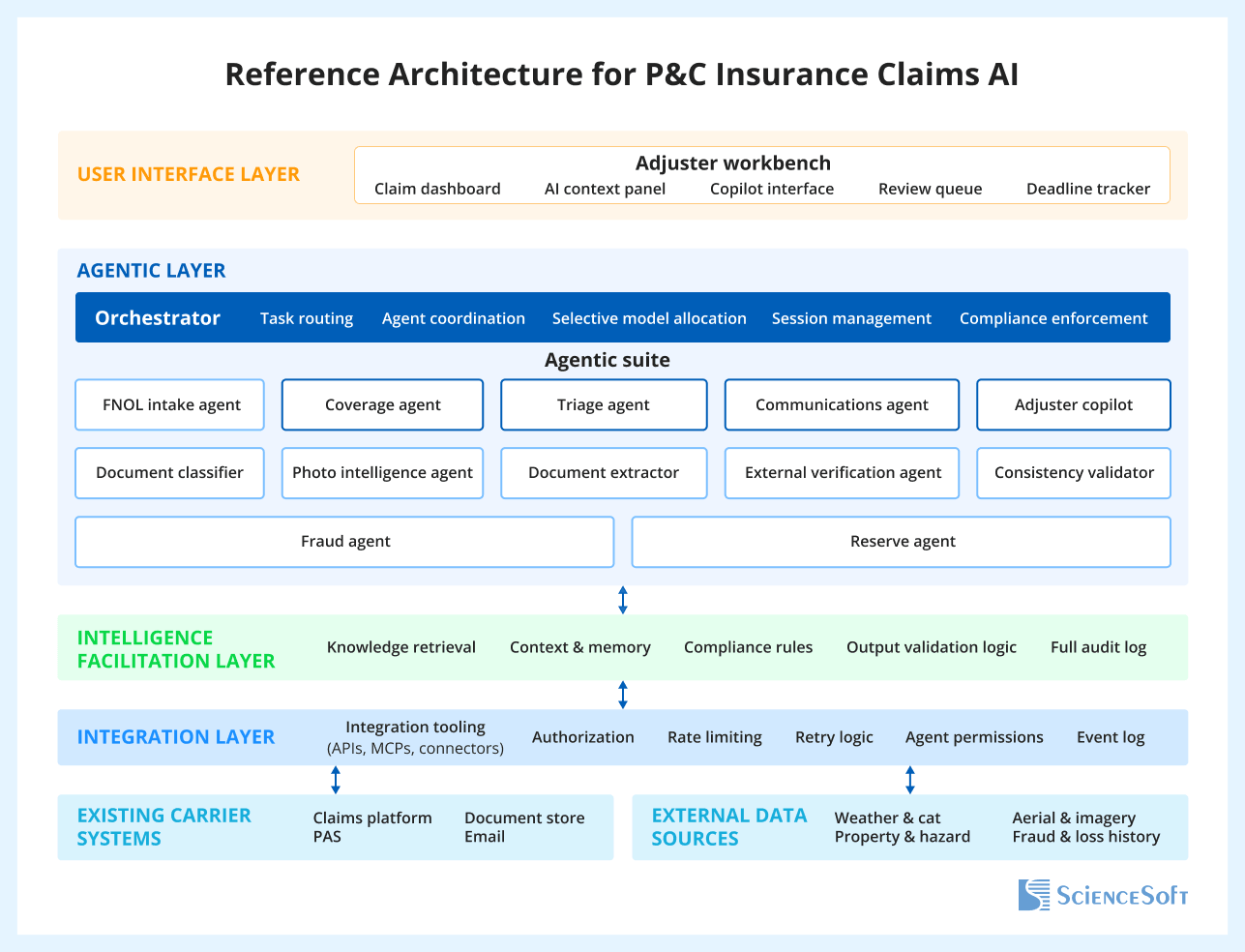
An extended blueprint of the layered AI architecture for P&C claims ScienceSoft presented at the Insurance Tech & Innovation Conference 2026 in Chicago
This approach allows you to add agentic AI capabilities without forcing major changes to your existing platforms. Depending on the use case and integration pattern, core claims systems may require limited or no modification. AI can retrieve claim documents, policy terms, adjuster notes, and business rules from existing systems, perform a defined task, and then return structured outputs through controlled integration points.
The layered architecture also gives you flexibility in how users interact with AI. You can embed claims AI control dashboards and assistant interfaces into one of your existing claims platforms or build a separate claims copilot app.
How Do We Actually Integrate AI With Our Existing Systems?
The answer largely depends on your AI scaling ambition.
If you only need an AI assistant that summarizes claim files or retrieves policy terms on request, then read-only point integrations would be enough. A copilot can connect to the claims platform and document repository, retrieve relevant information, and present it to the adjuster without changing the underlying workflow.
But if you want to scale AI agents across multiple claims processes, point connections to every app and data source in your stack may quickly become an engineering and security nightmare. In this case, ScienceSoft has found building a dedicated integration layer is a cheaper and operationally safer option.
The integration layer essentially acts as a single controlled gateway between the agentic intelligence layer and the broader claims software system, eliminating the need to build a bunch of separate AI integrations. As integration pipelines are decoupled from the rest of the AI system, you can add, change, and remove integrations without rewriting AI logic or breaking agentic operations.
We usually design the integration layer to support diverse technologies: APIs, protocols, middleware, custom connectors, and, where necessary, robotic process automation (RPA) interfaces. RPA is not ideal as a long-term integration strategy, but in insurance it can still be a practical bridge when important legacy systems do not expose modern APIs.
How Do We Prevent Hallucinations and Other AI Errors in Claims Processing?
Ironically, you usually get it by limiting AI’s “intelligence” so the system has little room to invent and mishandle anything.
The first step is to ground AI reasoning in trusted company data. This is usually done through retrieval-augmented generation (RAG). Think of it as a mechanism forcing the AI system to look up relevant claim documents, policy clauses, adjuster notes, estimates, guidelines, and other approved sources across your existing systems and knowledge bases before generating an answer or suggestion. This dramatically reduces the risk of fabricated facts because AI is working from the same data your adjusters would use.
The second step is to limit where AI is allowed to reason. This is exactly why modern claims AI architectures rely on multiple narrow agents handling specific operations (FNOL intake, evidence verification, claims triage, and so on) instead of one super-agent attempting to handle the entire claim. Each niche agent can be built on the AI model that best fits its specific task, and many tasks don’t require reasoning-capable large language models (LLMs) at all. That means you can eliminate hallucination risk from some parts of the claims workflow altogether.
Document classification, data extraction, policy clause retrieval, and visual evidence intake are good examples. ScienceSoft usually automates these tasks with agents built on encoder AI models rather than LLMs. The purpose of these models is to capture and structure data from existing sources. They don’t reason or draw conclusions, so they can’t fabricate anything by design.
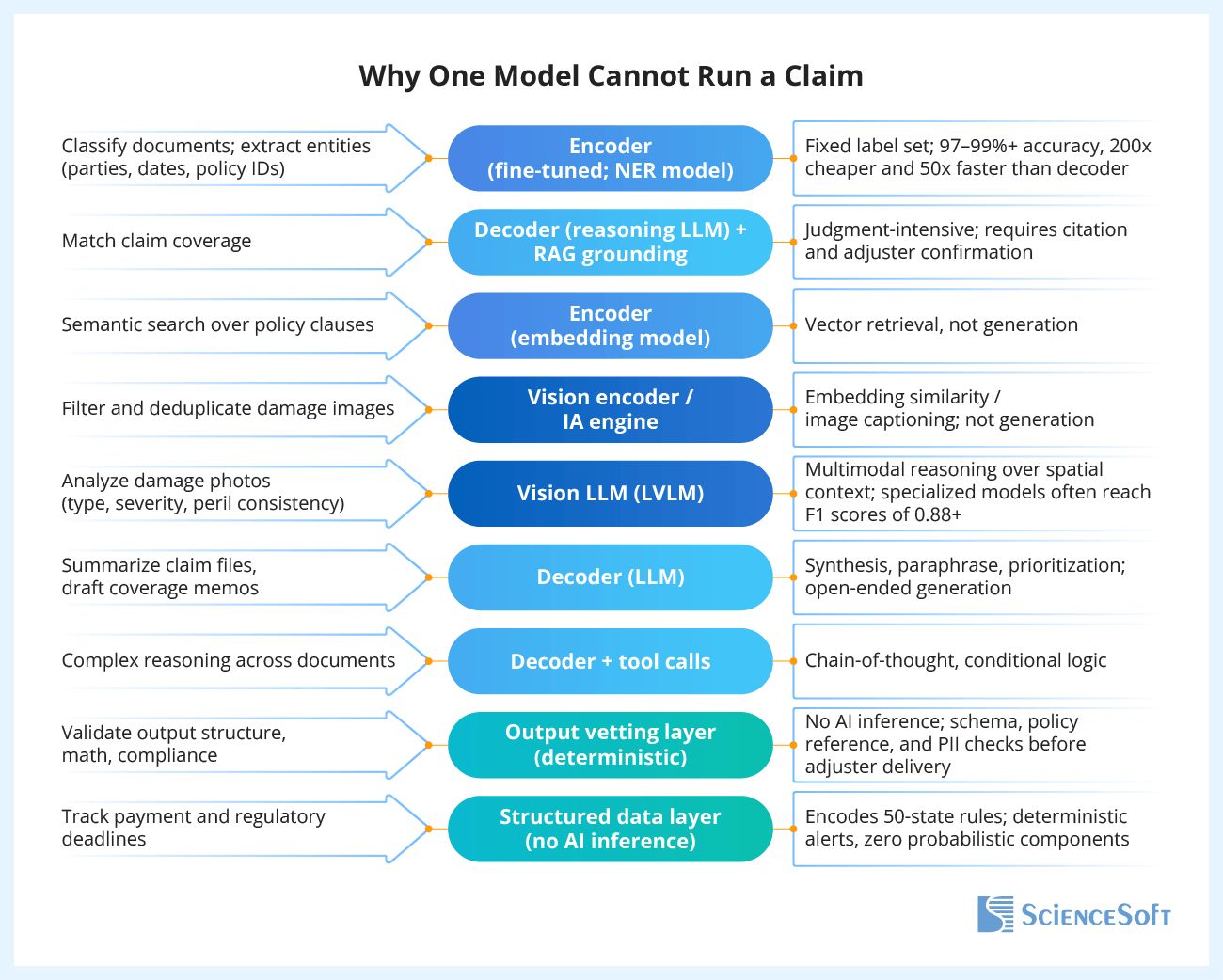
That said, encoder models can still make mistakes: misclassify a document, extract the wrong claim number, or assign evidence to the wrong case. Left unchecked, these errors can create bad inputs for downstream AI agents and eventually lead to incorrect AI reasoning.
That's why ScienceSoft typically adds deterministic validation mechanisms. The validator service checks AI outputs against required data structure, business rules, and trusted systems of record after each claim processing step. It detects missing and conflicting data, scores the output’s confidence, and matches the score to the preset confidence thresholds. Depending on the validation results, the engine can then move high-confidence results to the next step or route low-confidence cases for additional validation or manual checkup.
Human review should remain part of the architecture, but it shouldn't be the default accuracy safeguard. The better approach is multi-level control: rule-based validation for all AI outputs, with automated processing of low-risk, high-confidence cases and escalation to adjusters only when the system detects uncertainty, gaps, or risky conditions requiring explicit human approval.
Finally, implement continuous AI behavior oversight to monitor model performance, response quality, confidence scores, drift, and unusual agent behavior. This makes it easier to identify and resolve AI degradation before it starts affecting claims operations. At ScienceSoft, we typically use observability tools like OpenTelemetry or LangSmith for that.
How Do We Demonstrate Compliance of AI Claims Operations to Regulators?
Auditability is the foundation of regulatory evidence. If you cannot reconstruct how an AI-assisted claim was processed, it will be difficult to demonstrate that the process was fair, consistent, and compliant.
An audit trail should capture the full AI decision context: source data used by the AI system, model and prompt versions, AI outputs, confidence scores, business rules applied, exceptions detected, human interventions, and the final action taken. This gives compliance and claims leaders the ability to review how a claim moved through the AI workflow months or even years later.
You can find real-time logging and traceability pipelines with most of market-available AI observability tools and broader AI development platforms, like Azure AI Foundry or Amazon Bedrock. Such platforms can also provide model and prompt versioning, production change control, risk alerts, and compliance dashboards, all making it easier to monitor whether claims AI’s behavior aligns with your internal policies and regulatory rules.
At the workflow level, you need to implement rule-based compliance guardrails so AI automation operates strictly within your business and regulatory boundaries. For example, you can configure rules that prevent AI from automating claims above defined authority limits, require mandatory documents before a claim moves forward, escalate potentially fraudulent or legally sensitive cases, and block recommendations that fall outside approved handling guidelines. From my experience, the same deterministic validation mechanisms used for AI accuracy can also work well to verify AI compliance.
Importantly, compliance cannot be achieved by adding technology alone. State regulators are increasingly focused on how insurers govern, test, and monitor AI systems, with NAIC guidelines serving as a common reference point. That means your claims AI solution should be designed to provide well-tested, documented, and reviewable behavior from the outset, as required by sectoral standards.
How Do We Keep Customer Data Secure?
Data access and identity management are the first line of defense. In practice, this means your AI agents should operate under the same identity and authorization framework as your claims specialists, with access only to the data and tools required for their specific tasks.
This enables you to enforce the principle of least privilege, minimizing the risk of unauthorized access to customer data. A FNOL intake agent should not be able to access systems unrelated to its task and should not have the same permissions as, say, a payment workflow agent. In many cases, this does not require a separate AI security stack: existing enterprise IAM platforms can often be extended to AI agents alongside human users.
Another critical aspect is encrypting personally identifiable customer information, such as billing details, SSNs, policy numbers, and claim IDs. Besides standard encryption, we use specialized privacy techniques such as data masking, tokenization, and PII redaction so AI agents process only the information they need for a specific task.
Security also has to cover guardrails for the way AI operates. You need to restrict AI integrations to approved systems and trusted knowledge sources and protect agents against prompt injection, unauthorized tool use, unintended disclosure of sensitive data, and attempts to make the agent operate outside its approved workflow. For any third-party AI service, you should also clarify aspects like data residency, data retention terms, restrictions for data use in model training, logging policies, subcontractor access, and contractual controls before customer or claim data is exposed to the service.
You also need ongoing AI security monitoring. The most practical approach is to integrate an AI claims solution with your existing enterprise security and SIEM tools. This path pays off via a short learning curve, as your cybersecurity teams can detect and address anomalous agent behavior, policy violations, suspicious access patterns, and potential data exfiltration using familiar monitoring, alerting, and incident response processes.
How Long Does It Take to Implement AI Claims Automation?
The timeline depends on the use case, the maturity of your digital claims processes, and the complexity of integrating AI with your existing systems. From my experience, delivering a production-ready AI solution for a narrow claims task can be a matter of a few months.
At ScienceSoft, we usually start with a discovery phase, which normally takes 2–4 weeks. The goal is to identify the highest-impact AI automation use cases across claims workflows, define business rules, map source systems, clarify exception handling, establish clear AI KPIs, and decide where human involvement is required. This is also the stage where we define the target AI architecture, integration approach, security model, compliance controls, and production governance requirements.
Implementing a claims AI solution for a focused use case in one line of business, say, document intake, claims triage, or adjuster assistance in P&C, typically takes another 6–20 weeks. This phase includes AI solution engineering, agent configuration, integration with claims systems, testing, security and governance setup, and controlled production rollout. Starting with a narrow use case lets you confirm measurable business value, validate AI controls, and build organizational confidence before expanding AI use.
Enterprise-scale claims AI transformation program spanning multiple claim types, channels, lines of business, and operating units may take 8–24 months. If this is the goal, we prioritize high-impact AI opportunities during discovery and then incrementally deliver AI capabilities for priority workflows. This approach reduces delivery risk, accelerates time to value, and allows governance, security, and operating models to mature alongside the AI solution.
If you’re wondering how AI will work for your claims operation or need help with designing a tailored claims AI solution, feel free to contact me or other consultants at ScienceSoft.
