 ScienceSoft Global


60–80% of Liability and Cyber Insurance Underwriting to Include AI Risks by 2028, ScienceSoft Predicts





Related topics:
5 min read
Last updated:
ScienceSoft, a Texas-based AI transformation and software engineering firm working with the insurance industry since 2012, released non-sponsored research on how midsize US insurers will address AI risk in coverage and underwriting through 2028.
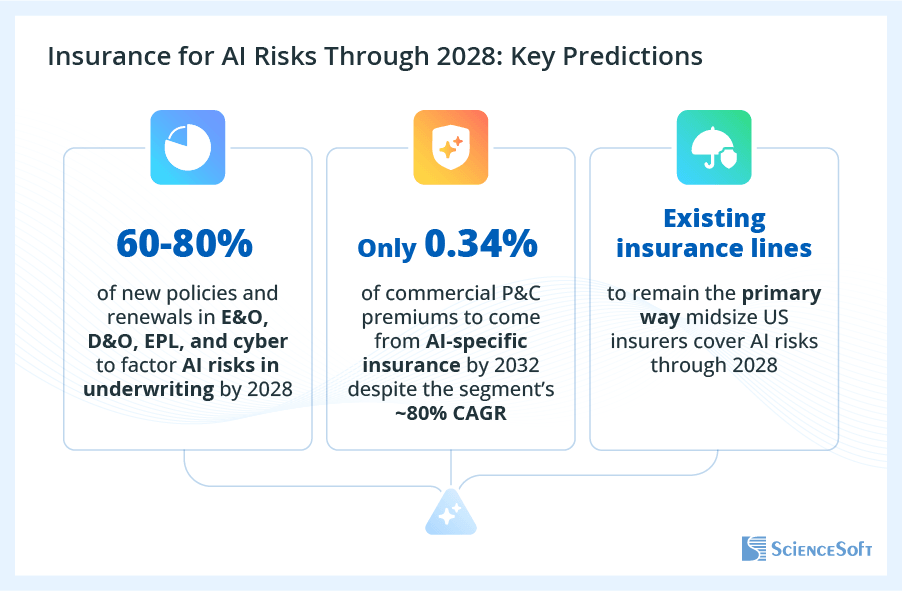
By 2028, most midsize US insurers will still address artificial intelligence (AI) risks primarily through their existing products, ScienceSoft predicts. The research team expects 60–80% of new policies and renewals in E&O, D&O, EPL, and cyber lines to factor AI risks into underwriting. Changes to coverage will lag behind, with AI-focused endorsements and standalone liability products introduced by a much smaller share of insurers. AI-specific insurance will grow fast, but will remain a small niche within the broader commercial insurance market.
At a glance:
- AI incidents and demand for insurance are growing. Publicly documented AI incidents rose 262% from 2022 to 2025, prompting businesses to seek clearer coverage against AI risks.
- Most midsize US insurers will keep AI risks within existing lines. Explicit AI wording, exclusions, endorsements, and standalone products will develop in parallel, but existing lines will remain the primary path through 2028.
- Underwriting will respond to AI risks faster than coverage. 60–80% of new policies and renewals in commercial liability and cyber lines will factor AI risks into underwriting by 2028, with AI use, autonomy, governance, and controls increasingly affecting pricing and terms.
- AI-specific insurance won’t become mass-market. The segment will grow at an ~80% CAGR through 2032 yet account for only around 0.34% of commercial P&C premiums. AI firms will become one of the main customer groups for AI liability insurance.
AI Risks Are Surging, Driving Demand for Dedicated Coverage
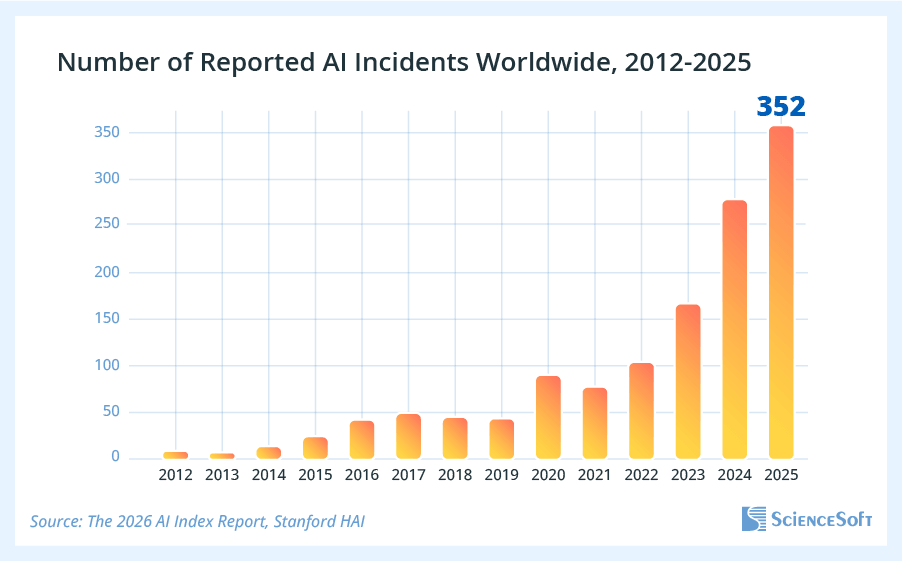
The 2025–2026 insurance market data shows a sharp global rise in AI-related incidents. Stanford HAI's 2026 AI Index Report recorded 362 publicly documented AI incidents worldwide in 2025, up 262% over three years. The report defines “AI incidents” as cases where AI systems caused or nearly caused harm to people, property, or the environment.
Potential AI exposures are diverse and complex. The MIT AI Risk Repository catalogs more than 1,700 AI-related risks. Aon’s Artificial Intelligence Risk Management 2026 paper groups AI-native risks into the following categories:
- Training-data copyright breaches.
- AI regulatory violations.
- Breached performance guarantees (failure of an AI solution to deliver provider-guaranteed results).
- “AI washing” (exaggerated or false claims about a company’s AI use or capabilities).
- Discrimination and bias.
- Harm caused by AI-controlled physical systems, including autonomous vehicles, robotics, and IoT devices.
- Deepfakes.
- Hallucinations.
ScienceSoft’s analysis of disclosed US incidents in 2025–2026 found that material cases concentrated mostly around discrimination, professional negligence caused by hallucinated output, customer data exposure, reputational harm, and regulatory compliance breaches.
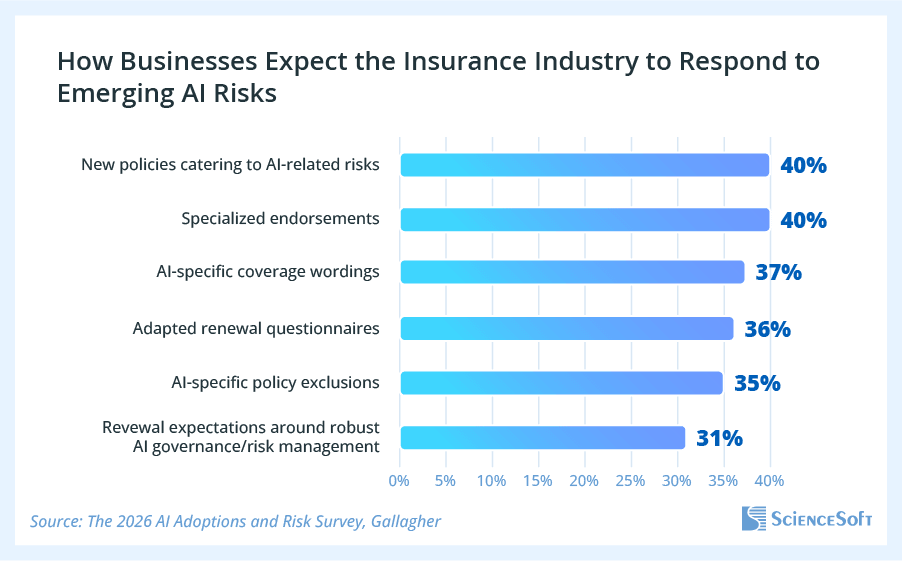
Businesses across industries are increasingly looking to insurance as a way to respond to AI-related risks. Gallagher's 2026 AI Adoption and Risk Survey found that 47% of organizations expanded their risk management practices, including insurance coverage, to address AI exposures. In the same study, organizations expected insurers to introduce new AI-specific policies, endorsements, and coverage adaptations as AI adoption grows.
Demand is especially visible around liability insurance. The 2026 Intangible vs Tangible Risks Comparison Report by Aon found that 84% of organizations that didn’t have AI liability coverage, or were unsure whether they had it, were interested in purchasing such insurance.
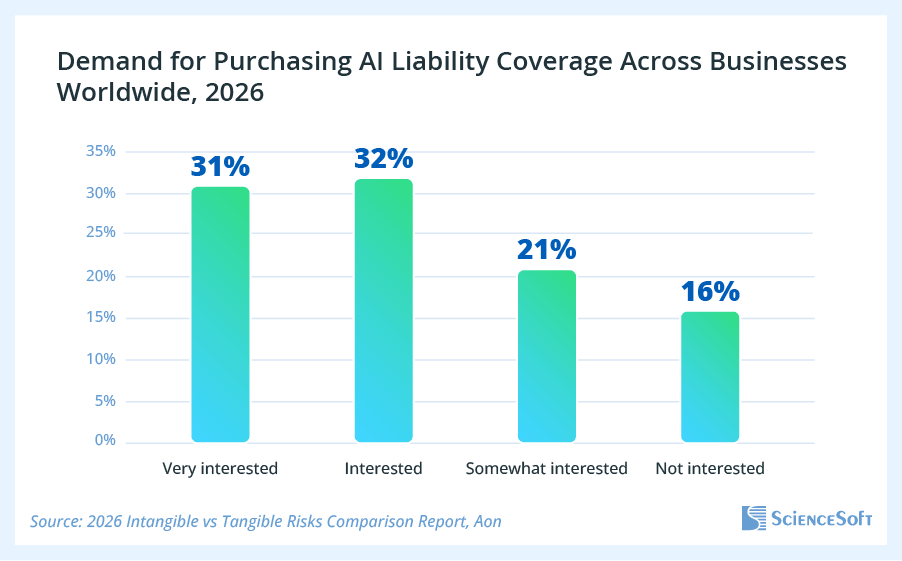
Commercial customers clearly want insurers to cover AI risk, and their expectations span different approaches. In a way, that gives insurers more room to choose how they respond: through new AI products, endorsements, clearer policy wording, or other means. While much of the market remains relatively silent on AI, any insurer that provides greater clarity on AI coverage may gain an advantage. And insurers don’t necessarily need to wait for unified routes. Relatively simple steps like clearer policy wording, targeted underwriting questions, and better tracking of AI-related claims can give customers more certainty now and position insurers to respond as demand develops. — Vital Soupel, Senior Insurance IT & AI Consultant, ScienceSoft
Most Insurers Keep Covering AI Risks Through Existing Lines, Despite Gaps
In Gallagher’s 2026 AI Adoption and Risk Survey, 20% of insurance professionals said at least one of their clients had experienced an AI-related loss or insurance claim in the past year. Gallagher expects both claim frequency and severity to rise as businesses rely more heavily on AI for critical products and services.
The litigation signal is moving in the same direction. Gallagher Re reported that cumulative lawsuits related to generative AI in the US exceeded 700 in 2025, with annual filings up 978% from 2021. Gallagher’s 2026 Cyber Insurance Market Outlook cited more than 200 active legal cases related to AI and machine learning in the cyber insurance segment alone.
Despite growing customer demand and AI exposures, most insurers have kept their policy offerings largely unchanged. In Aon’s 2026 Intangible vs Tangible Risks Comparison Report, 63% of insurance professionals said their existing policies don’t explicitly cover AI-related threats. The study’s broader findings suggest that over 90% of potential coverage for AI risks under existing policies falls into what Aon calls “silent AI,” meaning the policies neither explicitly cover nor exclude AI-related risks.
In practice, many AI losses are still handled under conventional coverage. Aon’s Spring 2026 Insurance Market Update revealed that AI-related incidents continue to appear under established liability categories like Errors and Omissions (E&O), Directors and Officers (D&O), and Employment Practices Liability (EPL). This suggests most insurers haven’t yet developed separate insurance classes for AI risks.
At the same time, traditional coverage leaves significant gaps. Gallagher Re, in its 2026 report Smart Systems, Blind Spots: Rethinking Insurance for the AI Era, suggests that existing cyber, technology E&O, product liability, and commercial general liability (GL) policies may respond only partially or conditionally to AI risks, particularly to novel liability perils created by generative AI.
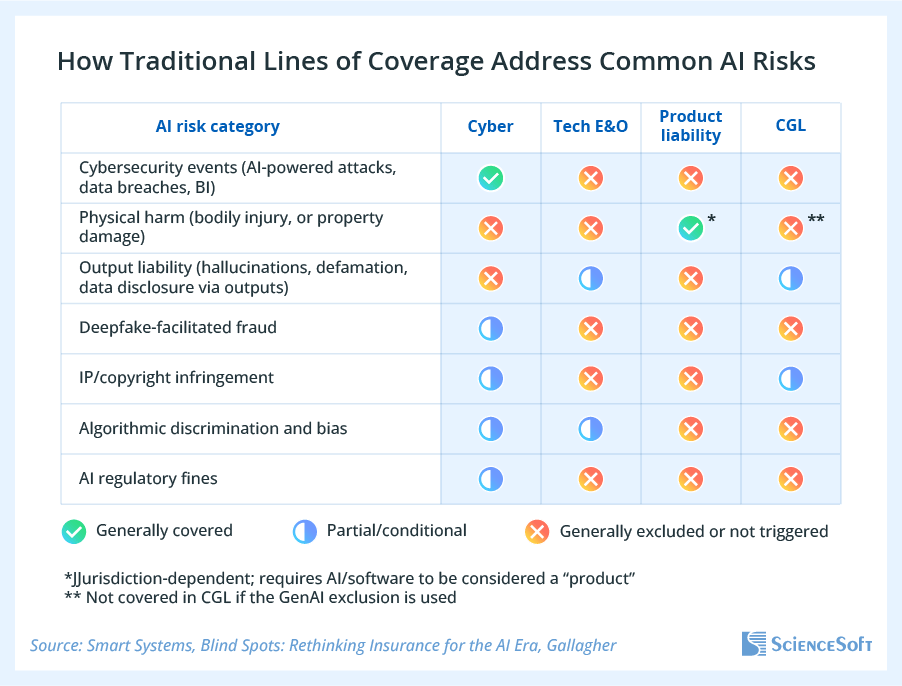
Insurance customers similarly indicate that traditional coverage doesn’t fully address AI-related losses. In Gallagher's 2026 AI Adoption and Risk Survey, only 53% of insureds who had experienced an AI-related loss or claim said they were fully covered. Aon's 2026 Intangible vs Tangible Risks Comparison Report shares even less optimistic findings: only 22% of organizations said existing insurance or a standalone AI policy covered their AI liability risks.
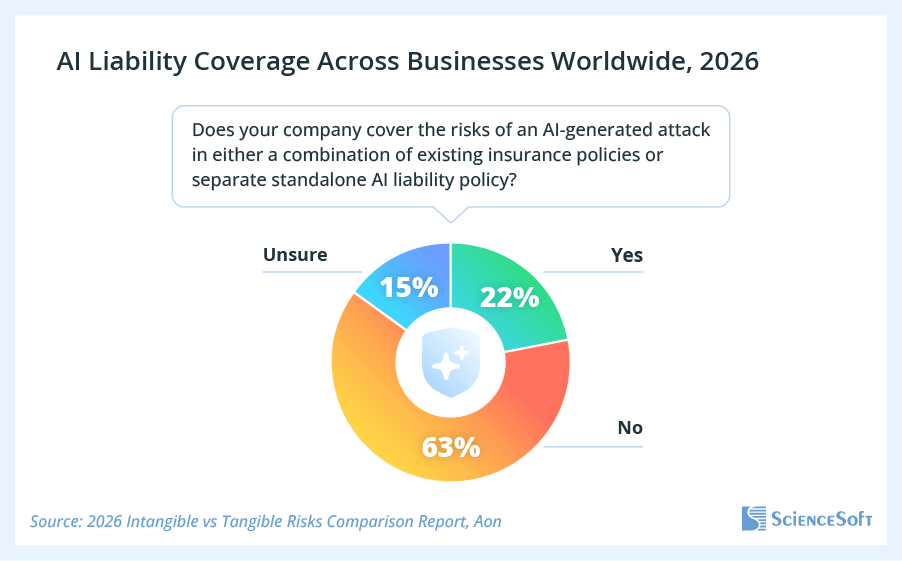
ScienceSoft expects this coverage gap to grow as AI use expands unless insurers make AI treatment more explicit in underwriting and policy terms.
AI-Specific Insurance Coverage to Grow But Remain Niche Through 2028
US insurers are already testing ways to make AI treatment more explicit. ScienceSoft’s research groups them into four paths: adding affirmative AI wording to existing policies, adding AI exclusions, attaching AI-specific endorsements, and launching dedicated AI insurance products.
However, few insurers are currently ready to offer AI coverage. In an exploratory sample of 10 midsize US insurers, ScienceSoft found no carrier that explicitly stated in public materials that it offered AI-focused coverage. A targeted search identified only a few midsize insurers with affirmative AI coverage: Coalition and Beazley within existing cyber policies and HSB through a dedicated AI liability product. ScienceSoft acknowledges, however, that looking at public materials may not show the full picture, as some AI coverage may be bespoke or broker-distributed rather than publicly offered.
Across the broader US market, ScienceSoft identified fewer than 10 insurers and MGAs offering AI-specific coverage through endorsements or standalone policies. Examples include AXA XL, Munich Re, Relm, Testudo (a Lloyd’s coverholder), and Armilla (backed by A-rated insurers, including Chaucer, AXIS Capital, Convex, Swiss Re, and Greenlight Re).
ScienceSoft predicts that most midsize carriers will take the path of making AI coverage more explicit in existing lines. AI losses map relatively well onto E&O, D&O, EPL, cyber, and GL exposures, and carriers already have established distribution, claims processes, and pricing frameworks for these lines. They can therefore selectively clarify coverage without creating an entirely new insurance class.
Exclusions are also likely to become more visible. The Insurer found that, as of July 2026, more than 60 P&C insurance groups, including AIG and Great American Insurance Group, had filed AI-related exclusions with regulators. However, some insurers noted they didn’t plan to use them immediately. AIG said it had no plans to implement its proposed exclusions right away but wanted the option available if the frequency and scale of claims increased.
Dedicated AI coverage through endorsements or standalone policies will grow, but is unlikely to become mainstream among insurers by 2028. Deloitte projects that the global AI-specific insurance market will rise from about $40 million in 2024 to $4.8 billion by 2032 at an approximately 80% CAGR. Even at that pace, Deloitte estimates the segment would account for only around 0.34% of commercial P&C premiums by 2032.
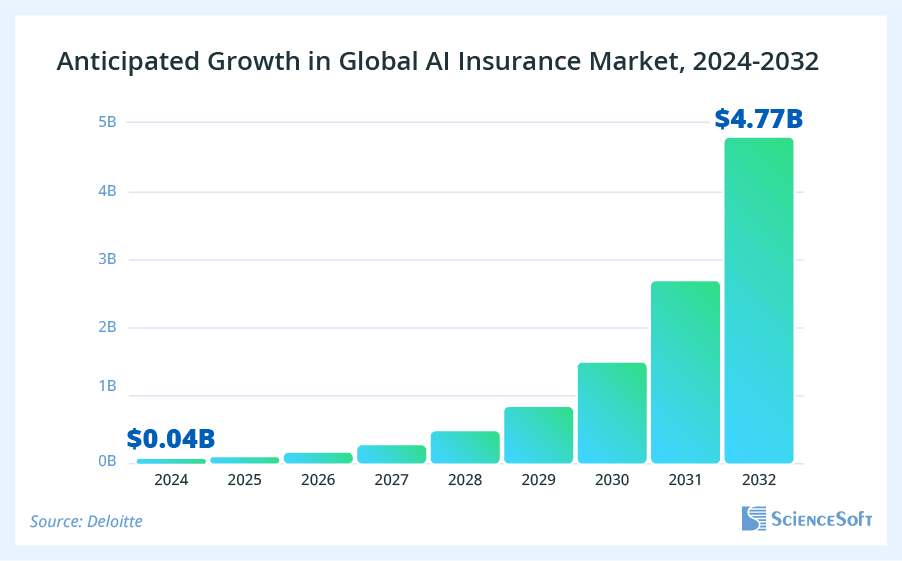
Industry experts and consultancies expect many insurers to take a wait-and-see approach. Deloitte anticipates midsize insurers will watch large global carriers build AI coverage pricing and loss history before moving further. Paige Cheasley, National Technology Practice Leader at Gallagher Canada, also believes insurers will watch how AI claims develop before introducing exclusions at scale.
Insurers Remain Divided on How to Cover AI Risks
As of August 2026, there’s no industry consensus that AI insurance should become a standalone class.
Some insurance experts see vast room for dedicated AI liability coverage structures.
We believe that there can be many different AI insurance products in the market. Some can be endorsements to existing products. Some products can be standalone and cover a bundle of different AI risks. — Michael Von Gablenz, Head of Insure AI at Munich Re and HSB (Gallagher Re, May 2026).
Others doubt that AI insurance should become a distinct product and expect existing liability lines to adapt instead.
As of now, I am not convinced that “AI Insurance” is, or should be, a standalone category. Right now, that sounds more like marketing than underwriting. My expectation is that today’s E&O and cyber markets will adapt before they leave a large standalone opportunity for new entrants to exploit. — Jonathan Crystal, Managing Partner of Crystal Venture Partners (Gallagher Re, May 2026).
ScienceSoft asked representatives of US insurance organizations whether growing AI-related claims and demand for protection could lead around 50% of midsize US insurers to offer AI-specific policies by 2028. Respondents generally expected new AI risks to create a role for standalone products, but were skeptical that AI-specific policies would become that widespread by 2028. One P&C broker suggested AI insurance will develop gradually: exclusions will appear while emerging risks are difficult to price, endorsements will let carriers adapt without rebuilding policies, and standalone products will come later when AI exposure becomes large and distinct enough.
Exclusions tend to show up early whenever a risk is still hard to price. It usually signals a temporary guardrail, not a permanent stance. Endorsements have followed the same path other tech-driven risks took before, with data breaches and cyber liability expanding through them long before standalone policies became common. — Rami Sneineh, Owner and a Licensed Insurance Producer at Insurance Navy.
ScienceSoft expects diverse approaches to develop in parallel through 2028: most midsize US insurers will continue addressing AI risks primarily through existing lines, with limited changes to policy offerings, while larger and specialist insurers will move further with AI-specific endorsements and standalone products.
AI Use and Governance to Become Standard Underwriting Factors
Underwriting for AI risks appears to be growing faster than coverage. Insurers are beginning to ask not just whether a company uses AI, but where it uses it and how it tests and governs it.
AI-specific insurance products already show how this can work. Testudo limits coverage to an agreed set of generative AI systems and excludes “shadow AI.” Armilla uses an upfront AI risk assessment to identify vulnerabilities and compliance gaps, then tailors coverage terms.
ScienceSoft’s findings suggest that similar considerations are beginning to enter the underwriting of traditional lines as well. Alessandro Lezzi, Head of Cyber Risks at Beazley, said in April 2026 that cyber insurance underwriters need to adapt their questions to assess AI controls and governance. Aon similarly argues that AI governance, transparency, and disclosure can affect eligibility and policy terms and that higher-risk AI uses in healthcare, defense, and autonomous robotics may require stricter safeguards. Munich Re notes that accurate risk profiling also requires information about how AI systems are developed and trained, even when companies consider that information proprietary.
Renewal questionnaires are already becoming more detailed. Techné AI reports AI-specific questions in 2026 D&O underwriting at AIG, Chubb, Travelers Insurance, Beazley, AXA XL, and Lloyd’s syndicates. Its market observations suggest that weak answers can lead to 15–40% higher premiums, AI-specific exclusions, sublimits on AI-related coverage, or reduced overall limits. Other practitioner evidence points to questions and requirements around AI use policies, workforce AI training, human oversight, vendor due diligence, and documented AI risk assessments.
The growing use of agentic AI systems, which can act autonomously rather than only provide recommendations, will likely make AI risk underwriting even more granular. EIP’s CEO Ross Sinclair suggested in an August 2026 Financial Times letter that underwriters will need to assess AI agents’ authority, what data and systems they can access, and what agent controls are in place.
ScienceSoft expects underwriting for AI risks to become commonplace by 2028. The research team estimates that 60–80% of new policies and renewals in E&O, D&O, EPL, and cyber lines will incorporate AI-related risk into underwriting. This is likely to affect pricing, retentions, limits, sublimits, coverage conditions, and risk control requirements. New scoring tools such as AIQA Global’s AIQ Score show that more standardized AI governance assessment is emerging, although broad insurer adoption has not yet been demonstrated.
Unclear Liability and Regulatory Uncertainty to Slow AI Insurance Development
According to ScienceSoft’s research and recent client work, insurers identify several characteristics of AI that make AI-related risks difficult to assess and insure:
- Complex liability and risk attribution remain a major challenge. Gallagher notes that AI systems typically involve multiple parties, including developers, model and component providers, and users, making it difficult to determine responsibility when a loss occurs.
- Insurers also face the risk of widespread losses from a single AI failure. Kevin Kalinich, Intangible Assets Global Collaboration Leader at Aon, said insurers may be able to cover a $400–500 million AI-related loss at one company, but a failure in a widely used AI system could affect thousands of companies at once. This accumulation risk makes AI exposures harder to price and insure.
- Black-box AI logic adds further uncertainty. Mosaic Insurance has pointed to the unpredictability and opacity of large language model (LLM) outputs as a barrier to traditional underwriting and has declined to underwrite LLM risks even while offering insurance for other types of AI-supported software.
- Regulatory uncertainty remains another barrier. As of August 2026, ScienceSoft found no NAIC standard, Federal Insurance Office report, or state regulation specifying whether and how AI-related losses should be covered. ScienceSoft’s insurance clients expect regulatory clarity to make it easier to adjust existing coverage or design new AI-specific products.
At the same time, ScienceSoft’s research indicates that some of these challenges are becoming more manageable. For example, black-box AI logic can already be addressed through explainable model design and AI observability tools, giving businesses and insurers better visibility into how AI systems operate and why failures occur. However, complex risk and liability attribution and regulatory uncertainty are likely to slow the development of AI coverage, even as insurers gain more experience underwriting AI risks.
Impact on Insurance Organizations, Customers, and Partners
Insurers
For insurers, growing demand for AI coverage may create a new revenue source, particularly as businesses seek protection against risks that existing policies do not cover. Yet responding to that demand will require significant product and policy work. Insurers that choose to make AI treatment explicit will need to decide which risks to cover or exclude, whether to adjust existing policies or add endorsements, and where dedicated AI products make more sense. They will also need to define limits, sublimits, conditions, and pricing for AI risks, which may be difficult while AI loss history remains limited.
Even without launching dedicated AI coverage, insurers will have much work to do. Underwriters will face increasingly complex assessments of AI use, autonomy, and controls. They will also increasingly need to assess concentration risk when many insureds rely on the same AI model, platform, or vendor. Expertise in AI, cybersecurity, and technology risks will become more valuable as insurers start assessing AI exposure more systematically.
Insurers that start factoring AI into underwriting early and consistently flag AI involvement in claims will build risk and loss data sooner. Over time, this should help them profile and price AI-related risks more accurately.
Insurers may also need dedicated cybersecurity, legal, and technology experts to determine what went wrong and who’s responsible when AI-related claims occur. They may need more structured claims processes that bring these specialists together when AI is involved. ScienceSoft also anticipates growing demand for AI-specific claims and underwriting tooling.
Brokers
Brokers will see more demand for AI-focused policy reviews and coverage advice from businesses seeking AI insurance. In practice, brokers will need to understand how a client uses AI, compare those risks against its existing liability policies, and identify where AI risks are covered and where additional coverage may be needed.
As AI-specific policy wording becomes more common, brokers will also play an important role in comparing insurers’ offerings and helping clients understand differences in AI coverage conditions.
Commercial insurance customers
Businesses will increasingly need clarity on whether their AI-related risks are covered as insurers make AI treatment more explicit. They will likely rely more on brokers to review existing policies, identify AI-related gaps, and determine whether additional coverage is needed. Organizations using AI in higher-risk areas may face higher premiums, lower coverage limits, or stricter requirements. At the same time, getting AI coverage may require companies to provide insurers with more detail on how they build, use, and control AI.
AI software providers
AI vendors should expect stronger customer focus on AI risk controls. Companies seeking AI insurance may prefer vendors that can demonstrate proper AI testing, governance, and security, because these measures can help them meet insurers’ underwriting requirements and secure lower premiums. AI providers are likely to face more customer questions about how their systems work and how they manage risk as part of due diligence.
Businesses will increasingly expect AI vendors to take financial responsibility when their technology causes harm. That means more contractual liability for AI providers, and likely a stronger need to insure it. We expect more AI firms to seek dedicated coverage through 2028, potentially making them one of the main customer groups for AI liability insurance. The market is already responding: Vouch and Embroker have introduced AI-focused insurance specifically for AI developers. — Vital Soupel, Senior Insurance IT & AI Consultant, ScienceSoft
Insurance regulators
As carriers rely more on AI-specific underwriting questions, exclusions, endorsements, and specialist products, regulators will face growing pressure to clarify how AI-related risks should be treated in underwriting and coverage.
Individuals
Employees and consumers may benefit indirectly if insurance requirements encourage businesses to use AI more responsibly and strengthen controls around AI systems. Better governance can reduce risks of personal data exposure and unintended discrimination.
On the flip side, individuals may also absorb some of the cost: businesses can pass higher insurance expenses on to customers through higher prices, while employees working with AI may face more training, documentation, and compliance requirements.
