 ScienceSoft Global
 Healthcare
 Finance



AI Chatbot Development Services
ScienceSoft builds conversational AI assistants that can survive real business complexity: disconnected legacy systems, strict security, overwhelming amounts of changing data, and users who expect fast, accurate help every time they talk to AI.
With 21 years of experience in regulated industries like healthcare and insurance, we engineer AI assistants that safely plug into large business systems and remain stable, compliant, and scalable in the long term.
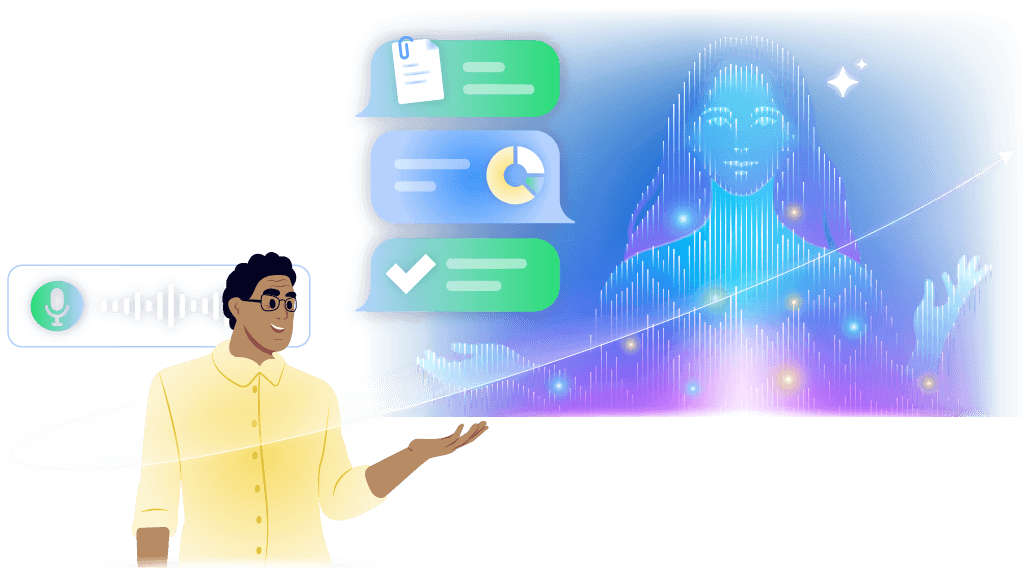
Conversational AI development services are needed to build and integrate context-aware AI assistants that work across your systems, data, and business rules, so users can find what they need, complete tasks, and interact with business processes in one place.
Why Build a Conversational AI Assistant With ScienceSoft
- 37 years in AI services.
- 21+ years of experience and hundreds of software projects in healthcare and insurance.
- Expertise in investments, lending, payments, finance, manufacturing, retail, telecoms, and 20 other industries.
- 750+ specialists, including senior AI architects, data scientists, machine learning engineers, software developers, security experts, and DevSecOps engineers with 9–20 years of experience.
- Architecture & Solutions CoE that lays the right foundation for AI success through proven architecture patterns, security controls, and governance practices.
- PMO that de-risks AI delivery with proactive planning and continuous control over scope, timelines, and priorities.
- In-house compliance consultants that help align AI solutions with global standards (e.g., SOC 2, PCI DSS/SSF, NIST), regional privacy rules (e.g., GDPR, Saudi PDPL), and sectoral regulations (e.g., HIPAA, FDA QMSR, SOX, GLBA, NYDFS).
Partnerships and recognitions

Named among America’s Fastest-Growing Companies by Financial Times, 5 years in a row
ScienceSoft is the winner of the AI Leader Awards 2026 in the Best AI Solution for Insurance category
HTN Now Awards 2025/26 finalist in the Best AI Scribe Solution category
Semifinalist in Amazon Nova Partner Demo Competition for real-time AI voice scheduler

Microsoft Solutions Partner for Data & AI
AWS Partner since 2017

ISO 9001-certified quality management system

ISO 27001-certified security management system, extended with ISO 27701 privacy controls

ISO 13485-certified medical device quality management system
Conversational AI Functionality We Deliver
ScienceSoft can implement any combination of the conversational AI capabilities below as standalone AI solutions or as modules integrated into existing software, including business applications, customer or partner portals, and employee tools.

Multimodal input understanding
Conversational AI can process text messages, voice requests, images, scanned documents, and mixed-format inputs. It identifies user identity, intent, urgency, sentiment, and context signals before selecting the next response or escalation path.

Visual and non-verbal input recognition
Camera-enabled AI applications can identify gestures, sign language, written text, objects, or site conditions. GenAI and machine learning models classify the visual input, extract relevant details, and pass them into the conversation or workflow context.

Grounded answers from enterprise data
RAG pipelines can retrieve relevant facts from approved documents, policies, tickets, emails, databases, and business applications. Semantic and hybrid search help generate answers from current enterprise sources instead of relying on model memory.

Source attribution and action traceability
Source attribution can expose which documents, records, or knowledge base entries were used to generate a response. Decision traceability can also show confidence indicators, approval history, executed actions, and reasoning summaries.

Context-aware response generation
Responses can be adapted to user roles, interaction history, account data, channel, sentiment, and communication preferences. The same capability can also apply approved terminology, response structures, compliance wording, and enterprise tone rules.

Conversation memory and continuity
Conversation memory keeps relevant details, workflow state, and previous user inputs available across sessions and channels. A request started in a web chat, an app, or a voice interface can continue elsewhere without needing repeated explanations.

AI-assisted reasoning and decision support
AI reasoning modules can compare options, check business rules, detect inconsistencies, summarize risks, and prepare recommended next steps. In sensitive scenarios, recommendations can be validated through deterministic rules, confidence thresholds, or human review.

Human handovers
Human handover logic uses confidence scores, sentiment, issue category, urgency, and business impact to detect cases that need expert involvement. The hand-off package can include conversation summaries, extracted entities, workflow status, and source links.

Proactive communication
Conversational AI can initiate communication (e.g., notifications, messages, phone calls) in response to preset events, deadlines, workflow conditions, or user behavior. Typical triggers include upcoming appointments, status changes, alerts, and follow-up questions.

Opportunity identification
Opportunity detection can work in parallel with service or support conversations. AI models can analyze product usage, account history, behavioral patterns, and conversation context to flag signals for upsell, cross-sell, renewal, retention, or next-best action.

Tool calling and task execution
Tool calling connects conversational AI flows with APIs and business systems. User actions can trigger ticket creation, CRM updates, form completion, appointment booking, approval routing, notifications, or other actions inside connected software.

Multi-step process orchestration (Agentic AI)
Agentic AI solutions can handle complex requests as coordinated process chains. A single orchestrated flow may retrieve account data, verify eligibility, generate a document, update records, and notify internal teams through several tools or downstream AI agents.

Conversation analytics and improvement loops
Conversation analytics tracks topics, escalations, resolution patterns, user feedback, workflow outcomes, and AI performance metrics. These insights can refine prompts, retrieval logic, routing rules, response quality, and automation scenarios over time.
Sample Architecture for a Conversational AI Assistant
Below, ScienceSoft’s solution architects describe a real-world architecture for a conversational AI assistant designed to automate employee self-service for HR and IT requests. The assistant can orchestrate a wide range of tasks, including PTO management, policy Q&A, access provisioning, and onboarding guidance. The same architectural principles apply when building assistants for customers, partners, or patients (e.g., healthcare chatbots for patient support, insurance assistants for customer service) — the main differences are in the channels, authentication methods, and external system integrations. The core design stays consistent: separating agent responsibilities, securely identifying users, enforcing controls and guardrails over actions and data access, and retrieving information from trusted internal and external systems.
A similar architecture can be implemented in different cloud environments (Azure, AWS, GCP) or on premises, as the core pattern relies on orchestration and tool execution rather than platform-specific components.
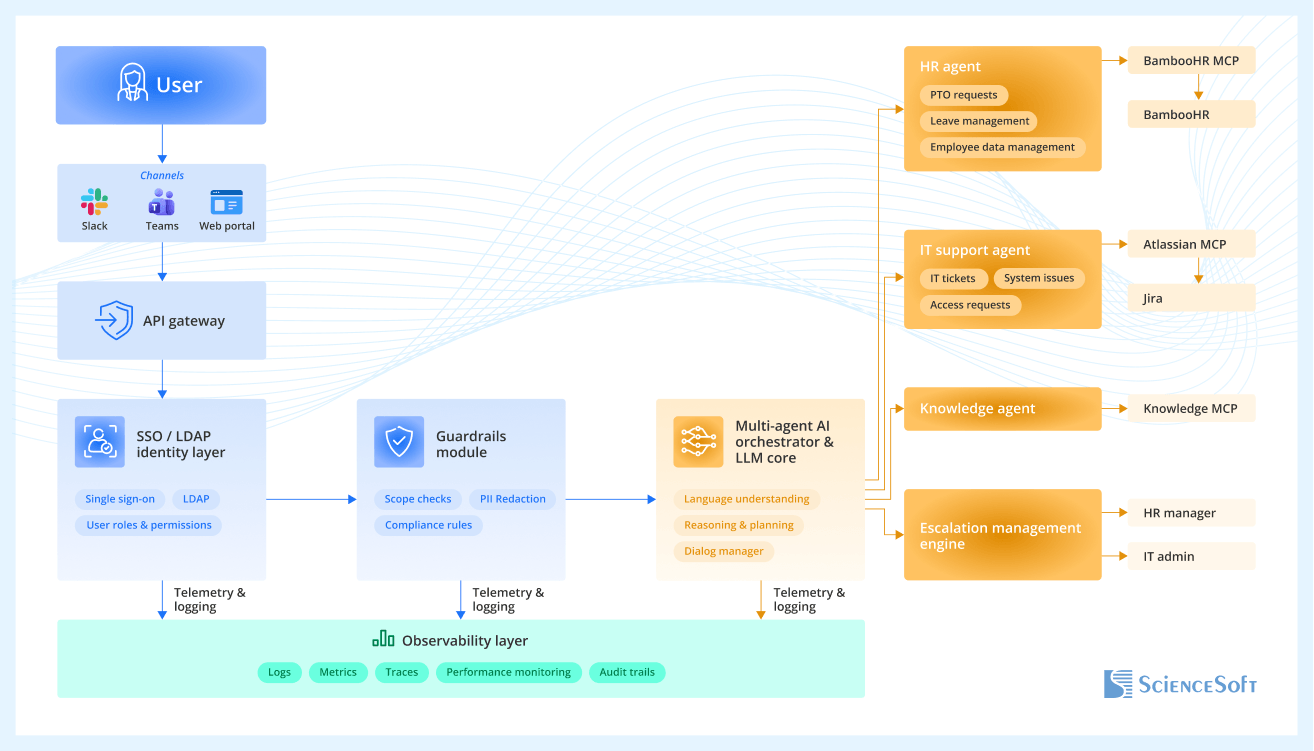
The assistant is embedded into employee communication channels such as Microsoft Teams and Slack, providing a single conversational entry point for HR and IT requests. Each session starts with identity resolution via SSO/LDAP (Azure AD, Okta, or Google Workspace), which determines employee role, department, and access rights.
An orchestrator. At the center of the system is an orchestrator, which acts as a control plane for all interactions. It interprets user intent, maintains conversation context, applies policy and compliance rules, and coordinates downstream execution. Rather than directly exposing all enterprise tools to the assistant, the orchestrator enforces what actions are allowed, what requires approval, and what must be escalated to humans. It also determines how a request is handled—whether it requires information retrieval, structured workflow execution, or a combination of both.
Task-specific agents are responsible for executing bounded operations within clearly defined domains. Each agent operates with minimal privileges and is connected only to the data sources and tools required for its function.
For operational tasks, task-specific agents connect to enterprise systems:
- HRIS (Workday, BambooHR) for PTO, benefits, and employee data updates.
- ITSM (ServiceNow, Jira Service Desk) for support tickets, access requests, and incident routing.
Each agent is narrowly scoped (e.g., “check PTO balance”, “submit access request”, “create ticket”), ensuring the LLM cannot directly modify enterprise systems without structured execution paths.

The architecture in the diagram uses a centralized orchestration model, where every request flows through a single control layer responsible for intent recognition, knowledge retrieval, tool execution, and policy enforcement across HRIS, ITSM, and identity systems. Enterprises usually start with this approach because it is simpler to implement, provides a single governance and security control point (RBAC, guardrails, audit logs), and enforces consistent behavior across all workflows.
The alternative is a hybrid execution model, where simple, high-volume actions (like policy lookups or PTO balance checks) bypass orchestration and go directly to enterprise systems, while complex or sensitive workflows still go through centralized control and approvals. This approach improves latency, scalability, and cost efficiency at scale, but adds complexity to the architecture and requires stricter cross-system governance.
For information-based requests, the orchestrator routes queries to the relevant HR, IT, onboarding, benefits, or policy vector knowledge source. Retrieval can combine vector search, keyword search, metadata filters, and live system queries, while enforcing user-specific access permissions before content is passed to the model.
An approval routing engine manages all actions that require human authorization (e.g., access escalations, privilege changes). It routes requests to managers or system owners through Teams, Slack, or email and blocks execution until the approver makes a decision.
A guardrails layer sits between the orchestrator, AI agents, and enterprise systems. Before an agent accesses data or executes an action, the guardrails layer verifies the user's identity, permissions, and applicable business policies, and checks whether the requested action requires additional approvals. It can also redact or mask sensitive information, restrict access to protected data, enforce role-based access rules, and validate that agent-generated actions comply with predefined business constraints. After execution, the same layer can verify outcomes, inspect responses for policy violations or unauthorized disclosures, and attach audit metadata before returning the result to the user.
An observability layer captures the full execution trail, including user requests, agent decisions, retrieval results, tool calls, approvals, executed actions, and final responses. It stores this information in an immutable, SIEM-compatible audit repository, enabling troubleshooting, performance analysis, compliance reporting, and investigation of disputed or anomalous actions. The observability layer also provides the data needed to evaluate agent behavior, identify failure patterns, and continuously improve system performance and reliability.
ScienceSoft’s Services for Conversational AI Implementation

Conversational AI strategy and architecture
We help clients identify conversational AI use cases that can realistically deliver business value, design how they should work, and validate them early so they don’t turn into costly pilots with unclear ROI. Our consultants and architects can analyze your current workflows, systems, and security posture to define the optimal solution scope, recommend specific AI and cloud providers, design the governance and integration architecture, and plan AI rollout.

Conversational AI assistant engineering
We design and build conversational AI assistants that securely connect to enterprise systems, execute multi-step business workflows, and operate predictably in production environments with changing data, users, and operational constraints. We handle the full delivery — from data preparation and RAG/GraphRAG pipelines to orchestration, integrations, and guardrails.

Conversational AI maintenance and QA
We help companies keep conversational AI assistants accurate, controllable, secure, and commercially sustainable after launch. Our teams implement evaluation pipelines, observability, and control mechanisms that make AI assistants measurable and governable in production.
We also improve existing AI behavior by addressing accuracy, stability, and performance gaps, and by introducing feedback loops that support continuous, safe optimization in real-world conditions.
Let’s Discuss Your AI Initiative
Whether you’re launching your first AI assistant or trying to scale beyond a disappointing pilot, we can help. We’re prepared to have an honest, non-binding conversation to discuss your concerns and see where we can help.
How ScienceSoft Tackles Some of the Hardest Problems in Conversational AI

Challenge #1: Hallucinations
LLM-based systems can generate incorrect or unsupported answers when information is missing, ambiguous, or fragmented across enterprise systems.
Solution by ScienceSoft
Challenge #2: AI can’t catch up with changing data and business processes
Business rules, workflows, and knowledge sources evolve continuously, while conversational AI systems can quickly become outdated if they rely on static prompts or hardcoded logic.
Solution by ScienceSoft
Сhallenge #3: Uncertainty about what the AI can access, do, and share
Once a conversational AI assistant starts interacting with enterprise systems and external AI services, organizations often lose visibility into where data travels, what actions the assistant can perform, and who remains responsible for those actions. Without clear boundaries, the assistant may expose information to the wrong users, send data to unapproved third-party services, or perform actions that business stakeholders never intended to automate.
Solution by ScienceSoft
How Much Will a Conversational AI Assistant Cost?
Conversational AI assistant development costs typically start at $20,000–$70,000 for simple FAQ-style bots using knowledge retrieval with little or no system integration. Mid-range solutions cost $80,000–$250,000 and can automate standard workflows through integrations with CRM, ticketing, or scheduling systems, plus basic orchestration and escalation mechanisms. Advanced assistants range from $250,000–$700,000+ — these are deeply integrated systems that orchestrate multi-step processes across multiple enterprise applications, retrieve and synthesize knowledge from diverse internal and external sources, and operate within strict explainability and governance requirements, particularly in regulated industries such as healthcare and finance.
Here are ScienceSoft’s sample cost ranges for common development scenarios. These ranges cover the design and implementation work and exclude software licenses, cloud hosting, and AI model usage:

$20,000–$70,000
For a foundational AI chatbot deployed on web or mobile channels to handle lightweight customer interactions. These solutions typically use curated knowledge or basic retrieval-augmented generation (RAG), supported by simple guardrails and analytics, with minimal integration into sensitive data sources or internal systems — which makes them easier to set up, govern, and maintain.

$80,000–$250,000+
For an AI assistant that automates workflows such as customer support, scheduling, order handling, or employee self-service. These solutions typically integrate with CRM, help desk, scheduling, or ecommerce systems; they can authenticate users, execute simple cross-system workflows, and escalate tasks to humans.

$250,000–$700,000+
For an enterprise-scale conversational AI platform or multi-agent system orchestrating complex business processes across multiple systems and departments. These solutions system must coordinate interdependent actions across services, maintain persistent context over long-running processes, enforce complex validation before executing actions, and ensure reliable behavior across distributed enterprise systems under strict operational constraints.
These estimates cover the design and implementation of a custom solution and exclude third-party software licenses, cloud infrastructure costs, and AI model usage fees. The figures shown are indicative only and do not represent ScienceSoft's official pricing. We estimate each project individually based on the client's requirements, existing environment, and business objectives.
Client Review


They delivered a fully customized AI medical chatbot PoC in just two weeks, which was unbelievable. The attention to detail in the chatbot design, and especially the pitch deck, was amazing — with this kit on hand, we are ready to go into investor discussions confidently. It’s not often that you find a team that moves this fast without sacrificing quality.

