 ScienceSoft Global
 Healthcare
 Insurance
 Investment



Data Streaming
Architecture, Toolset, Costs
In big data services since 2003, ScienceSoft helps companies in healthcare, insurance, investment, telecoms, ecommerce, energy, manufacturing, and other industries build low-latency data streaming solutions to enhance business operations and customer experience.

Contributors

Principal Architect, AI & Data Management Expert, ScienceSoft

Senior Healthcare IT & AI Consultant, ScienceSoft
44% of IT Leaders Cite up to 5X ROI on Data Streaming Investments
These findings are featured in the 2025 Data Streaming Report by Confluent, which presents feedback from 4,175 IT leaders across 12 countries and major industries, including healthcare, insurance, investment, financial services, manufacturing, retail, telecom, media, logistics, and technology. For 86% of organizations, data streaming is considered a critical or highly important strategic priority, and 64% plan to increase investments in data streaming platforms in 2025. Additionally, 89% of IT leaders view data streaming as a key enabler for advancing AI adoption.
Sample Architecture of a Data Streaming Solution
Data streaming is the low-latency processing of continuously arriving data, which enables real-time tracking and analytics, business process automation, personalized user experiences, and more.
ScienceSoft’s software engineering experts suggest Lambda architecture as the most universal option suited for complex data streaming tasks, including big data analytics and AI-powered automation. The provided sample architecture can be simplified or expanded, depending on the unique data streaming needs of each organization.
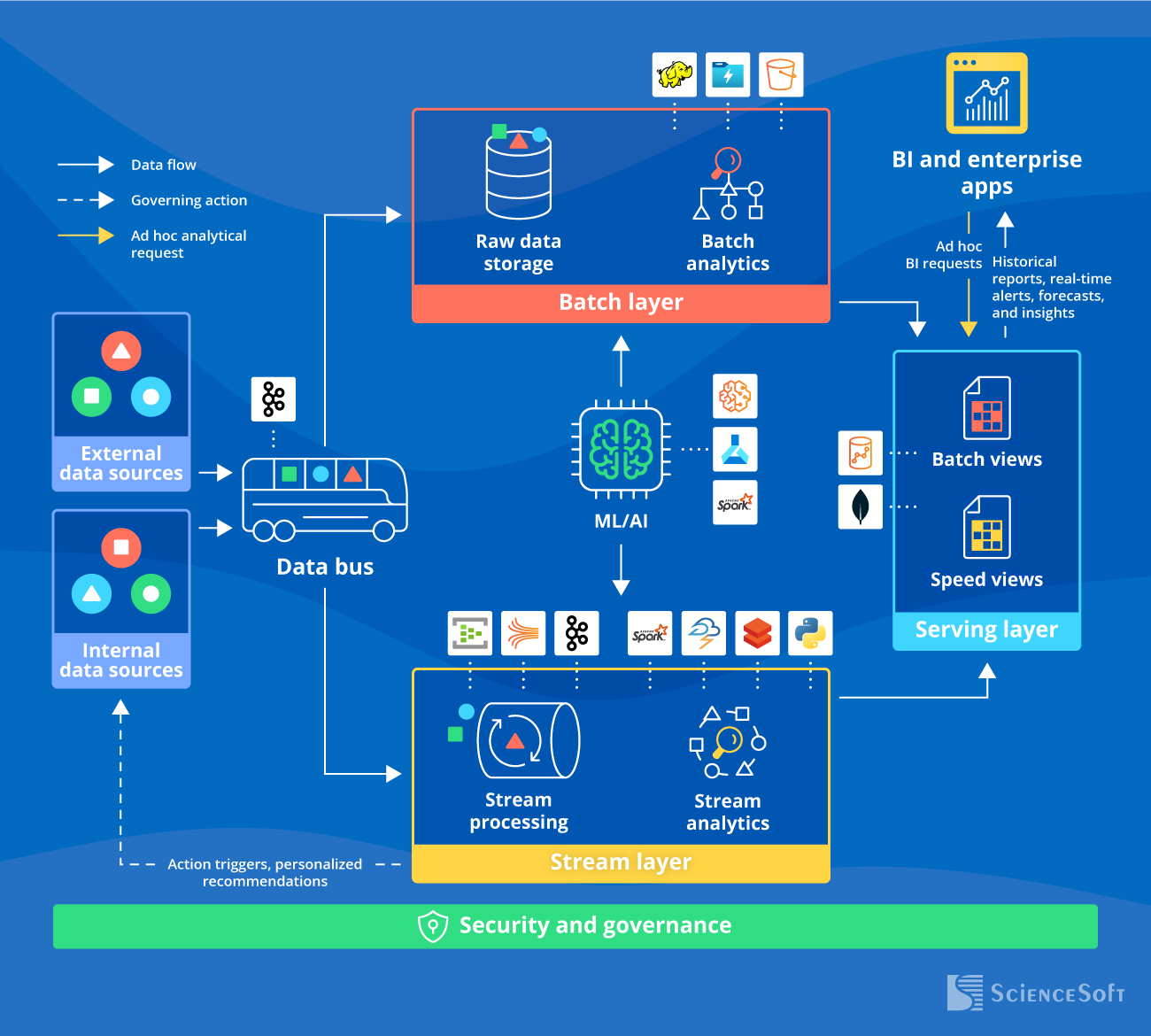
Data streaming solutions can process data from a variety of sources, including enterprise software (e.g., ERP, CRM, EHR), IoT systems, customer apps (e.g., ridesharing apps, ecommerce platforms), and external sources (e.g., financial data marketplaces, weather information systems).
In most cases, stream data has value for both real-time and historical use. For instance, financial transaction data is processed in real time to enable ML/AI-powered fraud detection; then, the results are accumulated in historical data storage that can be used to continuously improve the accuracy of ML/AI models. To support both low-latency output and historical data analytics, stream processing solutions can have two processing layers:
Stream layer
- The message ingestion engine captures data streams and sends them on for processing.
- The stream processing module enables low-latency responses to the incoming data, such as instant alerts on abnormal sensor readings, automated commands to manufacturing equipment, or personalized content feeds for every user.
Batch layer
- The data intended for historical analytics is kept in its initial format in cost-effective raw data storage (a.k.a. data lake).
- The raw data is sent to the batch processing module according to the established schedule (e.g., every 12 hours). Here, data is filtered, cleaned, deduplicated, and prepared for complex analytics.
|
|
|
|
|
|
NB: In cases when historical data analytics has a supplementary role (e.g., online gaming platforms, GPS tracking apps), it may be feasible to combine batch and stream processing in one layer and use Kappa architecture as a more flexible and cheaper to implement alternative to Lambda. |
|
|
|
|
|
Analytical data storage is a data warehouse (DWH) or a big data database that aggregates data from both layers according to the chosen data model. This data becomes the source of reports and analytical insights for BI software and enterprise systems. Data scientists and data analysts can also query the storage for ad hoc data exploration.
The machine learning or artificial intelligence (ML/AI) engine is an optional block that enables advanced streaming data analytics (e.g., financial fraud detection, social media algorithms, dynamic price optimization). The ML training module is responsible for the continuous improvement of ML/AI models based on historical data.
Data quality, integrity, and security are enforced by the data governance framework that is usually developed in compliance with case-specific regulations (e.g., HIPAA for healthcare). Some of the most common data governance measures are encrypting data at rest and in transit, data masking and anonymization, data backup and recovery, and role-based access.
Strong Data Governance as a Key Reliability Differentiator of a Streaming Data Solution
When designing their streaming data solutions, businesses often hyperfocus on performance, fault tolerance, and scalability. So, they deploy high-performing big data technologies, say Kafka and Spark, and expect the system to thrive. However, this is only the tip of the iceberg, as any data processing and analytics system needs to combine output speed with accuracy and security. Here is where the importance of data governance comes into play. Apart from having skills in big data technologies, your solution architect should be able to properly assess the given data environment and develop ethical and secure data handling practices that ensure high data quality and integrity.
Technologies and Tools to Build a Streaming Data Solution
Raw data storage
- Amazon S3
- Azure Data Lake
- Azure Blob Storage
- Azure Files
- Google Cloud Storage
- Microsoft Fabric
- HDFS
Stream message ingestion
- Apache Kafka
- Azure IoT Hub
- Azure Event Hubs
- AWS IoT Core
- Amazon Kinesis
- Google Cloud Dataflow
Stream processing
- Amazon Managed Streaming for Apache Kafka
- AWS Lambda
- Azure Functions
- Google Cloud Functions
- Microsoft Fabric
- Apache Storm
- Apache Spark
Batch processing
- Azure Data Lake Analytics
- Azure HDInsight
- Amazon EMR
- Google Cloud Dataproc
- Google Cloud Dataflow
- Google Cloud Data Fusion
- Google Cloud Data Catalog
- Microsoft Fabric
- Pig
- Apache Hive
- Apache Sqoop
- Hadoop MapReduce
Analytics data storage
- Amazon Redshift
- Amazon DynamoDB
- Azure Stream Analytics
- Azure Synapse Analytics
- Azure Cosmos DB
- Google Cloud Datastore
- Microsoft Fabric
- Apache Hive
- MongoDB
AI/ML
ML framework and libraries
- Apache Mahout
- Apache MXNet
- Caffe
- TensorFlow
- Keras
- Torch
- OpenCV
- Apache Spark MLlib
- Theano
- Scikit Learn
- Gensim
- SpaCy
Platforms and services
- Azure Cognitive Services
- Microsoft Fabric
- Microsoft Bot Framework
- Azure Machine Learning
- Amazon SageMaker AI
- Amazon Lex
- Amazon Transcribe
- Amazon Polly
- Google Cloud AI Platform
Security and governance tools
- Apache Airflow
- Talend
- Informatica
- Zaloni Arena
- Apache ZooKeeper
- Azkaban
- AWS Cloud Security services
- Azure Security services
Estimate the Development Cost of Your Data Streaming Solution

The cost of implementing a streaming solution may vary from $150,000 to $1,000,000+, depending on the solution's complexity. Some of the cost factors include the number and nature of the data sources, the streaming data volume and complexity, the number of solution users, and the need for analytics and ML/AI capabilities.
Use our online calculator to get a custom ballpark estimate. It's free and non-binding.
