 ScienceSoft Global
 ScienceSoft Finance


AI to Carry up to 40% Relative Weight Among Factors Affecting Investment Valuations in 2027, ScienceSoft Predicts


Related topics:
5 min read
Last updated:
ScienceSoft, an AI transformation and software engineering company working with the investment industry since 2007, released non-sponsored research on how public and private equity investors will factor AI's impact into company valuations through 2027.
AI in Company Valuations: The 2026 Landscape
- AI is becoming an increasingly important factor in investment assessments. Investors are moving beyond evaluating AI adoption alone to examining its measurable financial impact, competitive implications, and business-model risks.
- AI's impact on company valuations varies significantly by industry, depending on how strongly AI can improve operating performance, disrupt existing revenue models, and reshape competitive positions.
- Public and private equity investors assess AI differently, mainly due to differences in data access and influence over AI strategies. Private equity investors use deal-level due diligence and portfolio companies' value creation plans, while public equity investors rely on company disclosures and AI strategy analysis.
- Dedicated AI valuation models are not standard practice in 2026. Investors assess AI-related opportunities and risks within established valuation frameworks.
ScienceSoft's Prediction for 2027 and Analytical Methodology
Key forecasts
- By the end of 2027, public and private equity investors will routinely assess not just whether companies have adopted AI, but how AI affects their financial performance, competitive position, and business-model risks, ScienceSoft predicts.
- Rather than adopting dedicated AI valuation models, investors will increasingly incorporate AI-related opportunities and risks into established valuation approaches and investment due diligence.
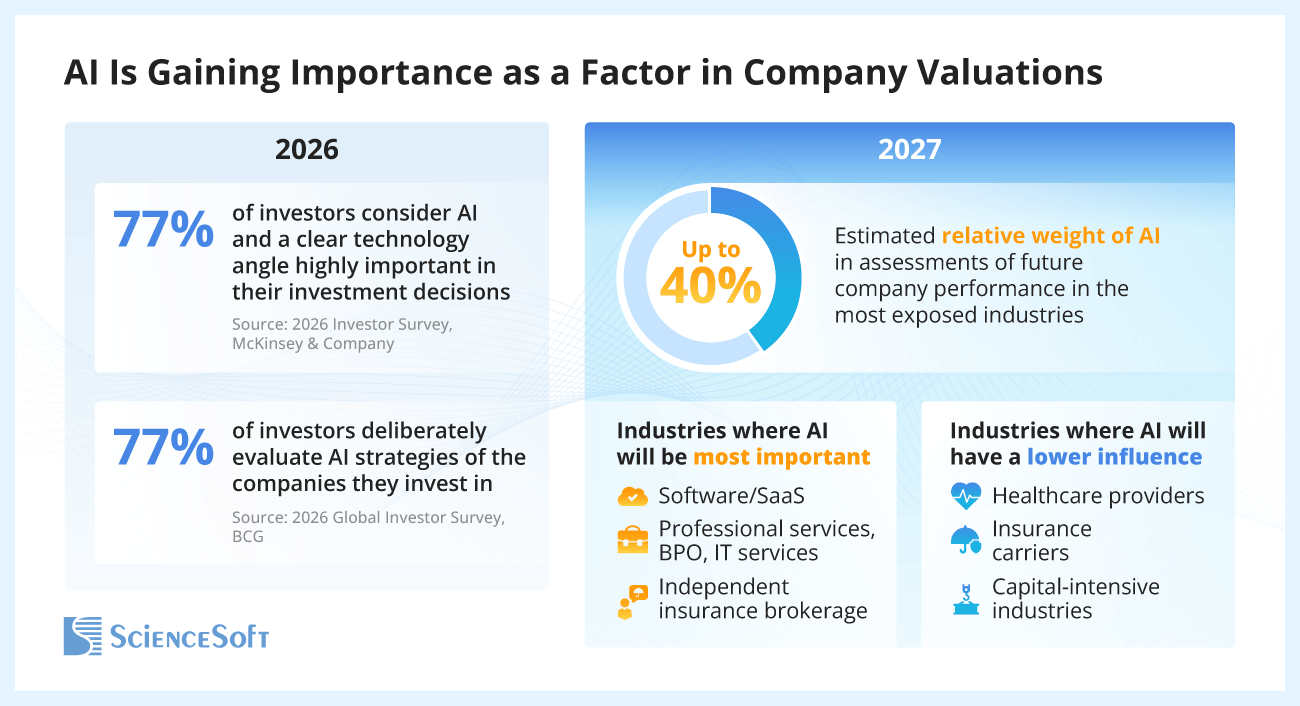
- The research team estimates that through 2027, AI will carry the greatest relative weight among factors affecting valuations of software and SaaS companies (30–40%), professional services, business process outsourcing (BPO), and IT services companies (25–40%), and independent insurance producers (25–35%). Its estimated importance will be lower for healthcare providers (10–20%) and insurance carriers (5–15%), and relatively limited in capital-intensive sectors such as manufacturing, oil and gas, and construction (3–5%).
ScienceSoft suggests that investors may use these ranges as an indication of how much weight AI-related opportunities and risks could carry in company assessments across industries by the end of 2027. The research team emphasizes that lower estimates don’t imply companies will benefit less from AI adoption. Rather, AI is expected to play a smaller role relative to other factors driving their financial performance and investment attractiveness.
Analytical methodology
Why ScienceSoft estimated AI's relative weight
Conventional valuation approaches, such as discounted cash flow (DCF) and earnings or revenue multiples, don't assign AI a standardized, separately quantifiable weight among the factors driving company value. Instead, AI's influence is reflected indirectly in assumptions about revenue growth, operating costs, margins, competitive advantages, and business risks.
This makes it difficult to assess AI's overall significance relative to other factors affecting a company's future performance. ScienceSoft therefore set out to estimate how much weight AI-related influences would carry if they were considered explicitly as an underlying factor in company valuation — and how this weight would differ across industries by the end of 2027.
How ScienceSoft estimated and interpreted the weight
The research team assessed how extensively and significantly AI could influence the main drivers of future company performance in each industry, including through changes in operating efficiency, customer demand, competitive position, and business models. The estimates account for both the opportunities created by AI adoption and the risks of AI-driven disruption.
The resulting ranges represent ScienceSoft's estimates of AI's relative weight alongside other business performance factors. For example, the predicted 30–40% weight for software and SaaS reflects AI's potential to reshape several major drivers of company value, while the 3–5% estimate for capital-intensive industries reflects its more limited influence relative to other drivers.
These percentages are expert estimates, not weights calculated from an existing valuation model. They don't represent shares of company value or expected valuation changes. Nor do they need to add up to 100% with other factors: in a hypothetical assessment, AI and other business drivers, such as workforce productivity, customer demand, and operating costs, could each have their own weight on a scale from 0% to 100%. These weights could overlap, as AI may influence several other business drivers simultaneously.
Industry selection
ScienceSoft focused primarily on industries where it has established expertise: healthcare, insurance, and IT. It also included professional services and capital-intensive industries (manufacturing, oil and gas, and construction) to compare sectors with different levels and types of exposure to AI-related opportunities and disruption risks. The selection is intended to illustrate these differences, not provide a comprehensive assessment of all industries.
AI’s Connection to Investment Valuation Becomes Explicit
McKinsey & Company, in its report The State of AI in 2026, found that 89% of organizations across industries regularly use AI in at least one business function. The 2025 report edition indicated particularly high AI adoption in insurance and technology (95% each), healthcare (92%), professional services (91%), and financial services (86%). Gartner reported that 85% of functional leaders across industries expected to increase their AI spending in 2026.
Investment industry studies increasingly point to a correlation between the AI capabilities of equity-backed companies and investors’ expectations for returns. Morgan Stanley, in its 2026 research Mapping AI's Rate of Change, found that through 2025, investors’ forward earnings expectations for global AI adopters’ equity consistently outpaced those of the MSCI World IMI Index, and the gap is continuing to widen.
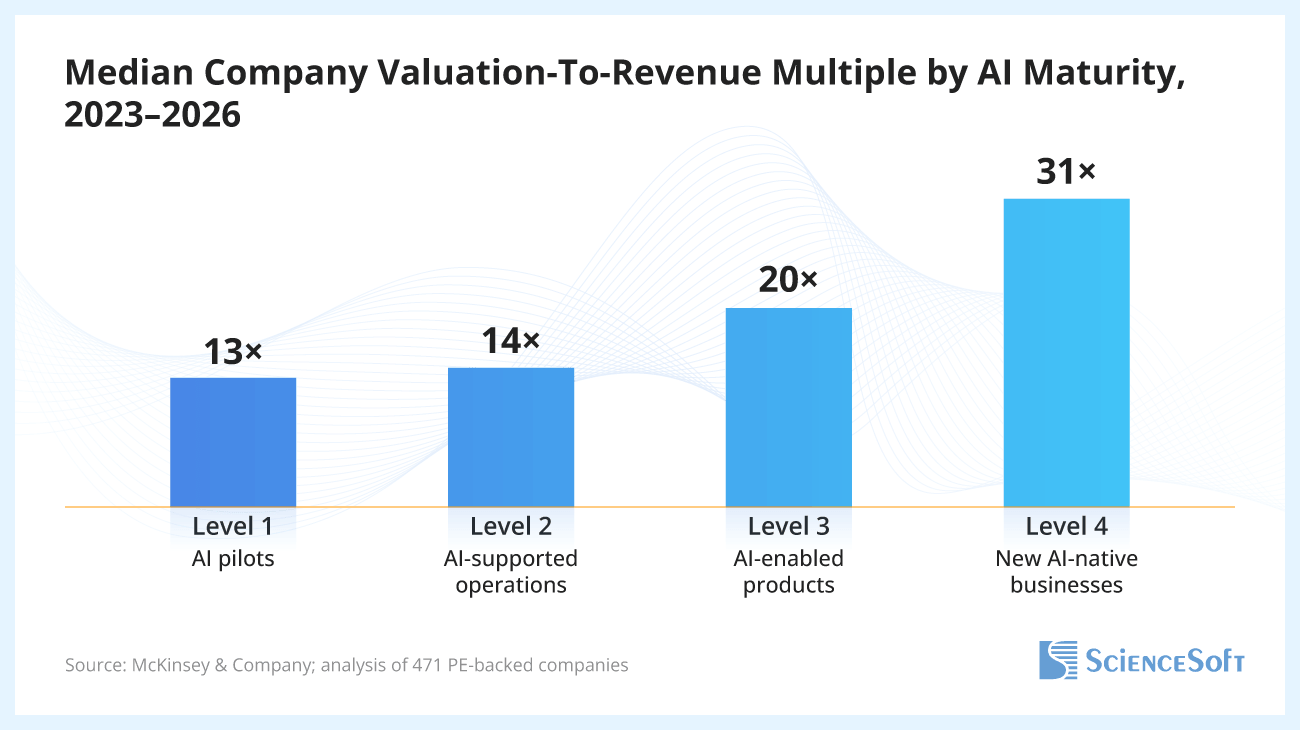
Similarly, McKinsey & Company’s findings show that private-equity-backed companies experimenting with individual AI tools have a median valuation-to-revenue multiple of 13x, compared to 14x for firms integrating AI into internal operations, 20x for those transforming products through AI, and 31x for companies building new AI-enabled businesses.
2026 research by Boston Consulting Group (BCG) directly indicates stronger AI-associated return potential for private equity investors. The research identified that private-equity-backed companies systematically building advanced AI capabilities across functions have nearly twice the return on invested capital of companies that don’t.
ScienceSoft analysts note that these studies do not establish AI adoption, or its absence, as an independent cause of higher or lower company valuations. Nevertheless, they suggest that AI capabilities are becoming an increasingly important factor in how investors assess companies' financial prospects and investment attractiveness.
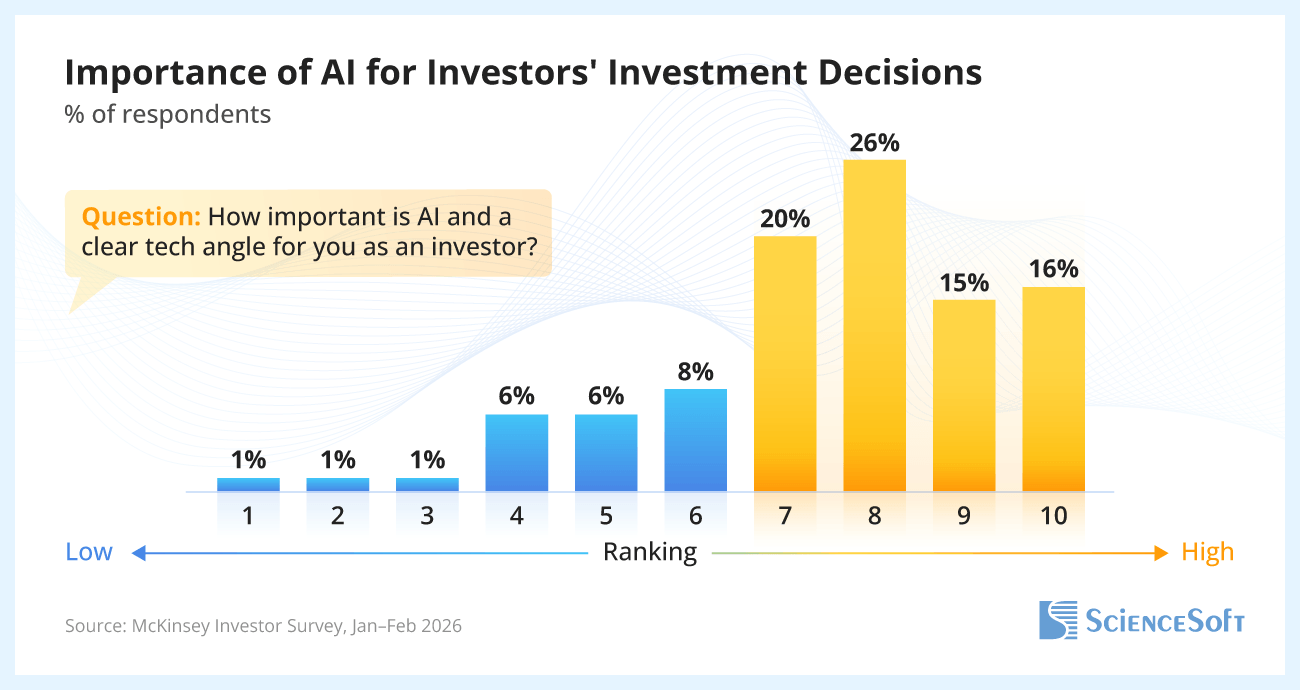
Investor sentiment confirms that AI is becoming an explicit consideration in investment decisions. McKinsey & Company’s 2026 investor survey found that 77% of public and private market investors in the US and Europe rate AI and a clear technology angle as highly important when selecting investments, scoring them 7 or higher on a 10-point scale. 31% of survey participants assigned them a score of 9 or 10, and only 3% rated these factors relatively unimportant.
Investors to Factor AI’s Durable Impact and Risks in Conventional Due Diligence
As AI implementation outcomes across industries become material, investors are increasingly looking beyond AI adoption toward its operational and financial impact. ScienceSoft predicts that by the end of 2027, investors will routinely assess the actual and expected AI impact on business productivity and the company’s bottom line.
McKinsey & Company's annual investor surveys show this shift in assessment practices: the aforementioned 2026 survey found that, compared to 2024, investors place greater emphasis on AI-related cost efficiencies, margin improvement, and AI deployment at scale as characteristics of companies expected to perform well.
McKinsey & Company also highlights that investors increasingly assess AI through its contribution to the company’s long-term financial performance, competitive position, and sustainable returns. The 2026 investor survey identified three major considerations for public and private equity investors:
- Resilience: Can the company make sound strategic investments and maintain its competitive position amid uncertainty?
- AI credibility: Can the company demonstrate how its AI investments contribute to margins, productivity, or a sustainable competitive advantage?
- Cash and capital discipline: Can the company generate cash and allocate capital effectively, including investments in AI?
PwC, in its 2026 mid-year outlook Global M&A Trends in Private Capital, similarly reports that private equity investors increasingly assess companies’ readiness for AI and management plans for using AI to improve productivity, margins, and growth. PwC suggests that these considerations can affect the entire investment lifecycle, from investment theses to due diligence, post-acquisition value creation planning, and exit decisions.
Exposure to AI-driven business disruption is becoming as important in company assessments as the potential benefits of AI adoption. The aforementioned 2026 research by Morgan Stanley suggests that broader AI adoption could reduce demand for companies’ products and services, enable competitors to operate at significantly lower costs, or change industry economics. This, in turn, could undermine existing revenue streams, pricing power, and competitive advantages.
Morgan Stanley highlights that investors increasingly recognize those AI-related business risks. Its research found that through 2025, investors distinguished companies positioned to benefit from AI from those vulnerable to margin pressure, competitive erosion, and business model disruption. Companies more exposed to these risks faced weaker earnings expectations and valuations. PwC similarly identifies vulnerability to AI disruption as a major emerging factor in company valuations.
As of Q4 2026, AI's growing importance for investment selection hasn’t yet reflected in firms' published investment criteria. ScienceSoft reviewed the publicly disclosed investment criteria of 10 US-based private equity firms: Carlyle, Alpine Investors, Trivest Partners, Southfield Capital, HKW, Merion Investment Partners, Palm Beach Capital, Acacia Partners, Baymark Partners, and Freestone Partners. The review found that none explicitly listed AI adoption or AI-driven disruption as standalone criteria. ScienceSoft analysts note that this doesn’t mean the firms overlook AI or lack dedicated AI assessment frameworks; they may already consider AI’s implications within broader assessments of financial performance, competitive advantage, and risk.
Investment professionals interviewed by ScienceSoft for the research share this view, suggesting that AI-related assessment may become a standard part of conventional investment due diligence over the next 1–2 years.
“When I'm evaluating a company now, AI maturity isn't a separate checkbox; it's folded directly into how I assess operational leverage. I expect AI exposure to become as standard in due diligence as customer concentration or working capital analysis is today, not as a separate 'AI assessment' but folded into ordinary operational diligence.” — Christopher Vandaele, Investor and Operator, Vandaele Capital
ScienceSoft's own consulting experience also suggests that AI's growing impact on investments may not require a separate valuation exercise.
I don’t think AI will necessarily require a separate valuation model. Rather, AI will be reflected in investors’ existing metrics and assumptions: revenue growth, margins, operating costs, productivity, scalability, future cash flows, and the company’s risk profile.

Executive Director of Solution Design & Competencies, Financial IT & AI Principal Consultant, ScienceSoft
Public and Private Equity Investors Take Different AI Valuation Paths
Both public and private equity investors are moving toward more systematic assessments of AI adoption outcomes. However, their approaches differ due to varying levels of access to company data and abilities to influence companies' AI strategies. ScienceSoft expects that information asymmetry will remain a key factor shaping the depth of AI assessments through 2027.
Public equity investors assess AI through company disclosures and dedicated AI strategy analysis
Public equity investors primarily track company-level AI developments through corporate filings, earnings calls, investor presentations, and operating disclosures. These sources already provide ample information: FactSet’s analysis of Q2 2026 earnings calls found that 331 of 493 S&P 500 companies (67%) mentioned AI, substantially exceeding the five-year average of 178 companies.
However, this information is less granular than what private equity investors can access, limiting public investors’ ability to assess AI’s operational and financial impact in detail. To gain deeper insight, public equity investors increasingly conduct dedicated evaluations of companies’ AI strategies and their potential to deliver sustainable financial gains. BCG, in its 2026 Global Investor Survey, found that 77% of investors deliberately evaluate the AI strategies of the companies they invest in.
Insights from major investment managers highlight three areas of emphasis in public equity investors' AI assessments:
- Exposure to AI-driven opportunities and disruption. Suney Hindocha, Associate Portfolio Manager at Janus Henderson Investors, emphasizes understanding where a company stands on the spectrum of AI exposure, from potential beneficiaries to businesses vulnerable to disruption, and why. Hindocha considers this assessment essential to constructing resilient investment portfolios.
- Measurable financial impact. Kate Lakin, Director of Research and Portfolio Manager at Putnam Investments, part of Franklin Templeton, focuses on quantifying how AI-related revenue opportunities and cost savings affect companies’ earnings estimates.
- Management’s ability to navigate AI-driven change. Grace Su, Portfolio Manager at ClearBridge Investments, also part of Franklin Templeton, prioritizes assessing whether company leadership anticipates emerging AI-related threats and has a clear view of long-term, AI-enabled business success. These insights already inform ClearBridge Investments’ financial models, helping estimate future earnings potential and determine how much of that potential is already reflected in share prices.
Notably, public equity investors remain cautious about the durability of AI-enabled competitive advantages. In the aforementioned BCG survey, only 22% of surveyed investors expected AI to create sustainable competitive differentiation. 39% anticipated that AI-driven efficiency gains would become widespread across companies, and 27% expected early AI-enabled advantages to diminish as competitors caught up.
Private equity investors assess AI through deal-level due diligence and portcos’ value creation plans
Private equity’s transaction-level due diligence lets investors obtain granular company information, including internal financial and operational data, technology assessments, and direct insights from management. After acquisition, private equity investors can actively participate in portfolio companies' AI adoption plans and gain firsthand evidence of AI’s financial results. This gives them a broad information base for evaluating companies’ AI capabilities and their potential financial impact, both before and after investment. At the same time, this depth of assessment requires private equity investors to develop specialized technical and industry expertise or engage external experts.
AI valuation is emerging as an explicit topic in private equity firms’ due diligence assessments. PwC, in its 2026 outlook Global M&A Trends for Private Equity and Principal Investors, revealed that AI-related questions already account for 30–40% of investment committee discussions. The surveyed large sponsors highlighted that these discussions include whether AI could improve portfolio-company productivity and growth or expose business models to disruption.
Industry conferences also point to growing attention to AI-related valuation factors. Operating Partners Forum Napa 2026, a US major private equity conference, held a dedicated session on assessing AI adoption in target companies during due diligence.
Leading private equity firms also give an idea of major aspects of AI-related investment assessments:
- Financial performance and business resilience. KKR, in its Q1 2026 earnings call, identified margins, pricing power, workflow relevance, and cash flow resilience as key considerations in AI-related investment underwriting.
- AI-driven value opportunities and disruption risks. TPG evaluates its portfolio companies using an internal framework that considers potential benefits from AI adoption and risks of AI-driven disruption. Similarly, Apollo Global Management applies an AI disruption assessment framework that divides portfolio companies in its target industries into 12–14 categories based on vulnerability to AI-driven change.
- Post-acquisition value creation potential. Craig Larson, Partner and Head of Investor Relations at KKR, emphasizes evaluating opportunities to deploy AI across portfolio companies to improve operational efficiency, products, and growth. This helps investors identify specific AI initiatives that could increase a company's value during the holding period and strengthen returns upon exit.
- Long-term AI exposure. Dean Mihas, Co-CEO and Managing Director at GTCR, highlights the importance of assessing how AI could reshape opportunities and competitive threats across industries over the next 5–7 years to guide investment selection and portfolio diversification.
AI-Related Valuation Factors Differ Significantly Across Industries
ScienceSoft's AI transformation experience indicates that AI-related opportunities and risks differ substantially across industries. In some sectors, like SaaS, AI can reshape products and entire business models; in others, like manufacturing, it primarily affects operational efficiency.
AI-focused investment assessments are beginning to reflect these differences. ScienceSoft analyzed the key AI-related opportunities, risks, and limitations investors consider across industries in 2026. The research team also identified the business performance metrics that most commonly reflect AI's impact on company valuations.
The table below summarizes the findings, with the selected industries listed from most to least exposed to AI-driven business disruption.
| Industry | Exposure to disruption | AI opportunities affecting valuation | AI-related risks and limitations | KPIs reflecting AI impact |
|---|---|---|---|---|
|
Software / SaaS |
Very high |
New revenue streams; faster software development; lower development costs |
Weaker product differentiation, pricing power, and subscription demand |
Revenue growth; margins; development and operating costs; customer retention; product competitiveness |
|
Professional services / BPO / IT services |
Very high |
Higher employee productivity; lower service delivery costs |
Fewer billable hours; pricing pressure; clients bringing work in-house |
Billable revenue; margins; employee productivity; service demand; pricing trends |
|
Independent insurance producers (brokers, agencies) |
High |
Streamlined sales and placements; lower operating costs; higher margins |
Disruption of brokerage and distribution models by AI-enabled competitors |
Revenue and margins; cost per transaction; workflow efficiency; client retention; competitive position |
|
Healthcare providers |
Moderate |
Reduced administrative workload; improved staff productivity and capacity |
Productivity gains may not translate into higher revenue or lower costs |
Realized cost savings; staff productivity and capacity; revenue; operating margins |
|
Insurance carriers |
Moderate |
Faster claims processing; more efficient underwriting and policy administration |
AI benefits may be difficult to isolate from other performance drivers |
Claims and administrative costs; processing efficiency; loss ratio; operating margins |
|
Capital-intensive industries (manufacturing, oil and gas, construction) |
Low |
Improved quality control, productivity, planning, maintenance, and asset utilization |
AI has limited impact on demand, prices, physical capacity, input costs, and capital requirements |
Productivity; quality rates; throughput; downtime; operating costs; margins; capital efficiency |
Sources: Bain, T. Rowe Price, Morningstar (1, 2, 3, 4, 5, 6), PwC (1, 2, 3), Software Equity Group(1, 2), Fidelity Investments, Auxo Capital Advisors, Nixon Peabody, JAMA Network Open, L.E.K. Consulting (1, 2), ScienceSoft’s proprietary research.
AI To Become a Major Valuation Factor in Disruption-Prone Sectors Through 2027
ScienceSoft expects AI's influence on valuations to grow at different rates across industries, reflecting differences in AI-related opportunities and risks. ScienceSoft analysts predict that AI will become a more significant factor in investment decisions for industries most exposed to AI-driven disruption, while its influence will remain more limited in less exposed sectors.
To compare how these differences will develop through 2027, ScienceSoft analysts estimated AI's relative weight in investors' assessments of future company value across industries. The team based its estimates on how strongly AI could influence both future company performance and the valuation multiples applied to that performance. The analysis considered AI's potential impact on each sector's major operational, market, strategic, and risk drivers, including growth prospects, the durability of competitive advantages, and business model disruption risks.
Based on its estimates, ScienceSoft predicts that by the end of 2027, AI will carry significant weight (25–40%) relative to other factors influencing company valuations in software/SaaS, professional services, BPO, IT services, and independent insurance brokerage. In these industries, AI can disrupt existing business models, threaten revenue streams, and reshape competitive dynamics. AI will carry less weight (3–20%) in valuations of healthcare providers, insurance carriers, and capital-intensive companies, where it has less influence on the main drivers of financial performance.
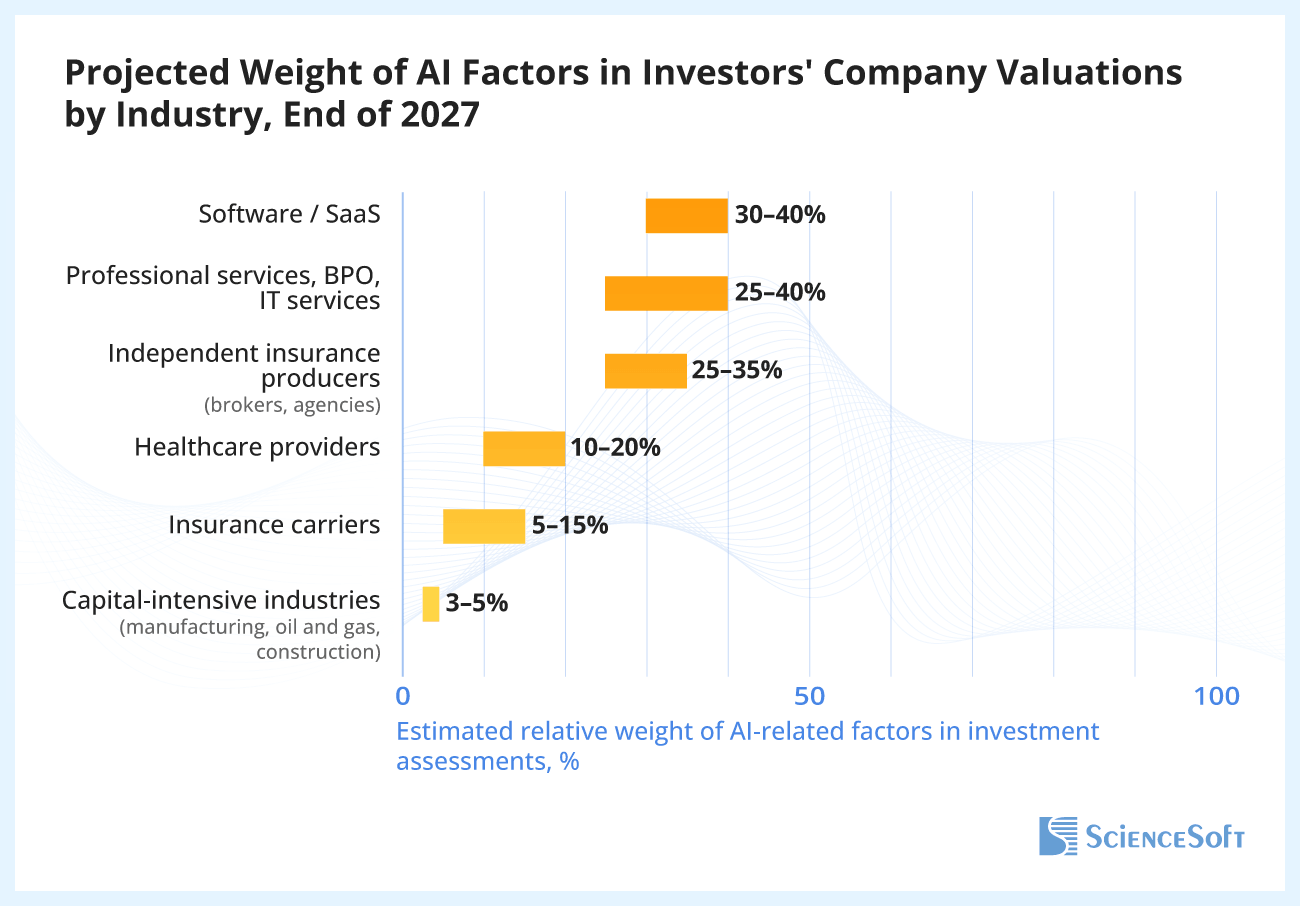
ScienceSoft expects the software/SaaS sector to see the greatest relative weight of AI in investment assessments, at 30–40%. AI can affect both financial performance and the sustainability of software business models by changing development costs, product differentiation, customer retention, and pricing power.
Professional services, BPO, and IT services follow at 25–40%. AI can improve margins through automation while reducing demand for labor-intensive services. Investors will increasingly need to assess whether companies can turn productivity gains into sustainable earnings without undermining revenue.
For independent insurance producers, the estimated weight is 25–35%. AI can reduce servicing costs and improve margins, but it may also disrupt traditional brokerage and distribution models.
In contrast, for insurance carriers, the estimated weight is only 5–15%. Here, AI can improve underwriting, claims handling, and operating efficiency, but catastrophe exposure, reserves, pricing cycles, and investment returns remain major drivers of profitability.
For large insurers with strong balance sheets, I don’t expect falling behind on AI to have much impact on valuations by 2027. Risks like major storms, unexpected claims costs, and insurance pricing cycles still matter far more. But it’s a different story for brokers and comparison websites. Much of their business relies on routine work that AI can now handle. Investors are already paying attention to that risk, and by 2027, assessing it will be standard practice.

Senior Insurance IT & AI Consultant, ScienceSoft
For healthcare providers, AI is expected to remain a meaningful but secondary valuation force, with a relative weight of 10–20%. AI can help healthcare providers reduce administrative workloads and free up staff time. However, these efficiency gains translate into financial value only when they allow providers to treat more patients or reduce costs.
Saving staff hours doesn't automatically mean creating financial value. If a doctor saves 20% of their documentation time but the hospital doesn't treat more patients or reduce costs, the financial gains may be limited. But if that time allows the same team to serve more patients, AI can directly contribute to revenue growth and operating leverage.

Senior Healthcare IT & AI Consultant, ScienceSoft
In manufacturing, oil and gas, and construction, the estimated weight is 3–5%. In these industries, AI can help transform operations and make better use of existing assets. However, company valuations will continue to depend heavily on physical capacity, demand, selling prices, raw material and energy costs, and capital investment requirements.
AI's Uncertain Economics and Long-Term Risks Complicate Valuations
Investor sentiment and industry research point to persisting challenges in assessing AI's impact on company valuations. ScienceSoft identifies the difficulty of translating AI-driven operational gains into measurable financial results as a primary obstacle.
A 2026 CEO survey by Bain & Company illustrates this problem: 82% of surveyed CEOs across industries reported that their AI transformations were, at best, only partially delivering their intended results; among all surveyed CEOs, 23% reported results below expectations. Bain also points to a persistent micro-productivity trap, in which AI improves individual tasks without generating company-wide financial benefits. This means investors cannot assume that successful AI deployments will translate into stronger financial performance.
Another challenge is the uncertainty surrounding AI's long-term effects on companies and industries. For investors, this makes it difficult to estimate when AI-driven benefits or disruption might materialize and whether competitive advantages will endure, increasing uncertainty around long-term earnings forecasts and associated valuations.
Howard Marks, Co-Founder and Co-Chairman of Oaktree Capital Management, emphasized this uncertainty in a March 2026 Bloomberg interview, arguing that investors need a view of both what is likely to happen and how likely their predictions are to be correct. In a December 2025 memo, Marks also noted that AI's newness makes the extent and timing of its effects difficult to predict, complicating assessments of future AI exposure.
One more challenge is distinguishing meaningful AI capabilities and assessing them consistently across companies. Participants in ScienceSoft’s private interviews suggest that maturity scores alone may not show how differently companies use AI or what results they achieve. For investors, this creates a risk that companies with very different AI exposure may appear similar when assessed using broad adoption metrics.
“The distinction that will matter most isn't whether a company has adopted AI tools; it's whether those tools are actually completing work end-to-end or just organizing it into a nicer dashboard that a person still has to operate. That gap is easy to miss on a surface-level review, and it's exactly where I expect diligence practices to get sharper over the next couple of years.” — Christopher Vandaele, an active investor and operator at Vandaele Capital.
Some respondents raised a related concern about the poor quality of AI-related due diligence:
“AI-related due diligence becomes standard, and much of it will be done badly. Firms will add an AI maturity score to the diligence checklist because limited partners ask for one. The useful version is a revenue-line-by-revenue-line exposure map, but very few investment deal teams today have the operational expertise to perform such analysis.” — Lee McCabe, Founder of Claymore Partners.
Some industry players also warn of the risk of overestimating AI's future financial benefits. BCG's 2026 Global Investor Survey highlighted this concern: 73% of surveyed investors expect current bullish AI expectations and optimistic valuations to create future headwinds for valuations and total shareholder returns.
The same survey also identified concerns about incomplete AI-related disclosures: only 57% of surveyed investors agreed that companies report adequately on their AI agendas.
Investment firms and service providers are beginning to address these challenges through structured assessment frameworks. Carlyle introduced its Sustainable and Responsible AI (SRAI) framework to evaluate material AI-related risks and opportunities during pre-investment due diligence. The framework considers factors such as AI dependence, data sensitivity, regulatory exposure, governance, and controls, with assessments tailored to each company's industry and AI use cases.
EY-Parthenon introduced dedicated AI due diligence services for private equity firms, corporate clients, and software companies. Experts from EY-Parthenon's Software Strategy Group conduct standardized assessments of AI-related market opportunities, disruption risks, and AI maturity across products, software development, and business operations, helping clients evaluate AI's potential impact more systematically.
Regulatory developments focus on improving the information available to investors. The SEC Investor Advisory Committee recommended that the SEC require public companies to provide standardized disclosures of material AI use, including AI governance and its effects on internal operations and customer-facing activities. If SEC adopts these requirements, they could make it easier for investors to consistently valuate and compare companies' AI use, governance, risks, and business impact.
Implications and Practical Guidance for Investment Market Participants
ScienceSoft expects the impact of AI-focused investment assessments to be most visible among three groups:
Private equity investment professionals
For private equity firms and their investment teams, evaluating AI readiness and disruption exposure could strengthen deal selection and post-acquisition value creation planning. However, effective assessments will require greater technical, cybersecurity, data, and industry expertise, potentially increasing due diligence costs.
Public equity investment professionals
For public equity analysts, AI will become an additional consideration in forecasting revenue, margins, and future earnings. Public equity portfolio managers may gain opportunities to distinguish companies with durable AI-related advantages from competitors whose improvements are temporary or already reflected in market valuations. Inconsistent corporate disclosures and uncertainty around long-term effects will remain major obstacles in 2027.
Companies seeking investment
Companies seeking investment will face greater pressure to demonstrate the financial relevance of their AI initiatives. Those that can connect AI investments with measurable improvements in productivity, margins, revenue, or competitive position may strengthen their investment case. Conversely, extensive AI spending without measurable economic benefits may attract greater scrutiny.
Three questions investors should ask when assessing AI's impact — and companies seeking investment should be prepared to answer
- How does AI affect revenue, costs, and cash flow? Examine AI adoption rates, changes in output per employee, staffing costs, revenue, and operating margins, as well as AI implementation and operating costs. Comparing these figures before and after AI deployment helps establish whether AI is delivering economic benefits and whether those benefits justify the costs.
- How does AI change the company's revenue prospects and competitive edge? AI-driven efficiency improvements may be offset by lower prices, reduced demand, or intensifying competition. Examine revenue and margins by product or service line, contract terms and pricing structures, customer retention, and the share of revenue vulnerable to automation. These findings help determine whether AI is likely to strengthen future earnings or undermine existing business models.
- How sustainable are the expected benefits? Investigate areas that could make a company's AI capabilities difficult to replicate: proprietary data, AI integration into business workflows, strong governance, and the ability to scale AI reliably. The findings will help assess whether AI provides a lasting advantage that competitors can't easily achieve using widely available tools, and whether it justifies higher long-term growth or margin assumptions.
Executive Director of Solution Design & Competencies, Financial IT & AI Principal Consultant, ScienceSoft
