 ScienceSoft Global
 ScienceSoft Finance



Q2 2026 Investment AI Trends: Investment Firms Scale Assistive AI. Retail Brokerages Expand AI-Powered Investment Advice




Related topics:
5 min read
Last updated:
An AI transformation and investment IT consulting company with 19 years in the field, ScienceSoft works with investment firms and fintech vendors to build AI-supported solutions that improve investment decision-making, reduce administrative burden, and elevate investor experience. Drawing on ScienceSoft’s Q2 2026 Investment AI Market Watch and recent project work, we describe how firms deploy assistive AI, why autonomous AI agents remain limited, and how AI-powered investment advice is evolving.
At a glance:
- Investment firms favor assistive AI with low autonomy. AI adoption continues to accelerate, but firms prioritize assistive tools (e.g., employee copilots) over autonomous AI agents that can execute chosen tasks independently.
- AI assistants move into core investment workflows. Portfolio intelligence, investment research, and advisor productivity emerge as the leading AI use cases across investment firms and wealthtech providers.
- AI-powered retail advisory expands. Retail brokerages move beyond AI assistants toward personalized investment guidance.
- The commercial AI market is broadening. Investment firms increasingly rely on commercial AI platforms. Large asset managers partner with AI product vendors to accelerate AI adoption across their portfolio companies.
Investment Firms Double Down on AI. Assistive AI Remains the Industry's Default Choice
In Q2 2026, the adoption of artificial intelligence (AI) continued to accelerate across the investment industry, with firms moving from experiments to enterprise deployment. The 2026 WealthStack Study by WealthStack (part of Informa) found that 87% of wealth management firms are already using or piloting AI, up from 68% in 2025. 74% of wealth managers identified AI as the technology trend expected to have the greatest impact on the industry over the next five years.
A similar trend developed among asset management firms. The 2026 AI in Asset Management Survey by Mercer found that 55% of asset managers have AI integrated into at least one investment workflow, and 91% plan to increase AI adoption over the next 12 months.
Despite rapid adoption, investment firms remained selective about the types of AI they deploy. In Q2 2026, the industry continued to favor assistive AI — copilots and conversational assistants that support advisory and investment work. These solutions help investment professionals gather data, summarize research, analyze portfolios, prepare communications, and plan next steps, while keeping humans in control of final decisions.
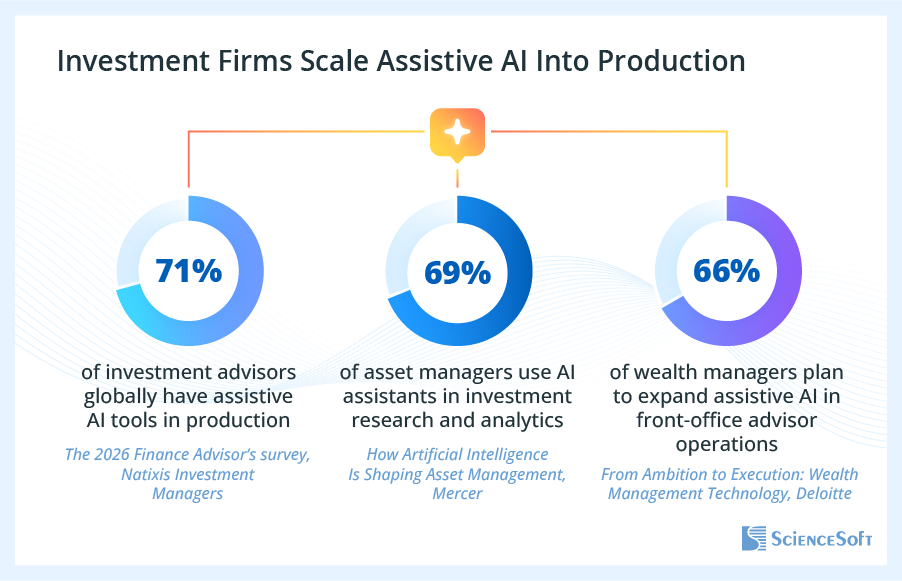
This human-in-the-loop operating model remained the industry's preferred approach to AI adoption, continuing the trend ScienceSoft observed in Q1 2026. WealthStack's study indicates that most frequently cited production AI use cases focus on assistive capabilities, where AI enhances advisor productivity, client service, and information access. The 2026 Finance Advisor’s survey by Natixis Investment Managers found that 71% of advisors already use assistive AI, primarily for client communications, administrative work, and market research, while 40% also use it in portfolio and risk analysis.
The 2026 Wealth Management Technology study by Deloitte revealed the same trend: 23 of 35 (66%) surveyed wealth managers indicated plans to expand assistive AI in front-office advisor operations, particularly for portfolio data retrieval, investor plan and report drafting, and next-best-action recommendations.
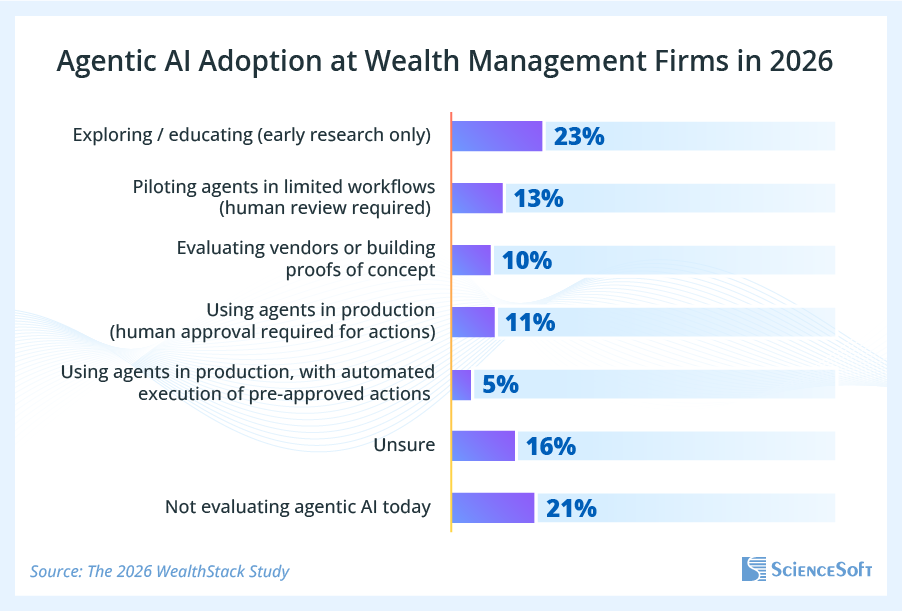
Enterprise adoption of agentic AI remained limited. Unlike AI assistants, agentic systems can coordinate and execute multi-step workflows with limited human involvement, for example, automating the entire investment research cycle or the portfolio monitoring and reporting process. While these capabilities promise greater operational efficiency, they also raise the bar for governance and risk management as AI takes on more autonomous responsibilities.
According to WealthStack's study, as of April 2026, only 16% of wealth managers had deployed AI agents in production, and just 5% trusted agents to autonomously execute pre-approved actions. 44% of respondents were either not evaluating agentic AI or remained in the education and exploration phase.
AI's business value remained concentrated in operational performance rather than investment alpha. In Mercer's study, 69% of investment firms reported efficiency gains and 55% achieved faster or better insights, while only 8% reported improved investment returns or lower portfolio risk. ScienceSoft's consultants note that operational improvements are easier to measure than investment outcomes. As a result, firms are likely to prioritize AI initiatives with clear productivity gains and measurable ROI.
Agentic AI has huge potential — we expect it to increase advisor productivity by 20–30%, and our estimates are broadly in line with what firms like BCG have reported. But giving AI more autonomy is a much bigger governance challenge. Investment firms are responsible for every investment decision and client interaction, so they need confidence that AI stays within clear boundaries and that people remain in control. Most firms aren't there yet. That's why we expect assistive AI to remain the main focus for now. It delivers immediate value while helping firms build the governance and operating model needed for more autonomous AI.

Executive Director of Solution Design & Competencies, Financial IT & AI Principal Consultant, ScienceSoft
Assistive AI Expands Across Portfolio, Research, and Advisor Support Workflows
In Q2 2026, investment firms focused their AI investments on assistive tools that help advisors interpret portfolio performance, research investment opportunities, and prepare client communications and reports.
Portfolio intelligence emerged as the dominant AI use case during the quarter. Vanguard introduced Expert Insights, an AI portfolio analysis tool that helps financial advisors interpret portfolio performance data, generate client-ready portfolio insights, and prepare personalized investment guidelines.
Wells Fargo expanded its Proposal and Portfolio Analytics platform with Auto Commentary, an AI capability from BlackRock’s Aladdin Wealth. This capability lets advisors automatically generate tailored portfolio commentaries based on client holdings, risk exposures, and investment preferences.
Investment research was another key area for AI deployment. Janus Henderson announced LIBROS, an AI-powered research platform for its investment teams. The platform will use assistive AI to summarize internal research, third-party analysis, and public market data into comprehensive research briefs and investment opportunity assessments. Janus Henderson expects the solution to help analysts identify relevant market signals faster and spend more time on investment decisions.
Another prominent use case was client relationship workflow support. Rockefeller Capital Management partnered with Anthropic to develop an assistive AI platform for its wealth management teams. The platform will help advisors retrieve and compile internal knowledge, draft client meeting notes, and handle client servicing requests. The initiative reflects a broader industry effort to reduce advisors’ administrative work and improve access to institutional knowledge.
Wealth technology providers closely mirrored the AI priorities of investment firms. Most Q2 2026 investment AI product launches focused on assistive AI capabilities that help advisors interpret portfolio data, identify financial planning issues, and prepare investment recommendations and reports. Prominent examples include an AI portfolio explanation capability by Envestnet, a monitoring assistant Pulse by Vestmark, and a financial planning assistant Iris by RightCapital.
Notably, most vendors opted to extend their existing investment software suites with native assistive AI capabilities rather than introduce standalone copilot applications. ScienceSoft’s consultants believe vendors took this path to address one of the industry's longstanding challenges: integrating AI into advisors' daily workflows. The Q2 2026 product releases embedded assistive AI directly into portfolio management and financial planning platforms, allowing advisors to use AI capabilities without leaving the systems where client data, investment models, and compliance information already live.
Retail Brokers Expand Investor-Facing AI Beyond Investment Assistants
In Q2 2026, retail investment brokerage firms continued expanding assistive AI capabilities for self-directed investors. The quarter's product launches indicate that retail brokers are increasingly using AI to provide services traditionally delivered by human financial advisors.
Market research and trade intelligence emerged as the primary assistive AI use cases in the retail segment. TradeStation released Insights AI, a market analytics AI assistant for retail traders. The assistant interprets stock market data and financial news and explains the factors driving price movements in actively traded securities, helping traders evaluate market conditions, plan trading strategies, and make more informed trading decisions.
Interactive Brokers expanded its retail trading platform with assistive AI capabilities by integrating ChatGPT, Claude, and Grok. These capabilities allow traders to analyze portfolios, evaluate trading opportunities, test strategies, and generate trade instructions using conversational interfaces.
SoFi introduced similar capabilities in Composer — an AI assistant that helps retail investors create, test, and backtest investment strategies. Upon user request, the assistant can also generate ready-to-execute trading rules that investors can deploy for automated execution within SoFi's investment platform.
Several firms focused on retail portfolio assistance. Charles Schwab introduced Portfolio Insights, an AI-powered capability that helps retail investors interpret the performance of their portfolios. The solution identifies the holdings that contributed most to recent portfolio changes, matches them to relevant market news and insights from Charles Schwab's investment research, and generates performance explanations using Charles Schwab's proprietary base of expert commentaries.
Q2 2026 also marked an important milestone for AI-powered investment advice. Coinbase introduced Coinbase Advisor, an AI-powered advisory service offered through Coinbase Advisors LLC, an SEC-registered investment adviser. Unlike earlier AI assistants that primarily provided investment information, the Coinbase solution delivers personalized guidance on portfolio allocation, trading decisions, and tax-loss harvesting under the existing regulatory framework for investment advisers.
I think we're entering an era where AI will increasingly take over routine portfolio analysis and investment guidance, especially for retail investors. That's not something I see as a threat to human advisors. If anything, I think it will make their role more valuable. Clients will always need someone they trust to help them make difficult financial decisions, especially when those decisions involve taxes, estate planning, or major life events. AI can analyze data and generate recommendations, but trust, judgment, and empathy are much harder to automate. I expect the most successful advisors will be the ones who learn to combine both.
Executive Director of Solution Design & Competencies, Financial IT & AI Principal Consultant, ScienceSoft
Wealthtech Vendors Push for Agentic AI. Early Products Focus on Narrow, Enterprise-Ready Agents
While enterprise deployment of agentic AI remained limited in Q2 2026, wealth technology providers continued expanding AI agent offerings. Rather than marketing complex multi-agent systems, product vendors focused on configurable agents that automate specific investment workflows.
One example is TIFIN’s release of TIFIN.AI, a platform offering a library of AI agents tailored to the needs of wealth management firms. The platform includes specialized agents for business development, client onboarding and servicing, portfolio management, investment research, and reporting.
Anthropic similarly introduced a suite of ready-to-run, customizable financial services agents, some of which are designed specifically for investment operations. The agents can automate tasks like KYC/KYB screening, investment research, meeting preparation, financial modeling, earnings analysis, and pitchbook generation.
Notably, vendors aligned their commercial AI agents with the investment industry's preferred operating model, where AI automates operational work, and humans retain decision-making authority. While Q2 2026 agentic AI solutions can independently execute predefined workflow steps, investment professionals remain responsible for defining automation rules, approving AI outputs, and authorizing transactions.
Like assistive AI products, commercial AI agents also prioritized enterprise integration. Many vendors included built-in integration capabilities as part of their agent offerings to help investment firms quickly connect AI agents to business-critical systems. For example, Anthropic, alongside its agent suite, introduced prebuilt connectors for investment firms’ internal research repositories, data warehouses, CRM platforms, and financial data platforms of leading providers, including FactSet, S&P Capital IQ, MSCI, Morningstar, and PitchBook.
Investment Firms Choose to Buy and Customize, Not Build AI. Large Asset Managers Back the AI Product Ecosystem
In Q2 2026, investment firms continued to rely primarily on commercial AI solutions. Mercer’s 2026 AI in Asset Management Survey revealed that 63% of asset managers use off-the-shelf AI solutions, while 51% deploy commercial AI platforms and extend them with proprietary AI models and workflows. Only 9% reported operating fully custom AI solutions.
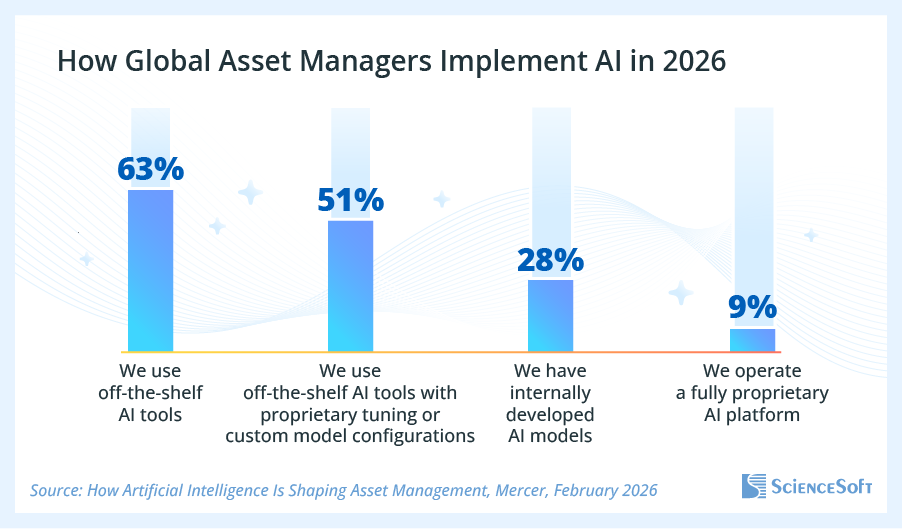
ScienceSoft’s consultants note that despite the practical preference for commercial AI solutions, off-the-shelf tools rarely solve the hardest enterprise challenges on their own. Connecting AI capabilities with multiple legacy investment platforms, fragmented data, and existing workflows remains a major engineering task. For many investment firms, the winning approach is combining proven third-party AI models and services with custom workflow automation and integration layers.
For niche use cases, commercial AI is often the easiest place to start, and it delivers value quickly. But for larger transformation initiatives, I encourage clients to design their AI architecture so they aren't locked into a single provider. That means building your own data layer, integrations, governance, and orchestration around AI services instead of tightly coupling multiple critical workflows to one vendor's models. If pricing changes, model quality declines, regulatory rules evolve, or a better provider enters the market, you should be able to replace individual AI components without rebuilding your entire solution. You don't need to own every AI model. But you should own the architecture that connects AI to your business.

Head of AI, Principal Architect, ScienceSoft
Q2 2026 was also marked by expanding partnerships between asset management firms and big tech AI vendors. Blackstone, Hellman & Friedman, Goldman Sachs, Apollo Global Management, General Atlantic, GIC, Leonard Green, Sequoia Capital, and other alternative asset managers backed Anthropic's new enterprise AI product venture. Shortly afterward, OpenAI announced a similar initiative supported by major private equity investment firms, including TPG, Brookfield Asset Management, Advent, and Bain Capital.
ScienceSoft's consultants believe these partnerships can both benefit the investment industry and create strategic risks. On the one hand, they can accelerate AI adoption by giving AI vendors capital and access to enterprise customers, while providing asset managers with early access to emerging AI technologies and a faster path to AI deployment across their portfolio companies. On the other hand, these partnerships may increase AI provider concentration, deepen dependence on vendors’ AI platforms, and reduce firms' bargaining power over time.
References
- The 2026 WealthStack Study: How Technology Is Driving the Growth of Wealth Management Firms and Reshaping the Industry (WealthStack, June 8, 2026).
- Moving Beyond the AI Pitch: Asset Managers’ use of AI (Mercer, 2026).
- AI Creates Investor Cheer In Turbulent Times – Natixis IM (WealthBriefing, June 25, 2026).
- From Ambition to Execution: Wealth Management Technology (Deloitte, 2026).
- AI and the New Economics of Wealth Management: 2026 Global Wealth Report (BCG, May 27, 2026).
- Vanguard Launches “Expert Insights,” Equipping Advisors with AI-Powered Portfolio Analysis Expertise (Vanguard, April 9, 2026).
- Wells Fargo launches Advisor Gateway for financial advisors (Wells Fargo, May 7, 2026).
- Janus Henderson and General Catalyst’s Percepta Build AI-Native Investment and Client Tools, Powered by Anthropic’s Claude (Janus Henderson, June 11, 2026).
- Rockefeller Capital Management Collaborates with Anthropic to Build AI-Enabled Wealth Management Platform (Rockefeller Capital Management, June 10, 2026).
- LIVE FROM ELEVATE 2026: Envestnet Unveils AI-Driven Enhancements and Accelerates Financial Planning Integration for Advisors on its Wealth Management Platform (Envestnet, May 19, 2026).
- Vestmark Introduces Pulse, Industry’s First AI Solution for Wealth Managers to Continuously Monitor Client Portfolios, Surface Suggestions, and Drive Execution (Vestmark, May 12, 2026).
- RightCapital Launches Iris, the First Planning-Focused AI Agent Designed to Transform the Financial Planning Process (Access Newswire, 23 June 2026).
- TradeStation Group Unveils Insights AI, Advancing Market Analysis for Active Traders (TradeStation, May 19, 2026).
- Interactive Brokers Expands AI Integration Capabilities – Adding ChatGPT and Grok to Its Growing Suite of Agentic Trading Tools (Interactive Brokers, June 22, 2026).
- Introducing Composer by SoFi: AI-Powered Investing From Idea to Execution (Business Wire, June 23, 2026).
- Charles Schwab Launches AI-Powered Capability That Helps Investors Understand Portfolio Performance and Market Activity (Charles Schwab, May 5, 2026).
- Coinbase (COIN) Launches SEC-Registered AI Investment Advisor for Coinbase One Subscribers (Yahoo Finance, June 20, 2026).
- TIFIN Group announces the consolidation of its AI businesses and the launch of TIFIN.AI, an industry-first agentic operating system (TIFIN, April 15, 2026).
- Agents for financial services (Anthropic, May 5, 2026).
- Anthropic Partners with Blackstone, Hellman & Friedman, and Goldman Sachs to Launch Enterprise AI Services Firm (Goldman Sachs, May 4, 2026).
- OpenAI Finalizes $10 Billion Joint Venture With PE Firms to Deploy AI (Bloomberg, May 4, 2026).
