ScienceSoft Global
 Healthcare
 Finance



Customer Engagement Portal
Capabilities, Costs, and Benefits
With 20 years of experience in web portal development, ScienceSoft implements customer engagement portals enabling efficient self-service, intuitive request submission and tracking, and integrated communications.
Customer Engagement Portal in Brief
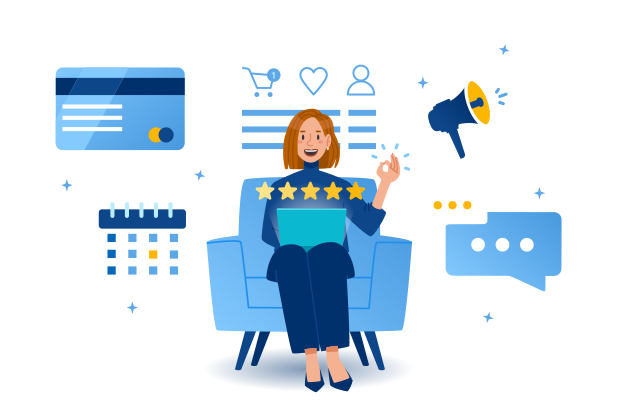
A customer engagement portal is meant for B2B and B2C companies to resolve the issues of rising support costs, low retention, and limited customer visibility. It combines self-service features with engagement tools to support two-way interactions like secure messaging, guided requests and approvals, content collaboration, feedback and follow-up cycles.
The portal connects to existing CRM, support, and marketing systems. For midsize organizations, custom or low-code builds typically range from $50,000- $200,000. Use our free online calculator to get a custom quote from our consultants.
Customer Engagement Portal Features

Profiles and real-time personalization
- Profiles are created and edited by customers or company representatives.
- The system consolidates identities, loyalty tiers, purchase history, referral status, and behaviors.
- The portal adjusts contextual UI and personalized offers based on the profile information, plan, and activity.
- Language, currency, and business hours follow locale.
- Profiles can be auto-populated from company CRM and customer sources (e.g., LinkedIn).

Customer identity and account self-service
- Customers use single sign-on, social login, or passwordless access.
- Customers can update profiles, roles, and memberships.
- Customers place, track, renew orders and subscriptions, accept quotes directly in the portal.

Knowledge base and community forums
- Articles sit alongside community Q&A, so readers move from how-to guides to tips without losing context.
- Customers share tips and solutions in moderated discussions.
- The system tracks unanswered queries and common search gaps worth fixing first.
- The portal provides article templates and simple content approval workflows.

Request facilitation and eligibility checks
- The portal provides customers with templates for claims, returns, quotes, new orders, or subscription changes.
- The system auto-checks required fields, formats, and attachments.
- Eligibility is verified against plans, policies, warranties, SLAs.
- Confirmed requests are created or updated in connected systems such as CRM, ERP, support system.

Communication and collaboration with customers
- Customers can chat, email, or call the company directly via the portal.
- Customers and employees collaborate on cases, tasks, and documents within a single workspace.
- The portal sends notifications and alerts to customers about deadlines, updates, overdue payments, etc.

AI assistance and smart search
- AI agent handles routine tasks (password change, order checks, account updates, scheduling).
- AI confirms user identity and consent before completing tasks.
- Semantic, typo-tolerant search shows the right article, form, or forum answer with next-step suggestions.
- The system routes requests requiring human judgment to agents with transcripts, intent, and attachments.
- AI-powered video avatars guide users through service details, subscription plans, payment info, etc.

Notifications and preference center
- Customers choose email, SMS, WhatsApp, or push for updates.
- The portal sends alerts on purchases, renewals, status, loyalty, or support.
- The system tracks opt-ins and consent across all channels.
- Customers receive only personalized offers and promotions.

Billing and payments
- The portal shows invoices, balance, receipts in one dashboard; supports multi-currency and tax rules.
- Customers pay via hosted checkout (card/ACH), save preferred payment methods, schedule autopay, or split into installments.
- The system closes paid invoices, shows credits/refunds, and synchronizes updates with other systems (e.g., ERP).

Security and compliance
- The system protects data in transit with TLS and encrypts databases and file uploads.
- Logs, policies, and reports are automatically provided for enterprise assessments.
- The system enforces multi-level authentication for high-risk activities.
- Company administrators define who can view or change data, create departments and assign managers and roles.

Journey analytics and search tuning
- The system reveals drop-offs and common user routes.
- The portal reports zero results and next clicks for tuning.
- Editors can track article gaps and deflection metrics.
- Product teams run A/B tests; the system sends scheduled exports to BI.

Engagement and loyalty
- The portal offers challenges for customers to complete and earn points.
- Tailored dashboards show points, tiers, and ways to convert points to discounts and benefits.
- Customers can invite peers and track referral benefits.
- The system recommends renewals, upgrades, and timely tasks.
How Customer Engagement Portal Integrates into Your Workflows
CRM
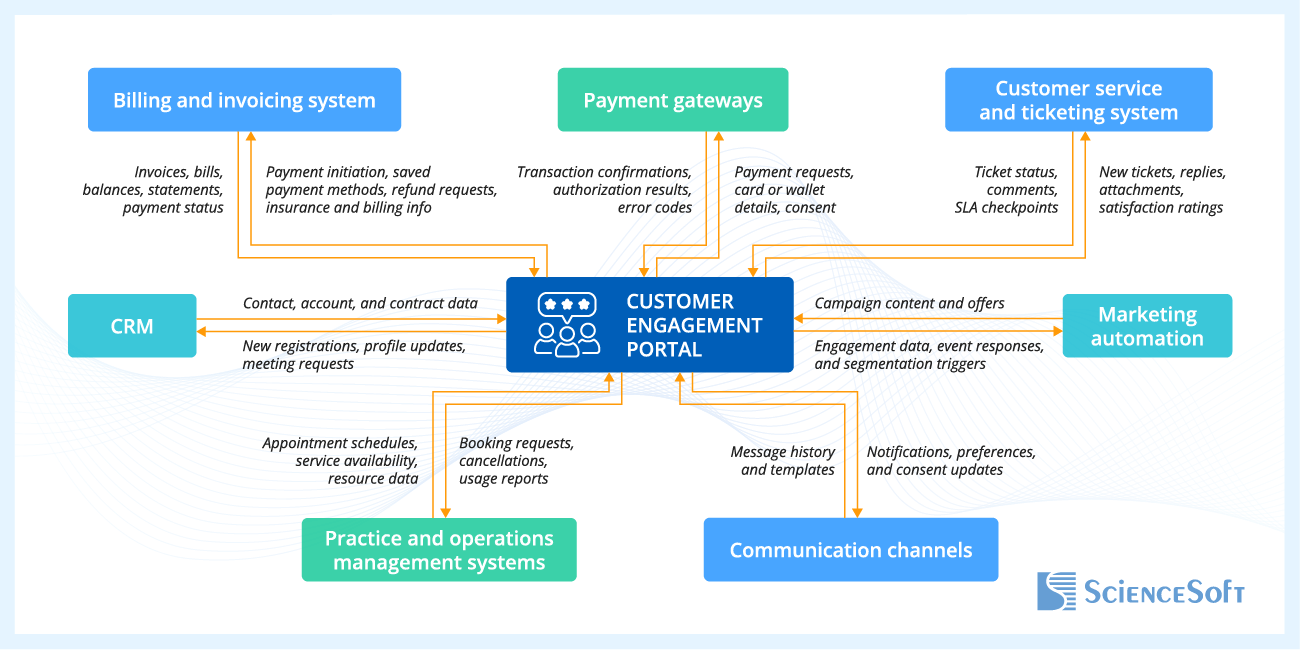
Integration with Microsoft Dynamics 365, Salesforce, or other CRMs allows the portal to receive customer-specific data (profiles, history, preferences) and record new interactions. When a new customer registers or an existing one updates their profile, this information in the CRM is updated.
Billing and invoicing system (ERP-native or standalone)
The integration is necessary for extracting payment credentials from customer profiles, issuing invoices and bills, updating and closing paid ones.
Required for enabling customers to pay for their purchases online via different payment methods (e.g., cards, bank transfers, Apple Pay, Google Pay, PayPal, Stripe).
Customer service and ticketing system
Connecting the portal with a customer service system allows users to submit support requests, attach files, and view case status or SLA updates without leaving the portal. At the same time, agent-side tools receive complete case histories, comments, and ratings, giving support staff full visibility into the customer’s journey.
Practice and operations management systems
This enables customers to check availability, view schedules, and submit booking or cancellation requests, while the backend system receives updated usage and appointment data in real time.
Communication channels
By integrating with email, SMS, and chat frameworks, the portal becomes the central hub for all customer conversations. Users can manage their communication preferences and consent, while the system makes sure that notifications, reminders, and chats remain visible in a single conversation history.
Marketing automation
Linking to marketing automation tools enables personalized outreach campaigns based on portal activity and engagement scores.
How to Develop a Customer Engagement Portal
The approach to developing a customer engagement portal depends on your starting point: you may need a full-cycle development project to build a portal from scratch or a focused integration and enhancement initiative to evolve your existing customer-facing system into an engagement hub. Based on our experience in custom portal development, ScienceSoft would like to suggest what to expect:
1.
Discovery and planning

Business analysts elicit requirements, define portal user roles, and outline engagement mechanics such as personalized dashboards, communities, and loyalty flows. The team maps necessary integrations and sets security and compliance requirements.
Typical duration: 2–4 weeks for integration-focused projects, up to 6 weeks for full-scale customer engagement portal planning.

ScienceSoft

2.
Architecture design
Solution architects design the modular structure, specify integration patterns and data flows, and set non-functional requirements (security, performance, availability, compliance). As a result, there is an architecture blueprint that supports the planned journeys and future evolution.
Typical duration: 2–4 weeks.
ScienceSoft
3.
UX and UI design

Business analysts and UX designers map key journeys, validate task flows, and produce clickable prototypes. UI designers create a component library (states, forms, tables, dashboards), align visuals with brand identity, and meet accessibility requirements.
Typical duration: 3–6 weeks.
ScienceSoft
4.
MVP development

The team implements core workflows (self-service, messaging, ticketing, order tracking) and connects the portal to CRM and service systems.
- Using low-code tools like Microsoft Power Pages and Microsoft Power Apps for standard UI and workflows can reduce delivery to 2–3 months.
- Full custom builds with complex logic and deep integrations usually take 4–6 months.
Agile iterations help release usable functionality early and scale later.
Apply low-code where suitable
Low-code tools like Microsoft Power Pages and Microsoft Power Apps can be extremely useful for building standard components faster and cheaper. At the same time, custom code covers complex logic and integrations. This hybrid model shortens delivery while preserving flexibility.


5.
QA, security, and compliance

QA engineers run automated and manual tests across key journeys; security specialists conduct checks for data protection, access control, and performance hardening.
Usually takes 3–6 weeks, depending on feature scope and data sensitivity.
ScienceSoft
6.
Knowledge transfer and evolution

The project team provides admin documentation, runbooks, and handover sessions so in-house staff can operate and scale the portal. Early usage data informs the roadmap for later releases (personalization, analytics, and new channels).
Average time: 1–3 months of post-launch stabilization; continuous evolution after that.
ScienceSoft
Custom Engagement Portal Development: Cost Estimation
If you are considering the development of a tailored solution, costs may vary as it allows you to pay only for the functionality that brings value in your specific case. Depending on the number of customers, integrations, feature complexity, and engagement goals, costs typically range from $50,000 to $200,000+.

Basic
Covers request/case hub, multichannel support, searchable knowledge base, basic proactive emails/SMS, and secure access; can accept up to 10,000 customers for B2C and up to 100 customers for B2B companies.
From $50,000

Enhanced
Contains the Basic functionality, plus AI-assisted chat, request and approval forms connected to back-office workflow, customer journey personalization, search tuning/analytics, consent center, and CRM integration. Supports up to 1M customers for B2C and up to 1K customers for B2B companies.
From $120,000

Advanced
Adds AI-powered avatars, real-time segmentation, next-best actions, role-based workspaces, AI-powered detection of churn risk and unusual behaviors, proactive outreach (offers, reminders), extensive integrations, adaptive content and more. Designed to host 1M+ customers for B2C and 1K+ customers for B2B companies.
From $200,000
Learn the Cost of Your Portal
ScienceSoft's team is ready to provide a quote for your specific case.
Our Clients Say



We teamed up with ScienceSoft trusting a solid experience that the company had in the domain of web portal development, and never regretted the decision. ScienceSoft’s team proved to be knowledgeable, thoughtful, and highly motivated.


I want to express how happy we are with the ScienceSoft team. Our goal was to design a B2B portal and mobile app that would enable our clients to optimize their inventory control for emergency supplies and equipment — a task that is as critical as it is complex.

I honestly can't say enough about how impressed I am with ScienceSoft. They delivered a fully customized Al medical chatbot PoC in just two weeks, which was unbelievable. The attention to detail in the chatbot design, and especially the pitch deck, was amazing - with this kit on hand, we are ready to go into investor discussions confidently.


ScienceSoft's experience in agile development ensured smooth project implementation and iterative development of Enonic XP. This enabled us to adjust to the changing market requirements and incorporate features that made us stand out from competition.





About ScienceSoft
-
ScienceSoft is a global IT consulting and software development company headquartered in McKinney, Texas.
-
Since 2005, we design and implement customer portals and customer engagement solutions to help businesses introduce self-service, two-way communication, and personalization.
-
Our teams cover the full cycle: discovery and UX, architecture, integrations with CRM, ERP, marketing tools, and more.
-
Being ISO 9001– and ISO 27001–certified, we rely on a mature quality management system and ensure strong data protection aligned with GDPR, HIPAA, and PCI DSS where required.