 ScienceSoft Global
 ScienceSoft Finance



Q1 2026 Investment AI Trends: GenAI Leads Adoption, Investment Firms Double Down on AI Despite Risks




Related topics:
5 min read
Last updated:
Investment firms are scaling generative AI and laying the groundwork for AI agents, but trust and integration concerns are slowing down adoption. Drawing on ScienceSoft’s Q1 2026 Investment AI Market Watch and 19 years of experience in investment IT, we break down where AI creates value today, how adoption patterns are evolving, and what will determine success in 2026 and beyond.
At a glance:
- Investment firms are accelerating AI spending despite growing advisor concerns. 95% of firms intend to increase AI budgets, with large players planning to allocate up to 10% of revenue to AI initiatives in 2026.
- Non-agentic generative AI remains the most actively pursued AI type. Advisors primarily use GenAI for research, communication, and operational decision support, while vendors expand their product portfolios into complex financial advisory use cases.
- Agentic AI is gaining traction, but adoption is still in its early stages. Investment firms test use cases, strengthen infrastructure, and build trust with non-agentic GenAI before moving toward autonomous workflows.
- Off-the-shelf AI tools lead adoption, mainly due to the complexity of custom setups. Advisors rely heavily on generic assistants like ChatGPT and Microsoft Copilot, exposing gaps in the market of investment-specific GenAI solutions.
Investment Leaders Increase AI Spending. Advisors Grow Cautious as AI Goes Live
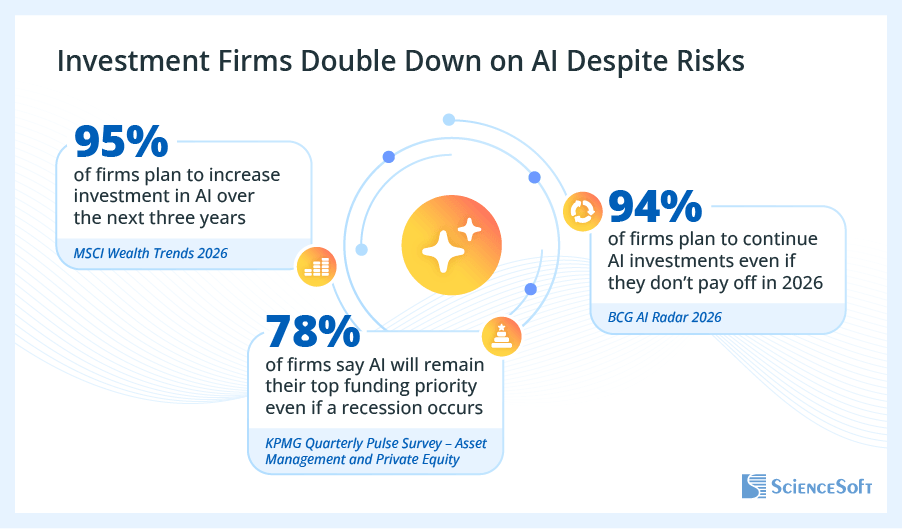
As of Q1 2026, artificial intelligence (AI) has reached widespread adoption in the investment industry, and the momentum behind further scaling continued to build. In its 2026 webinar, Top Trends in Wealth Management, Datos Insights shares that 87% of wealth management firms already use AI for at least one function. A 2026 Wealth Trends report by Morgan Stanley Capital International shows that 95% of firms plan to increase AI investment over the next three years.
2026 budgets clearly reflect the investment industry’s commitment to AI. The KPMG Quarterly Pulse Survey – Asset Management and Private Equity found that large firms (annual revenue ≥ $1B) plan to invest, on average, $101 million in AI in 2026. Generative AI is set to capture the largest share of funding. Notably, macroeconomic pressure is unlikely to affect budget decisions: 78% of investment leaders say AI will remain their top near-term priority even in the event of a recession. Delayed ROI won’t change the course either: according to BCG, 94% of organizations plan to continue their AI investments even if they don’t pay off in 2026.
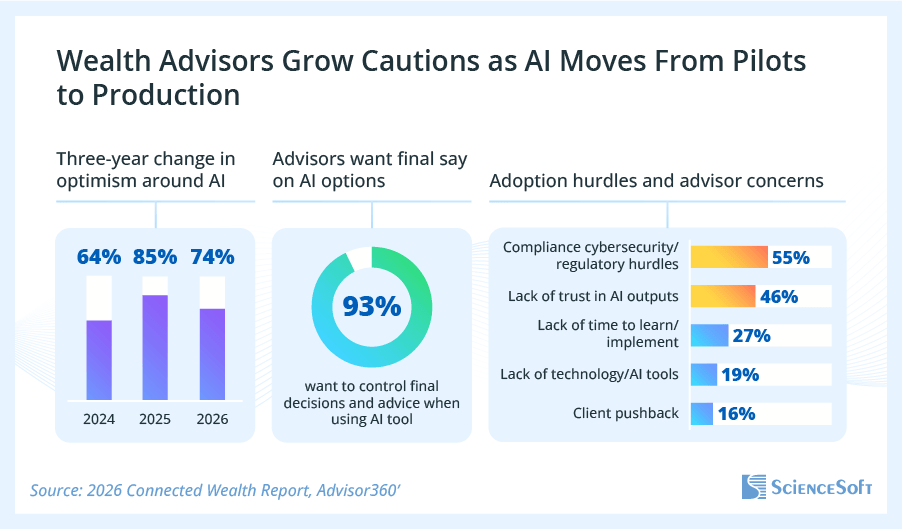
Yet, at the advisor level, sentiment towards AI is becoming more measured. A survey of 300 US wealth professionals by Advisor360° shows that although AI adoption continues to grow, the share of advisors who see AI as helpful dropped from 85% in 2025 to 74% in 2026. The growing hesitation has practical roots: advisors cite persisting compliance, security, and regulatory hurdles (55%) and potential inaccuracies in AI outputs (46%) as their major concerns. McKinsey’s 2026 AI Trust Maturity Survey revealed that AI stakeholders across industries became generally less confident in adequate response to AI risks in 2026.
Advisors’ caution becomes even more pronounced when client assets are involved. In Advisor360°’s survey, only 8% of advisors said they would allow AI to rebalance portfolios or execute trades without review, and 93% wanted final approval of AI-generated outputs even for lower-risk tasks. Some of ScienceSoft’s recent clients explicitly sought advice on improving AI adoption, fearing that low levels of advisor trust may curb the expected AI benefits.
What we’re seeing on the advisor side is a response to real operational risk. In production, every AI output becomes a liability question: is it compliant, can we trust it, can we explain it to investors and regulators? In many cases, AI went from a promising new tool to a massive headache for many industry professionals.
At the FutureProof Citywide 2026 conference in Miami, this shift was palpable. Conversations have moved away from what AI can do in theory to how to deploy it reliably inside real workflows, with validation layers, audit logs, and human checkpoints. Actual AI users have much higher expectations for it now, and many early AI pilots weren’t designed to reach this bar. To win advisors’ buy-in for AI in 2026, investment firms must ensure their AI systems can deliver reliable, traceable, and explainable outputs at scale.”

Mary Zayats, Financial IT Principal Consultant, ScienceSoft
GenAI Assistants Scale Across Advisor Workflows. Vendors Expand Into Financial Decision Support
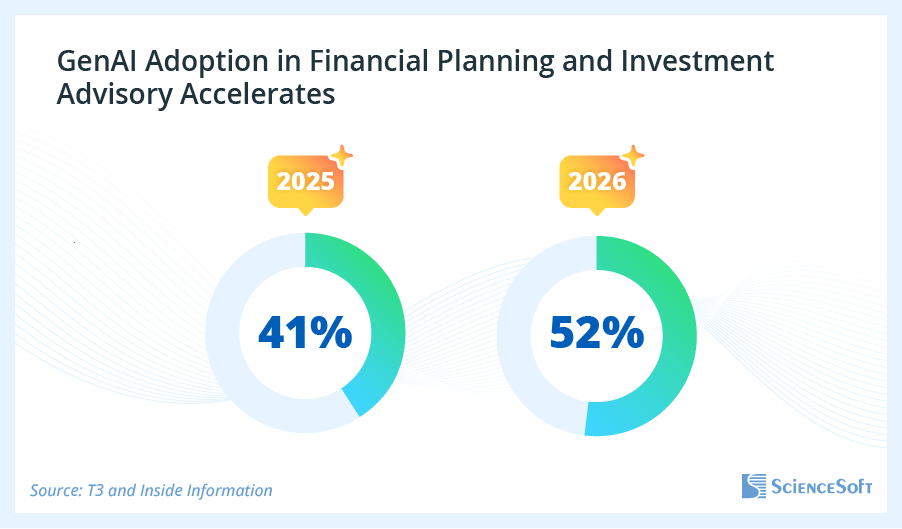
In Q1 2026, non-agentic generative AI remained the most actively pursued AI type in the investment industry. T3 and Inside Information report that 52% of financial planning and investment advisory professionals were using GenAI tools in early 2026, up from 41% the year before.
Non-agentic generative AI is primarily intended for conversational assistance, combining data summarization, content creation, and decision support functions. GenAI tools can handle complex reasoning and recommendation tasks without predefined logic while leaving decision-making and workflow execution in human hands.
GenAI use cases remained consistent with the late 2025 priorities. Investment firms continued scaling GenAI in financial research, client relationship management, and document generation. In Advisor360°’s 2026 survey, wealth advisors cited insight summarization and communication drafting as the most practical entry points.
Most enterprise GenAI deployments in Q1 2026 centered on administrative AI assistants embedded into advisors’ day-to-day workflows. The common functions were research summarization, meeting preparation, document creation, internal knowledge retrieval, and next-best-action support for client outreach. Morningstar, Franklin Templeton, Raymond James, and Prudential Advisors launched assistants along these lines, applying GenAI to aggregate client, portfolio, and market data, answer advisors’ questions on internal policies and procedures, suggest outreach priorities, and draft proposals, reports, and personalized communications.
The second group of launches pushed GenAI assistants closer to financial planning support. Claro Advisors implemented a GenAI-native tool that analyzes client, account, tax, and market data and generates suggestions on portfolio rebalancing, asset transitions, tax-loss harvesting, and liquidity optimization. The company reports time savings of up to 20 hours per week per advisor. Dynasty Financial Partners announced its plans to deploy Wealth.com’s AI assistant Ester to analyze clients’ estate, trust, and tax filing documents and life events and produce structured insights for tax and estate planning and optimization.
In Q1 2026, we saw advisors’ worst nightmares starting to materialize: AI began taking over niche human roles. JPMorgan Asset Management’s decision to end its use of proxy advisory firms and trust voting decisions across more than 3,000 annual shareholder meetings to a GenAI-driven platform shows how quickly AI’s benefits can outweigh the industry’s caution.
Proxy analysis is just the starting point. Traditional automation and ML already handle most decisions that follow repeatable logic on top of structured data. Where the rest of decisions involve document and media processing and context-aware reasoning, GenAI will take over faster than expected. I believe we’ll see similar moves in areas like investor due diligence and compliance monitoring in 2026.”
Mary Zayats, Financial IT Principal Consultant, ScienceSoft
Technology vendors also pushed beyond administrative support into more advanced advisory use cases in Q1 2026. The majority of new GenAI products were focused on helping advisors interpret portfolio and planning data more effectively. Apex Fintech Solutions and Wavvest introduced a financial planning assistant that combines client data to generate planning, tax, estate, and investment portfolio suggestions. Addepar released Addison, a GenAI assistant that lets investment professionals query portfolio data in plain language to get real-time insight into performance, allocations, liquidity, and risk. Libretto introduced Mert as a second-layer reviewer for financial plans, helping advisors identify gaps, test assumptions, and refine recommendations before presenting them to clients.
The second group of Q1 2026 AI products centered on tax modeling and scenario analysis. Altruist expanded its commercial AI assistant Hazel with tax planning capabilities. The assistant can now interpret tax return documents, CRM data, and client records, generate personalized tax strategies, and compare alternative decisions in real time. Global Financial AI introduced a platform for natural-language strategy design and testing, enabling users to translate investment ideas into structured models, run simulations, assess risk, and refine strategies.
Agentic AI Is Gaining Traction. Early Adopters Take a Staged Scaling Path
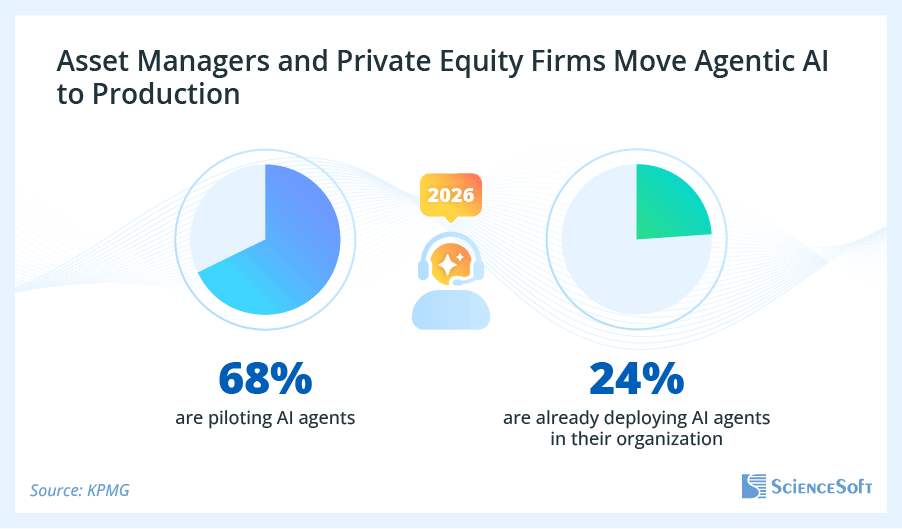
Agentic AI adoption remained at an early stage in Q1 2026, but the level of experimentation indicates strong interest. KPMG reports that, as of early 2026, 24% of asset management and private equity firms already had AI agents deployed in production, and 68% were actively piloting such solutions.
Unlike traditional AI/ML and non-agentic GenAI, which primarily support data processing and decision-making, agentic AI can act autonomously within and across investment workflows. Agentic AI solutions can plan and execute multi-step tasks with minimal human intervention: make decisions, trigger actions across systems, and orchestrate end-to-end investment automation processes.
McKinsey, in its Wealth Management 2035 Outlook, identifies agentic AI adoption as one of the key imperatives for wealth management firms. The report suggests that AI agents could reshape advisor roles toward a “life-coach” model, in which AI handles lead generation, portfolio analysis, execution, and compliance, while advisors focus on client relationships. Datos Insights estimates that AI agents could take over administrative work, which currently consumes 60% of advisor time, saving 30–45 minutes per meeting and generating hundreds of thousands in additional annual revenue per advisor.
The Q1 2026 agentic AI solutions for investment focused on automating administrative and data-heavy workflows.
- A wealthtech startup OneVest released its Agentic Wealth Operating System. The platform relies on AI agents to orchestrate and automate multi-step workflows, such as client account opening, fund transfers, billing, and compliance tracking. OneVest claims its solution helps reduce middle-office overhead and error rates and improves the advisor and client experience.
- An investment B2B SaaS firm working with EffectiveSoft introduced an agentic AI system that autonomously builds fully configured analytics dashboards. The agents interpret natural-language user requests, aggregate relevant financial data, construct charts and tables, and assemble them into structured dashboards, dynamically updating visualizations as new data becomes available. The firm reports 60% faster dashboard setup for complex, multi-asset portfolio scenarios.
Agentic AI adoption remains largely constrained by technical challenges and trust. In the KPMG survey, investment firms cited the complexity of agentic systems (63%) and the lack of agent-ready infrastructure (40%) as key barriers. Low trust in AI agents persists as another setback: the same survey found 51% of firms are uncomfortable with fully autonomous task execution, and 56% want human oversight when agents interact with sensitive data.
For many of ScienceSoft’s investment clients, the primary concern around agentic AI isn’t advisor resistance or change management — it’s real, unresolved liability. Once AI starts making or executing decisions tied to client assets, firms face regulatory, fiduciary, and audit risks that still lack clear legal precedent. Even when the exposure appears limited, few are willing to be first to test incident response in production.
In our engagements, we recommend a staged approach: deploy non-agentic GenAI in controlled workflows today while architecting data, governance, and integration layers from the outset to support future autonomy. This lets firms quickly expand toward agentic workflows as soon as they are confident in the business value, risk controls, and regulations.”
Mary Zayats, Financial IT Principal Consultant, ScienceSoft
The incremental AI adoption path aligns with broader industry thinking. McKinsey highlights the importance of reusable AI components, data pipelines, and governance frameworks for succeeding with agentic deployments. Advisor360° emphasizes that advisor trust in autonomous AI is best earned progressively, as intelligent solutions demonstrate consistent accuracy and reliability.
The approach has reflected in some of the Q1 2026 GenAI releases: Franklin Templeton originally positioned its non-agentic assistant platform to evolve into multi-agent system over time, and Addepar said it further plans to extend its advisor copilot with agentic capabilities.
Advisors Favor Off-the-Shelf AI. ChatGPT Leads GenAI Technology Choices
In Q1 2026, most investment firms prioritized commercial AI tools over custom builds. Datos Insights reports that 65% of AI adopters in the investment sector rely on off-the-shelf software products, while only 23% use custom solutions. KPMG found that 76% of firms exploring agentic AI plan to adopt solutions from established vendors.
In the GenAI segment, general-purpose conversational platforms led adoption among advisors. The 2026 report by T3 and Inside Information shows that ChatGPT remains the advisors’ top tool of choice, with 40.9% usage and an 8.24 quality rating, followed by Microsoft Copilot (20.5%). Google Gemini increased adoption from 6.9% in early 2025 to 13.6% in early 2026, while Perplexity and Claude apps both maintain 8.0+ quality ratings despite the lower market share.
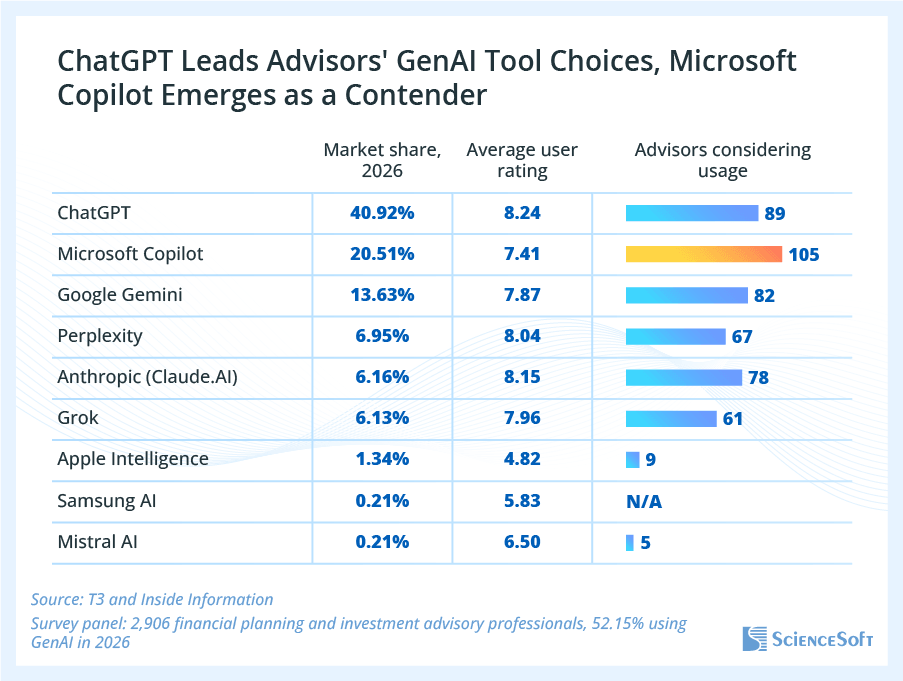
The same survey indicates high investor interest in Microsoft Copilot and suggests that this tool may gain larger market share by the end of 2026. ScienceSoft’s feasibility study for a US real estate investment firm revealed that customized Microsoft Copilot offers tighter integration with enterprise data and workflows for companies operating on Azure infrastructure.
Widespread use of general-purpose GenAI tools indicates strong demand but also highlights two structural gaps in the market for specialized products. The first is integration. Many of ScienceSoft’s investment clients say tools like ChatGPT or Microsoft Copilot are simply easier to adapt and embed into existing workflows. The second is familiarity and trust. Advisors default to tools they already know and providers they already rely on, and that combination often outweighs the benefits of niche functionality.
Specialist vendors should acknowledge the higher expectation bar for investment-specific AI. To gain traction, commercial tools need to fit directly into existing advisor environments. That requires flexible APIs for major CRMs and portfolio management systems, clear SDKs, and dedicated services to expedite integration.
The success of Altruist’s Hazel — one of the few investment-focused AI tools repeatedly cited by advisors in the T3 survey — reflects this approach. Hazel offers a simple interface resembling ChatGPT and integrates natively with Microsoft and Google environments and CRMs like Salesforce, making adoption easier without disrupting workflows.
To accelerate trust, vendors should also consider partnering with dominant platforms rather than competing with them. Hazel, for example, leverages infrastructure from Azure and AWS to match the reliability and performance of general-purpose assistants while differentiating through investment-specific intelligence.”

Vadim Belski, Head of AI, Principal Architect, ScienceSoft
References
- Top Trends in Wealth Management, 2026: Technology and Talent Reshape The Industry (Datos Insights, 2026).
- Wealth Trends 2026. How Advisers Are Repositioning for a Volatile World (MSCI, January 2026).
- KPMG Quarterly AI Pulse Survey. Perspectives from Asset Management and Private Equity leaders (KPMG, 2026).
- As AI Investments Surge, CEOs Take the Lead (BCG, January 15, 2026).
- 2026 Connected Wealth Report: AI Edition (Advisor360°, 2026).
- State of AI trust in 2026: Shifting to the agentic era (McKinsey, March 25, 2026).
- 2026 Advisor Software Survey Released at #T32026 (T3, March 10, 2026).
- Claro Advisors Launches AI-Native Wealth Management Platform for Independent Advisors (Claro Advisors, February 12, 2026).
- Morningstar Introduces AI Assistant Built into the Advisor Workflow (Morningstar, March 9, 2026).
- New Intelligence Hub Marks Expansion of Franklin Templeton’s Strategic Collaboration with Microsoft (Franklin Templeton, January 29, 2026).
- Raymond James launches proprietary digital AI agent to bolster operational excellence (Raymond James, January 27, 2026).
- Prudential Advisors Enhances Advisor Leads Program with AI and Data Science (PR Newswire, January 20, 2026).
- Dynasty Financial Partners Launches Partnership with Wealth.com’s Ester AI as a Service to Power Estate and Tax Planning (Wealth.com, March 9, 2026).
- JPMorgan Replaces Proxy Advisers With AI for Voting US Shares (Bloomberg, January 7, 2026).
- Apex Fintech Solutions and Wavvest Announce Strategic Partnership to Deliver AI-Powered Financial Planning (Apex Fintech Solutions, March 4, 2026).
- Addepar Unveils Addison, a Native AI Experience Built to Deliver Actionable Intelligence Across Investment Workflows (Fintech Finance News, March 4, 2026).
- Libretto Launches AI-Automated Client Onboarding and AI Assistant to Streamline Financial Planning and Asset Allocation (Business Wire, March 3, 2026).
- Altruist introduces AI-powered tax planning in Hazel (Altruist, February 10, 2026).
- Global Financial AI Announces Launch of a Specialized AI Platform for Strategy Modeling and Multi-Asset Execution (PR Newswire, February 23, 2026).
- US wealth management in 2035: A transformative decade begins (McKinsey, January 29, 2026).
- OneVest releases agentic wealth platform (Finextra, March 4, 2026).
- An AI assistant that turns natural-language requests into decision-ready dashboards (EffectiveSoft, 2026).
